In Hugging Face's agent course, 30% on real tasks is a pass
The theory quiz demands 80%, a gap showing that making an agent work on real data is the hard part, and the units can be taken out of order.
In brief
- Hugging Face released the course in 2025 as open source under Apache-2.0. The content and the certificates are free, and there is no deadline
- The Unit 1 certificate requires at least 80% on the quiz, while the completion certificate only needs an agent that scores above 30% on the benchmark. The gap between those two numbers is the FDE job
- Take the bonus unit on observability and evaluation before Unit 4: what you cannot measure, you cannot improve
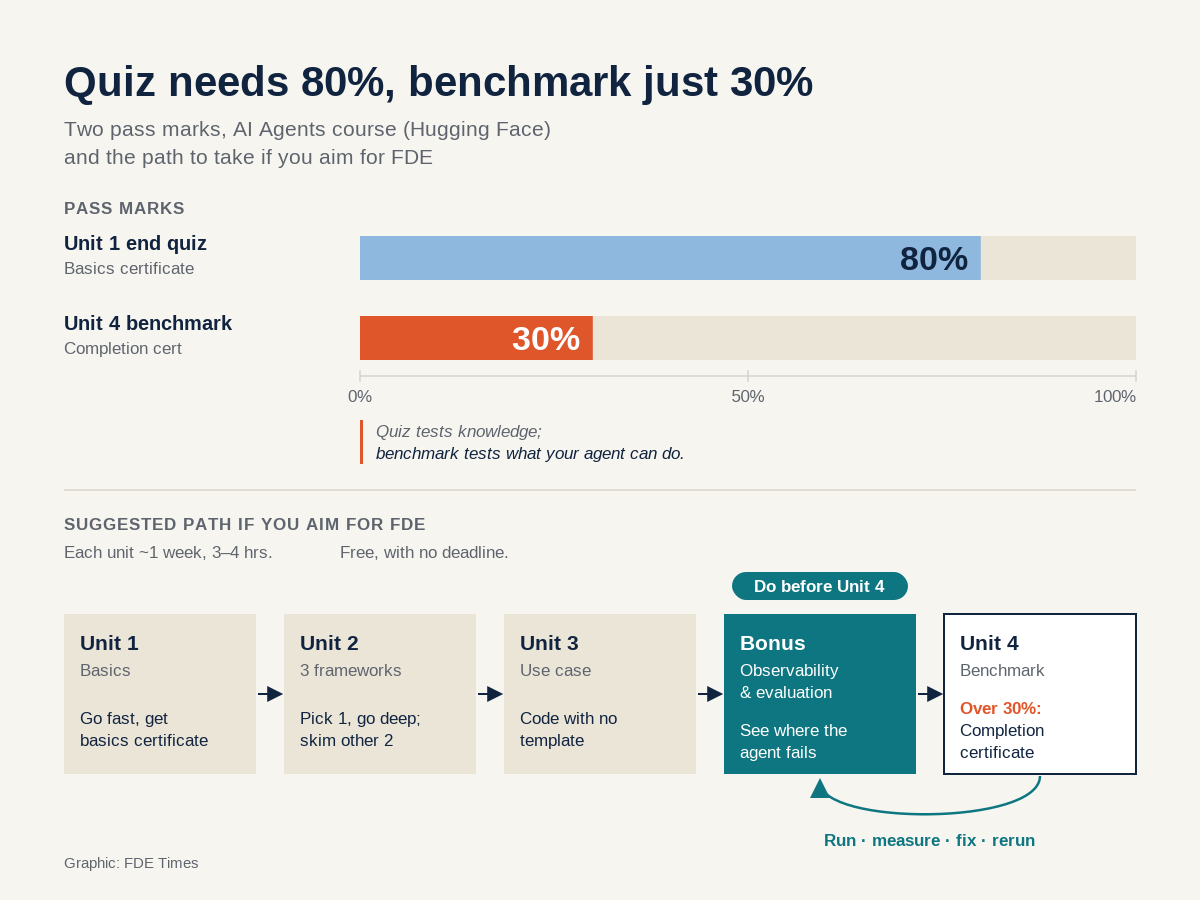
To earn the Unit 1 certificate in its AI Agents course, Hugging Face requires a score of at least 80% on the final quiz. To earn the certificate for completing the whole course, the agent you build only has to clear 30% on the final assignment’s benchmark. Those two numbers say almost everything about the course, and about the FDE job.
Answering theory questions correctly is easy. The far lower bar on the benchmark suggests that getting an agent to actually solve a problem is much harder. For a Forward Deployed Engineer, the question that matters is whether your agent works on real data, not what you know about tool calling.
For a developer with two to eight years of experience who wants to move into FDE work, the course is worth a few weeks. There is no need to follow its units in the order they are laid out, though.
Four units, two levels of certificate
The course’s official name is “Welcome to the 🤗 AI Agents Course”. It launched in 2025 at huggingface.co/learn/agents-course, is maintained by Ben Burtenshaw and Sergio Paniego, and was written and developed by Joffrey Thomas and Thomas Simonini. The whole repository is open under the Apache-2.0 license.
Hugging Face describes the goal as learning AI agents “in theory, design, and practice” with three frameworks: smolagents, LlamaIndex and LangGraph. The prerequisites are basic Python and a grounding in LLMs. Each unit is designed to take a week, at about 3–4 hours.
After onboarding come four units: Unit 1 on fundamentals, Unit 2 on frameworks, Unit 3 on use cases and Unit 4, a final assignment scored against a benchmark. The bonus units cover fine-tuning for function calling, observability and evaluation, and an agent that plays Pokemon. Learners can also share their agents on the Hub and compete against one another.
The certificates are entirely free and have no deadline. The fundamentals level is awarded after Unit 1; the completion level also requires a use-case assignment and the final challenge.
| Fundamentals certificate | Completion certificate | |
|---|---|---|
| Requirements | Finish Unit 1, score at least 80% on the final quiz | Unit 1 + a use-case assignment + the final challenge, above 30% on the benchmark |
| What it proves to an employer | You understand agent concepts | You have shipped an agent measured in numbers |
| How to put it on your CV | One short line | With your benchmark score and how you pushed it up |
Which order suits a future FDE?
Do not give every unit equal weight. If you have already called an LLM’s API, you can move through Unit 1 quickly: the aim at this stage is to collect the fundamentals certificate and get to the hands-on work.
Unit 2 teaches three frameworks. Pick one and go deep; skim the other two to see where they differ. What you want to take away is the ability to recognize the same agent concept written three different ways, not a memorized API for all three.
Unit 3, on use cases, is where you should start writing code without looking at the sample. Treat it as a customer-discovery exercise: read the brief as you would a client’s requirements, then ask what the input data looks like, which tools the agent is allowed to call, and what counts as “done”.
Then comes the most important part, and the place to break the sequence: take the bonus unit on observability and evaluation before Unit 4, not after. You cannot raise a benchmark score if you cannot see which step the agent fails at, which tool calls are unnecessary and where it stops too early. The loop of run, measure, fix and run again is a habit worth building now.
The bonus unit on fine-tuning for function calling is worth taking if you have seen agents call tools in the wrong format too many times. Save the Pokemon unit for a free weekend.
What the 30% teaches
The course’s choice to group smolagents, LangGraph and LlamaIndex in a single unit is also telling. The arrangement implies that the concepts are the lasting asset, while libraries can be swapped out at any time.
Seen in that light, the 30% threshold should not be read as leniency. It can be taken as a sign that agents on real problems are still far from perfect, and that your value lies in pushing the number up, step by deliberate step.
That is also how to write your CV. Do not stop at “completed the Hugging Face AI Agents course”. State what percentage your agent reached on the Unit 4 benchmark, what you changed to move it from one level to the next, and a link to the Hub so the interviewer can run it themselves.
When you read job descriptions for FDE roles, look for words such as evaluation, observability and tool calling. If they appear, you already have a project to talk about.
The certificate with your name on it is free. The benchmark number, and the story of how you pushed it up, are what FDE hiring managers want to hear.
Was this article useful?
Thanks for the feedback!