Anthropic's agent skills course skips the question clients ask
Six videos, about 22 minutes, cover building and sharing skills in Claude Code, but none teaches the evaluation needed to prove a skill works.
In brief
- The course has 6 videos totalling about 22 minutes, takes about 1 hour 45 minutes to complete, and covers only skills in Claude Code
- The six lessons teach how to create, configure, share and troubleshoot skills, but none is dedicated to evaluation
- Take the course first, then read the best practices guide so you write evaluations before instructions
Anthropic’s “Introduction to agent skills” course has just 6 videos, totalling about 22 minutes, according to @IT, ITmedia’s technology site. @IT also reports that the course launched on 10 March 2026 and has an estimated completion time of about 1 hour 45 minutes, including reading and hands-on work outside the videos. So set aside an afternoon for it; 22 minutes will not be enough.
The time is well spent. Anthropic describes skills as reusable markdown instructions that Claude automatically applies to the right task at the right time, and the course’s stated aim is to teach Claude once instead of repeating yourself forever. For an FDE, that is exactly how to package a client’s own workflows so the agent gets them right on every run.
But the course teaches mechanics, not measurement. None of the 6 lessons is dedicated to writing evaluations, yet the question a client will eventually ask is: how do you know the skill works?
Six lessons, from concept to troubleshooting
The course sits in Anthropic Academy, runs on the Skilljar platform and covers only skills in Claude Code. The six lessons are, in order: what skills are, creating your first skill, configuration and multi-file skills, how skills compare with other Claude Code features, sharing skills, and troubleshooting.
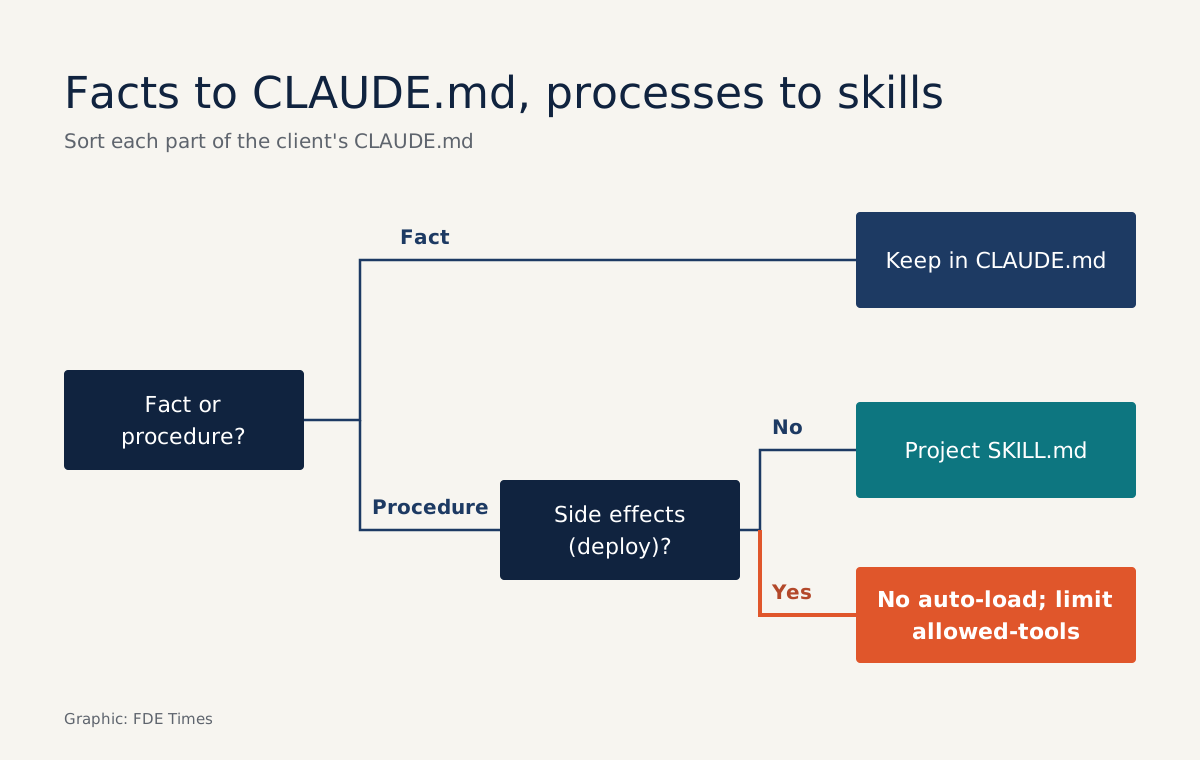
The technical foundation is compact. According to the Claude Code documentation, each skill is a folder with a SKILL.md file in two parts: YAML frontmatter that tells Claude when to use the skill, and a body holding the instructions. Project-level skills are shared by committing them to the repository, which makes the client’s repo the natural home for the client’s workflows.
Do not confuse this course with DeepLearning.AI’s “Agent Skills with Anthropic”. That is a different, much longer course, which treats skills as folders of instructions that extend an agent’s capabilities with specialised knowledge.
| Anthropic Academy | DeepLearning.AI | |
|---|---|---|
| Size | 6 videos, about 22 minutes | 10 lessons, 2 hours 19 minutes |
| Instructor | Anthropic | Elie Schoppik |
The order to study in: the Academy course first, to learn the mechanics, then straight away Anthropic’s “Skill authoring best practices” guide, because that is where the course’s gap gets filled. Leave the DeepLearning.AI course for later, when you want to go deeper.
Evaluations first, instructions second
The part the course leaves out is the step you should take first. Anthropic’s best practices guide is explicit: create evaluations before writing extensive documentation for a skill. That is why the diagram at the top of this article puts evaluation right after choosing the workflow, before you even open SKILL.md.
An evaluation is nothing complicated: a real request plus an expected result. The example in the guide is the request “extract all text from this PDF file and save it to output.txt”. You might write the expected result as: an output.txt file exists and contains all the text from the PDF.
Imagine you are working for an e-commerce company. One evaluation might be “refund order #1234”, with the expectation that the agent checks the order status and stops to ask for approval if the amount exceeds the finance team’s threshold. Write three statements like that and you know what the skill must do before you write a single line of instructions.
Help already exists for writing evals: in a blog post on 3 March 2026, Anthropic said skill-creator now helps write evals, meaning tests that check whether Claude does what you expect for a given prompt. Running them is another matter. According to the best practices guide, there is no built-in way to run them yet, so the evaluation harness is still yours to build.
Write only what Claude does not already know
Only once the evaluations exist do you write the body, and the rule for cutting is spelled out: add only context Claude does not already have, and every paragraph must justify the tokens it costs. With a client’s internal documentation, that means deleting the paragraph explaining what a refund is, or how to write a JOIN.
What stays are the rules only that client has, such as which threshold requires human approval, or which legacy system must not be touched. Evaluations written up front let you cut more aggressively: delete a paragraph, rerun, and if it still passes, the paragraph was not needed.
The description decides whether a skill gets called
However well the body is written, it is useless if Claude never picks the skill. According to the Claude Code documentation, the description determines whether Claude uses a skill. The documentation advises putting the main use case first, because the description plus when_to_use is truncated at 1,536 characters in the skill listing.
Anthropic identifies two failure modes: a description that is too broad makes the skill trigger by mistake; one that is too narrow means it never runs. A line such as “helps process orders” falls into the first. Rewrite it to a pattern: what the skill does, and when the user asks for what it should be used.
Evaluations help here too. When skill-creator was used for tuning, Anthropic reported improved triggering on 5 of its 6 public skills. Your evaluation set should also include requests that must not trigger the skill.
Turn the course into evidence on your CV
What convinces a hiring manager is not that you watched all six videos but whether the skill you built works. If a job posting mentions Claude Code or agent skills, put a repo in your portfolio with a SKILL.md, the evaluation set written up front and a few lines explaining why each passage was cut.
The course teaches you to build a skill. Proving it works is up to you, with evaluations written before the first line of instructions.
Was this article useful?
Thanks for the feedback!
6 sources
- Anthropic Academy Courses – Introduction to agent skills
- 【無料】Anthropic公式「エージェントスキル入門」講座が公開 · 2026-03-10
- Agent Skills with Anthropic – DeepLearning.AI · 2026-07-17
- Extend Claude with skills – Claude Code Docs
- Skill authoring best practices – Claude Docs
- Improving skill-creator: Test, measure, and refine Agent Skills · 2026-03-03