Only two modules of Andrew Ng's Python course matter for FDEs
The lessons on files, CSV and APIs match daily FDE work, but production LLMs and client skills have to be learned somewhere else.

In brief
- The course has 35 videos, 27 code examples and 8 graded assignments, 11 hours 30 minutes in total, and needs no prior coding
- For FDEs, the value sits in module 3 (files, CSV) and module 4 (packages, web APIs); the first two modules are basic syntax
- The course does not teach production LLMs, agents or client-facing skills, and FDE job postings ask for all three
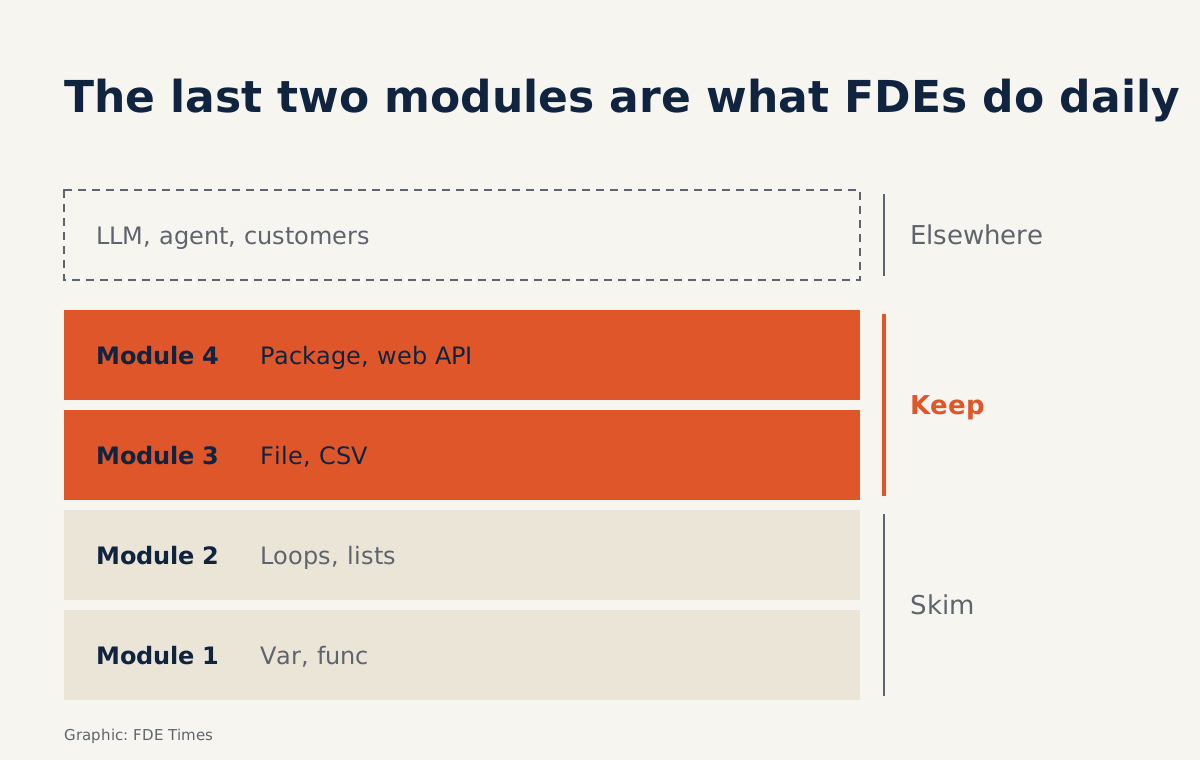
“AI Python for Beginners”, the course Andrew Ng teaches, runs to 11 hours 30 minutes, and the part a Forward Deployed Engineer actually takes to a client site fits into the last two modules: reading and writing files, CSV, packages and web APIs. The first two modules cover basic Python syntax that an engineer with a few years of experience can skim in an evening.
The job postings explain why. A Forward Deployed Engineer posting from Anthropic, now closed, listed “strong programming skills, proficiency in Python” as a core technical requirement.
The recruiting platform Paraform’s guide to the FDE role goes further: proficiency in at least one backend language such as Python, Java or Go, and comfort with pulling data, then normalizing and transforming it quickly.
For an engineer who wants to move into FDE work, the useful question is therefore narrow: which parts to study to meet that requirement, and which to skip without regret.
What the course actually contains
Andrew Ng teaches it and DeepLearning.AI publishes it. The official page is at deeplearning.ai/courses/ai-python-for-beginners/ and shows a last update of October 31, 2026. The course has four parts with 35 videos, 27 code examples and 8 graded assignments, at Beginner level.
No prior coding is required. The “AI assistant” in the course title is a chatbot built into the learning platform that helps you write, test and debug code and gives instant feedback. It is not Copilot or Cursor, so the habits you build will not carry over intact to the tools at a client site.
| Module | Content | Value for FDEs |
|---|---|---|
| 1 | Variables, functions, data types, the “Writing code with chatbots” lesson | Skim if you already code; keep the chatbot lesson |
| 2 | Loops, dictionaries, lists | Skim if you already code |
| 3 | Reading and writing files, CSV | Keep: this is daily work |
| 4 | Packages, web APIs | Keep: this is daily work |
On cost, the course page says access is free only for a limited time, while the platform is in beta. Certificates and graded assignments require a PRO plan, so check the terms when you sign up.
An exercise that turns the last two modules into real work
Take a hypothetical case. In your first week at a client, you receive a CSV exported from a legacy system. The date column mixes three formats, there are empty cells and duplicate rows, and you are asked to reconcile it against data that already lives behind an API.
Read the file, clean it, call the API, match the records: that is module 3 plus module 4, only with messier data than the exercises.
You can rebuild this scenario while you study. Generate about 200 rows of orders with the errors above, and add a country code column with a few misspelled codes. Then pick a free public web API that needs no key and returns country information by code.
The output should be measurable. The script should produce clean.csv with dates normalized to a single format, mismatches.csv with the rows whose codes could not be looked up, and print a summary: rows read, duplicate rows removed, date cells fixed, codes that did not match.
That summary is exactly what you would send a client on a real project.
Common mistakes when taking the course
The most common mistake is working only with the course’s tidy sample data. Code that runs correctly on a sample file says nothing about whether it will survive a client’s file. Always dirty the data yourself before you call an exercise finished.
The second mistake is letting the chatbot write the code and accepting it as is. The course describes the chatbot as helping you write, test and debug, which means two steps remain after the writing.
At a client, the valuable skill is reading and checking the code an assistant has just generated, quickly, before it touches real data, so start writing your own tests for the chatbot’s code now.
The third mistake is putting an introductory certificate at the top of your CV. People hiring FDEs read for evidence that you can handle real data, and a Beginner certificate gives them none.
Where the course stops, and what to study next
The course page says plainly that it is for anyone curious about AI and Python, from complete beginners to professionals who want to be more productive, and is not aimed at people who plan to become software developers or AI engineers. It is only the first step on the way to an FDE role.
The same Anthropic posting asked for experience with LLMs in production, including advanced prompt engineering and agent development, plus at least 4 years in a technical role working directly with customers.
Paraform also argues that what matters most for FDEs is stakeholder management, adaptability when things are still ambiguous, and tolerance for constant context switching. None of that can be learned from videos.
The sensible order is therefore clear. People who cannot code yet should take the whole course. Engineers fluent in Java or Go only need to skim the first two modules for syntax, then put their effort into modules 3 and 4.
If you already write Python every day, you can skip the course entirely. The next step is learning production LLMs and agents, while looking for chances to work directly with users in your current job.
On your CV, link to the repo for the exercise above, with a README listing each type of error you handled. When reading job postings, phrases such as “pulling and shaping data” signal that the skills from modules 3 and 4 will come up.
Andrew Ng’s course teaches you to open a client’s files. Earning the trust to open them is something you will have to learn elsewhere.
Was this article useful?
Thanks for the feedback!