FDE job postings rose 800%, but not every one is an FDE job
Ignore the job title and check what you build and where the code goes: five tests expose demo and support roles relabeled as forward deployed engineering.
In brief
- Between January and September 2025, FDE job postings rose more than 800%, so the title alone no longer tells you what the job is.
- A real FDE arrives after the deal closes, owns the running system, and is measured by customer outcomes plus the lessons brought back to the product.
- The hardest signal to fake is someone responsible for bringing custom solutions back into the product. Without it, the role is consulting with an engineering title.
Between January and September 2025, job postings for forward deployed engineers rose more than 800%, according to figures cited by Paraform. When a title spreads that fast, the postings cannot all describe the same job.
Nobody can count how many of them are old roles renamed to sound current. A cautious guess is still possible: a title is easy to change, the structure of a job much harder. Candidates should therefore read past the title and look at the details a company finds hard to disguise.
For a developer hoping to leave outsourcing work for an FDE role, as many in Vietnam are, the stakes are concrete. Take the wrong job and you can spend two years building pre-sales demos or doing customer support while your CV still says “engineer”. Fortunately, a job description usually gives itself away through five details, provided you know where to look.
What are you allowed to build?
Tandem proposes what it calls the “output test”: look at what each role is allowed to produce. A solutions engineer builds demos and architectures to close deals. An FDE writes custom code that did not exist before for a specific customer, then carries that work back into the product.
Paraform adds an important point: FDEs write production code, but not for the core product. That one sentence rules out both common misreadings. An FDE is no hobbyist demo builder, and no product engineer sitting at headquarters either.
Take a hypothetical job description. If the responsibilities read “build POCs and technical demos for prospective customers”, your output exists to sell, and that is solutions engineering. If they read “build production applications inside customer infrastructure”, you are reading the right kind of posting.
Do you arrive before or after the contract is signed?
The second test is timing. Aced draws the line this way: a solutions architect works before the sale, while an FDE arrives after the deal is done, so the product actually delivers value. The practical consequence is simple: any posting that mentions quota, pipeline or “supporting the sales team” leans towards SA work, whatever the title says.
Aced also draws a subtler boundary: an SA owns the design, not the running system.
So when reading a job description, look for words showing you are responsible after the system reaches production, such as operations, monitoring and incident handling.
If the responsibilities stop at “proposing architecture”, you are drawing the plans rather than building the house.
How success is measured reveals the job
Timing and output can still be written vaguely. Success metrics are harder to blur. According to Tandem, solutions engineers are measured on revenue and deal count. FDEs are measured on customer outcomes plus the lessons they bring back to the product.
If a job description includes a passage on what success looks like after a few months, read that passage most closely. If it is all revenue or renewal metrics, the role serves the sales team. If it describes a customer system running reliably and a deployment pattern that has made it onto the roadmap, it is an FDE role.
The hardest test to fake: who brings custom code back into the product?
The four tests above can all be fudged in writing. The fifth cannot, because it requires a decision about how the company is organized.
Valletta Software, writing from the hiring side, argues that any job description in which nobody is responsible for turning custom solutions into something reusable is, in substance, a consulting role with an engineering title.
A post on Substack puts it more bluntly. If nothing gets generalized, an FDE program is just an ordinary support contract with a grander name. The company is then a services business that happens to call its staff engineers.
Palantir’s original model explains why this feedback loop is central. According to a historical overview citing an April 2019 Palantir post, the company split two groups by scope: Dev built one capability used by many customers, while Delta worked for one customer across many capabilities.
The same overview describes the FDE model as a product development strategy that merely looks like services from the outside.
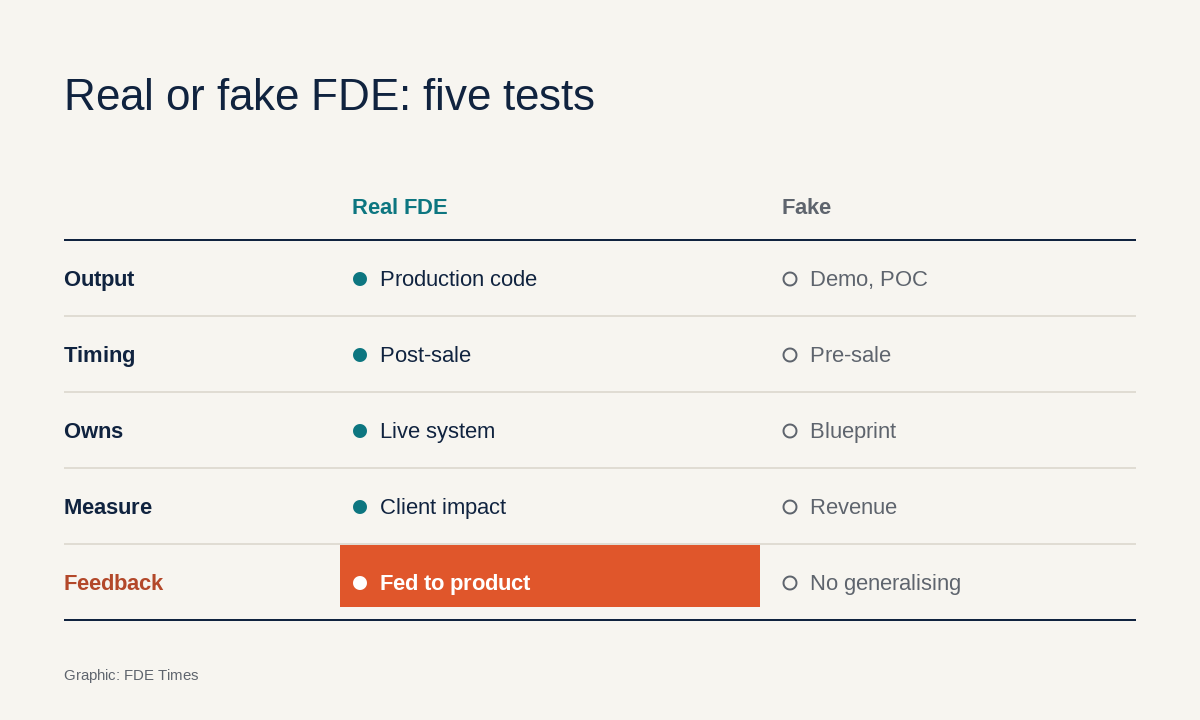
When reading a posting, you can score it quickly against this table:
| Test | Signs of a real FDE role | Signs of a relabeled role |
|---|---|---|
| Output | Custom production code running in the customer’s systems | Demos, POCs, architecture to close deals |
| Timing | After the contract is signed | Before the sale; mentions quota, pipeline |
| Ownership | Responsible for the running system | Owns only the design |
| Metric | Customer outcomes plus lessons for the product | Revenue, deal count |
| Feedback loop | Someone carries deployment patterns back to Product/Engineering | Nothing gets generalized |
Dissecting a real posting: Anthropic
Anthropic’s FDE posting, now closed to applications, is a good case for testing the table. It describes engineers embedded with strategic customers, working directly in the customer’s systems to build production applications with Claude models. Output test: pass.
The posting does not answer the ownership test directly. “Working in the customer’s systems” suggests you sit close to the running system, but it does not say who operates it after go-live. That is a question to ask in the interview rather than a gap to fill in yourself.
The most telling detail is the requirement to identify and codify repeatable deployment patterns, then feed them back to the Product and Engineering teams. That is precisely the feedback loop Valletta and the Substack post treat as the line between FDE work and consulting. The posting passes the hardest test.
The posting also states travel of up to about 25%. That differs from the figure Valletta considers most useful to publish: the share of time spent working in the customer’s environment. You can work inside a customer’s systems without going anywhere, so the travel figure is only a rough indicator, and you should still ask for the real number.
By contrast, be wary of job descriptions with an endless list of mandatory frameworks. Valletta observes that demanding as many as twelve frameworks shows the employer does not know what the job actually requires. Treat such a list as a prompt to ask what the daily work really involves.
Read a job description like a spec
When a concept is hot, some services companies will retitle their implementation or support teams as FDEs. That can happen in Vietnam as anywhere else. There is no need to guess their intent. Read the job description as you would a spec: find the inputs, the outputs, and who receives those outputs.
The table is only the first filter. The next step is the interview, where you ask what the job description leaves unanswered. Where does code written for one customer end up? Who decides to bring a deployment pattern into the product, and when did that last happen? If the interviewer stumbles, you have your answer.
The same table works for your own CV. Serious FDE employers look for people who have generalized their work, so do not stop at “deployed a system for customer X”.
Write it this way instead: solved the customer’s problem, then extracted the data-processing layer into a module reused by the next three projects. A line like that shows both the customer outcome and the lesson carried back to the product.
FDE postings will keep growing, and so will the relabeled ones. Before you apply, find the person at that company who turns one customer’s code into a shared product.
Was this article useful?
Thanks for the feedback!
7 sources
- FDE vs. implementation engineer vs. solutions engineer: the output test · 2026-08-10
- Forward-Deployed Engineer vs. Solutions Engineer vs. Customer Engineer: What Startups Actually Need in April 2026 · 2026-04-22
- Forward Deployed Engineer vs Solutions Architect (2026)
- Forward Deployed Engineer Job Description (2026 Template) · 2026-09-07
- Forward Deployed Engineer (Anthropic) · 2026-08-13
- The Difference Between a Forward Deployed Engineer and a Consultant With a Better Title Is One Design Decision · 2026-07-13
- The Rise of the Forward Deployed Engineer: History, Myths, and Why It's Back