Anthropic and Palantir FDE job ads ask for no AI certificates
They want proof you have made software run in someone else's environment, and Anthropic will even accept equivalent experience in place of a bachelor's degree.
In brief
- Neither Anthropic's nor Palantir's FDE job ads list any AI certificate. Anthropic asks for production experience and the ability to find a way through ambiguity; Palantir asks for programming fundamentals and the ability to make decisions with incomplete information.
- The experts quoted by InfoWorld treat certificates as a signal of foundational knowledge, or a tiebreaker between two equal candidates. They do not replace experience.
- Paraform-style interview questions demand concrete evidence: code you have deployed on a customer's infrastructure, and the hardest technical challenge you chose to take on yourself.
Anthropic’s job ad for a Forward Deployed Engineer, Applied AI, asks for production experience with LLMs: advanced prompt engineering, agent development, evaluation frameworks and deployment at scale. Not one line of it mentions a certificate.
Palantir’s is the same. Its ad for a new-graduate Forward Deployed Software Engineer asks for an engineering degree and proficiency in at least one language such as Python, Java, C++ or TypeScript. No AI certificate appears on the list.
Developers with a few years of experience who are planning to spend months of weekends earning another AI badge before applying for FDE roles should read both ads closely.
Two job ads do not represent the whole market, but the advice from the other hiring sources cited here points the same way: the heaviest item in an FDE application is evidence that you have made software work in someone else’s environment.
What are the job ads actually measuring?
Read carefully, the technical requirements in both ads are only a floor. Anthropic even accepts “equivalent experience” in place of a bachelor’s degree. If a formal degree can be replaced by real work, a short-course certificate counts for even less.
The deciding part sits in the lines describing temperament. Anthropic wants people with “high agency”, who can find their way through ambiguity in complex organizations, and estimates that about 25% of the time will be spent travelling to customers.
Palantir describes the FDE as someone who learns continuously, makes decisions when information is incomplete and does not wait to be told what to do next. It adds a travel requirement of 25 to 50% of the time.
That is a portrait of someone sitting in a customer’s office, facing a system nobody has explained to them, who still has to make decisions. A multiple-choice exam, however hard, struggles to reproduce that scene. So employers look for signals elsewhere.
Even the training side says so
This might seem to be the view of a few large companies. But the experts quoted by Bob Violino in an InfoWorld article say much the same. Kyle Elliott, a technology career coach, says plainly that employers are not necessarily looking for candidates with AI certificates.
The article also sets out two uses for certificates. Matt Scicchitano, who runs SAS’s global certification program, calls them a tiebreaker when two candidates are equal. Dion Hinchcliffe of Futurum Group sees them as a signal of foundational knowledge, and says explicitly that they do not replace experience.
The most striking admission comes from Readynez, a training provider with a commercial interest in certification. It writes that for technical hiring, simply completing a course is rarely enough, and that projects and a clean repo often carry more weight than badges.
When the people selling the courses say this, it is hard to treat a certificate as a ticket into the profession.
Two questions a certificate cannot answer
Paraform, a recruiting platform, has written a guide for companies hiring their first FDE. It opens bluntly: résumés lie about FDE readiness. That is the view of an intermediary, not an industry standard. But the questions it suggests are well worth practicing.
One asks candidates to show code they have written and deployed on a customer’s infrastructure. The other asks about the hardest technical challenge they chose to take on themselves, rather than one they were assigned, to test their persistence. No certificate helps with either.
The Pragmatic Engineer newsletter has noted the same trend. Commure and Matta value hands-on experience building and shipping projects end to end. Ramp favors seniority for Senior FDE roles but still hires some exceptional new grads, and Palantir takes newcomers with about a year of experience after university.
That last detail is the good news. The door is not closed to people with few years of experience. It is only hard to open for people with nothing to show.
Which questions can a certificate answer?
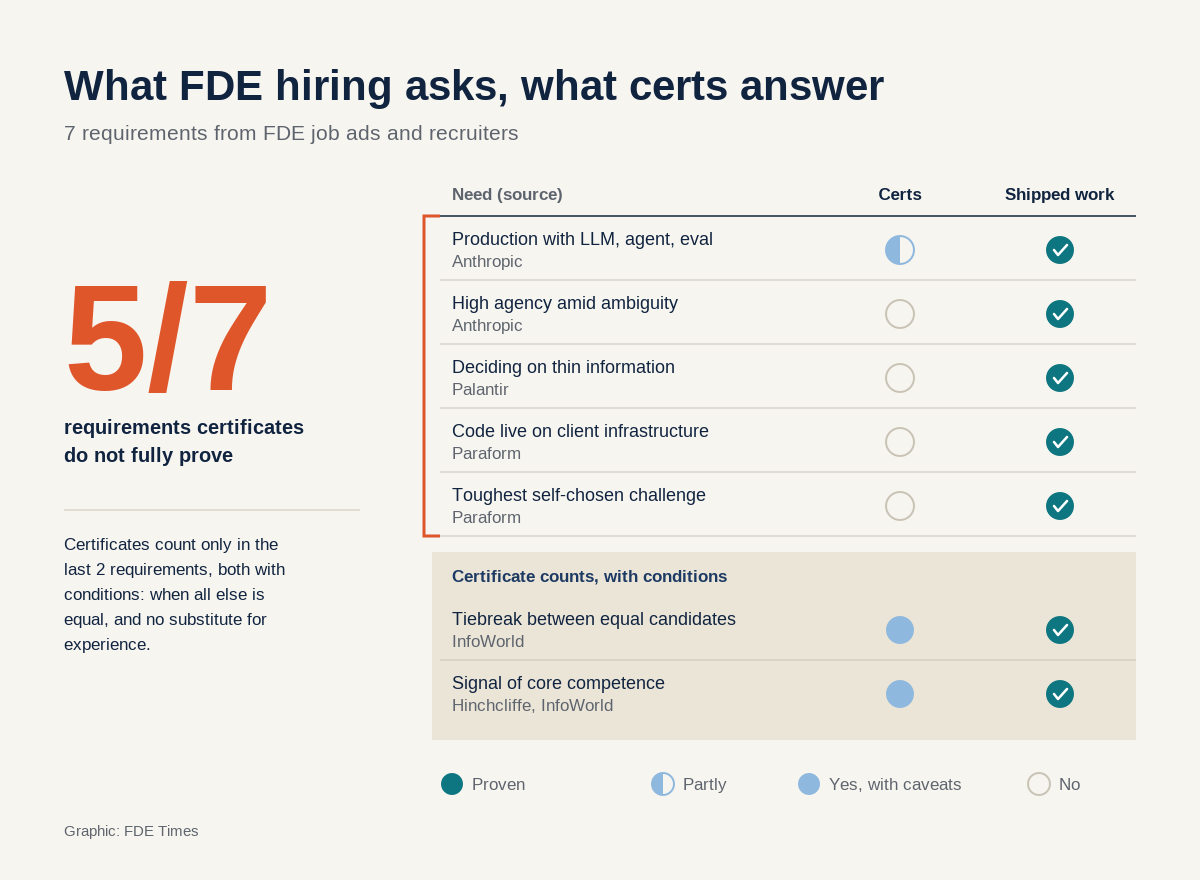
The table below matches each source’s requirement against a practical question: how far a certificate goes as proof, and what your project needs to show.
| Requirement (source) | Does a certificate prove it? | What the project needs to show |
|---|---|---|
| Production experience with LLMs, agents, evals (Anthropic) | Partly: you know the concepts | A system with real users, an eval suite and a history of bug fixes |
| High agency amid ambiguity (Anthropic) | No | A decision you made yourself when requirements were unclear |
| Decision-making with incomplete information (Palantir) | No | Notes on why you chose option A over B, and how it turned out |
| Code deployed on customer infrastructure (Paraform) | No | A repo plus a description of the real deployment environment |
| The hardest challenge you chose yourself (Paraform) | No | A story with moments where you got stuck, got it wrong and worked it out |
| Tiebreaker between two equal candidates (InfoWorld) | Yes, but only when everything else is equal | A live system, with numbers and users, so your application is never ranked level with others in the first place |
| Signal of foundational knowledge (Hinchcliffe, InfoWorld) | Yes, but it does not replace experience | You used that same platform to fix a bug or make a decision on real data |
Certificates earn a place only in the last two rows, and both come with conditions: everything else must be equal, and they cannot replace experience. The other five rows can be answered only by a project.
Two applications side by side
Take two hypothetical developers in Ho Chi Minh City, each with four years of backend work. The first holds three AI certificates from cloud providers. The second has none, but built an agent that sorts support emails for an acquaintance’s online store and has kept it running in production for several months.
When the interviewer says “show me code you have deployed on a customer’s infrastructure”, the first can only describe a lab exercise from a course. The second opens the repo and shows that the agent runs on the store’s server.
He explains why the eval suite uses labels assigned by the shop owner, and why he lowered the model’s confidence on emails containing the word “refund”.
On the question about a self-chosen challenge, the second developer already has a story. The email data mixed Vietnamese typed without diacritics with English, the shop owner could not say clearly what a correct classification looked like, and he had to settle on a criterion himself and refine it over time.
That is the “decision-making with incomplete information” Palantir writes about in its ad, only on a small scale.
The first developer’s three certificates are not worthless. If the two were equal in every other respect, they might give him a slight edge. In this example the two are not equal, and one interview with those two questions is enough to reveal it.
Where to put your effort
When reading an FDE job ad, look for verbs and nouns such as ship, production, customer and deploy, and note the travel percentage. Those words hint at what the interview will ask.
On a CV, every project should answer Paraform’s two questions. Do not just write “built a RAG chatbot with LangChain”.
Write something closer to: deployed an agent for a small business, defined the evaluation criteria myself when requirements were vague, built an eval suite, has real users, with a link to the repo.
Put the stack last, and the context and decisions first.
Anyone who still wants a certificate should treat it exactly as the experts in the InfoWorld article describe it: a signal of foundational knowledge, possibly a tiebreaker, but nothing that replaces experience.
Learn in order to build the project, rather than collecting a certificate in place of one. The hours a course takes could instead produce a small agent running for a real customer, even if that customer is a friend’s café.
At some point in an FDE interview loop, someone is likely to ask what you have put into production. You should have a repo to open, and the best time to start building it is now.
Was this article useful?
Thanks for the feedback!
6 sources
- Forward Deployed Engineer, Applied AI (Anthropic, qua General Catalyst job board)
- Forward Deployed Software Engineer, New Grad - Commercial (Palantir)
- What are Forward Deployed Engineers, and why are they so in demand? · 2025-08-12
- How To Hire Your First Forward Deployed Engineer · 2026-04-22
- AI developer certifications tech companies want (InfoWorld, Bob Violino) · 2025-09-15
- AI Certification vs AI Portfolio: Choosing the Right Course for Your Goals · 2024-03-05