Should you switch to FDE? A $173,816 median salary, and travel in 68% of roles
The salary is only half the story. The other half is how many days a month you get to spend at home, and where the role leads next.

In brief
- Bloomberry found a median salary of $173,816 across FDE job postings that disclosed a pay range. At the leading AI labs, compensation leans heavily towards equity.
- The trade-off is travel: 68% of roles require it, typically 25–50% of the time, concentrated in bursts that follow the project lifecycle.
- FDE is a springboard rather than a destination, but it suits only people who genuinely want to work alongside customers.
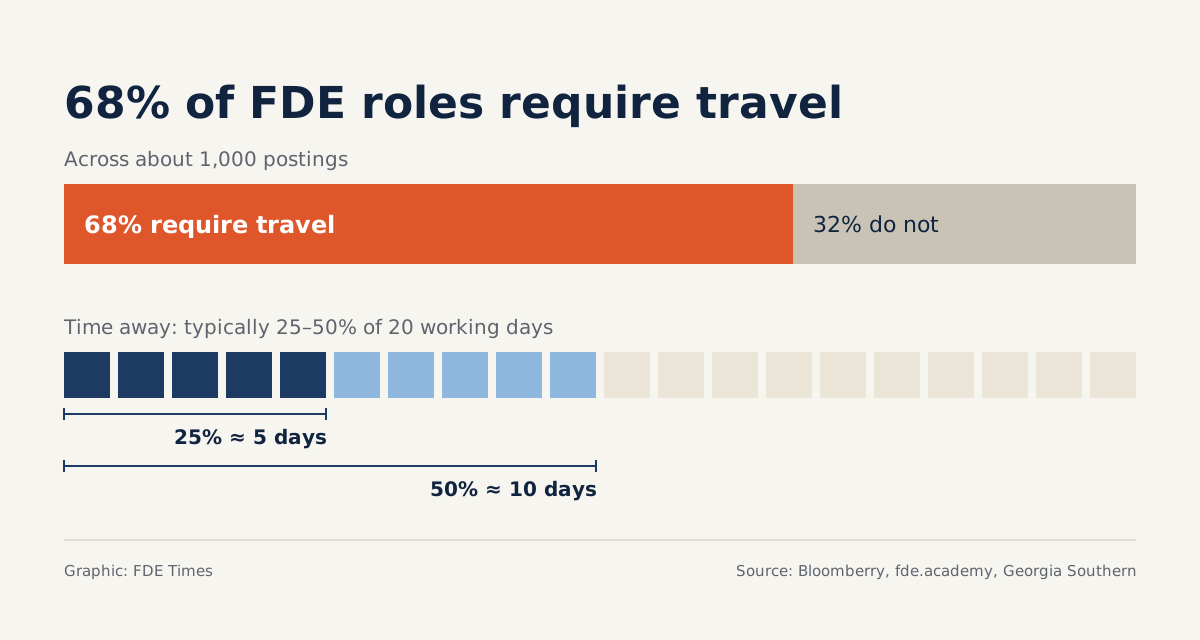
Bloomberry analysed about 1,000 Forward Deployed Engineer job postings and found two numbers that should be read together. Among postings that disclosed a pay range, the median salary was $173,816. In the same dataset, 68% of roles required travel.
The first number grabs more attention, but the second decides what your working week looks like. If you are an engineer with two to eight years of experience weighing a move, the question worth asking is not whether FDE pays well, but whether you can accept what comes with it.
High pay, but measured how?
At first glance the numbers seem not to line up. Bloomberry records a median salary of about $174K. The interview-prep site ClavePrep, by contrast, estimates average FDE total compensation (TC) in 2026 at around $238,000.
Do not subtract one from the other and treat the remainder as some specific payment. One is the median of salary ranges stated in job postings; the other is an average of total compensation, estimated by a different source. Together they give you a reference range, not a calculation.
Georgia Southern’s career guide explains that FDE pay is high because people who can do the job are scarce. The same guide notes that at the leading AI labs, compensation leans heavily towards equity.
Imagine two offers with the same stated TC. The first is mostly base salary; the second is mostly equity in an unlisted AI company. On paper they are equal, but rent is paid in cash, and equity is worth something only if the company succeeds.
So when comparing offers, separate the cash from the equity, and use only the cash to work out whether you can live comfortably.
25% or 50%: two different ways of life
The 68% figure only says that a role involves travel, not how much. Both fde.academy and the Georgia Southern guide put the common level at roughly 25% to 50% of the time, spent working on customer sites. That sounds like a narrow range, but its two ends describe very different lives.
Take a month with 20 working days. At 25%, that is about five days at a customer site, close to one week a month. At 50%, it is about ten days: half your working time spent somewhere else.
The good news is that the average rarely spreads evenly. According to fde.academy, FDE travel usually comes in bursts tied to the phases of a project. A project may need you on site continuously at kick-off or go-live, then barely at all afterwards.
The reasons for being there are concrete, too. fde.academy cites air-gapped systems: a system deliberately built with no remote access cannot be worked on remotely. If the company you are targeting sells into industries like these, assume you will have to travel.
| Aspect | Figure | What it means for you |
|---|---|---|
| Advertised salary | Median $173,816 (Bloomberry) | Only the salary range stated in postings, not total compensation |
| Total compensation | Average about $238,000 (ClavePrep) | Different measure, different source: use it as a reference, do not subtract it from the median salary |
| Equity | Leans heavily towards equity at the leading AI labs | Ask about the offer’s structure in detail; budget with the cash portion |
| Is there travel? | Required in 68% of roles | This is a share of roles, not the time you will spend away |
| How much? | Typically 25–50% of the time | About 5 to 10 days in a 20-working-day month |
| In what rhythm? | Bursts tied to project phases | Ask which phases the trips fall in so you can plan your personal life |
Career growth: a springboard, not a destination
ClavePrep states plainly that FDE is not a final career role. That is the strongest reason to make the switch, stronger even than the pay, because the routes onward are fairly clear.
According to fde.academy, the most common moves out are product management, Head of Customer Engineering, engineering leadership and technical consulting. ClavePrep adds that many of the best enterprise PMs at AI companies came from FDE roles, alongside those who moved up into management or founded companies.
The founder route has its own data. An analysis of former Palantir employees by the fund Concept VC found that FDE was the most common background among the founders surveyed.
The data does not spell out why, but there is a plausible explanation. According to Bloomberry, most FDEs start as software engineers and then add customer-facing skills, rather than the other way round.
People who follow that path therefore carry two things at once: the ability to ship code and the ability to understand what customers actually need. Those are exactly what a PM, an engineering lead or a founder must have.
Who should not choose FDE?
Bloomberry shows that working directly with customers is the number-one responsibility, appearing in 55% of postings, far ahead of any other task. So the first question for anyone considering the move is whether you really want to sit next to customers.
If your greatest pleasure is spending three uninterrupted weeks optimising a single module, the answer is probably no.
The second group is people who cannot be away from home in bursts. As the arithmetic above shows, even the low end of the common range is about a week a month. If your current circumstances do not allow that, look among the 32% of roles that do not require travel, and ask detailed questions before accepting.
If you still want to switch, where do you start?
First, read job postings more closely. Look for the travel level, the customers’ industries and any mention of equity. Those lines tell you more about the real job than the company’s mission statement.
Second, rewrite your CV to show the path Bloomberry describes: an engineer who has started working with users. Instead of “built the payments API”, write that you sat with the customer’s operations team, found the bottleneck, shipped the fix and measured the result.
Third, practise communication skills in your current job. Ask to join a customer call, take on an incident directly with internal users, or write the deployment documentation for a feature yourself. These skills can be learned, but only if you deliberately step away from the editor.
The $173,816 median salary is the easiest number in this line of work to remember. The harder question, and the one to answer before you open an offer, is whether you really want to spend a significant part of every month at a customer’s site.
Was this article useful?
Thanks for the feedback!
7 sources
- What I learned analyzing 1K forward deployed engineer jobs (Bloomberry) · 2025-11-18
- Why Do Forward Deployed Engineers Travel? · 2026-07-25
- What Is a Forward Deployed Engineer? Complete 2026 Guide · 2026-08-05
- Forward Deployed Engineer Salary & Career Path: What the Data Says in 2026 · 2026-06-30
- What FDEs Become Next: Senior Roles, Leadership Tracks, and Founding Paths After Forward Deployed Engineering · 2026-04-27
- Behind The People: Palantir (Concept VC)
- Forward Deployed Engineers and the Future of AI Engineering (DeepLearning.AI) · 2026-05-29