One, four or five years: what Palantir, Anthropic and OpenAI job ads say about the road to FDE
Extra weeks of study do not turn into years of experience. Aimed at the right hiring tier, though, they can build the evidence recruiters actually check.

In brief
- Same FDE title, very different experience thresholds: Palantir asks for 1+ years, Anthropic for 4+ years customer-facing, OpenAI for 5+ years.
- The gap between tiers lies in whether you have worked with customers and shipped LLMs to production, not in programming languages.
- Use weeks of study to produce verifiable work and stories, then apply to the tier that matches the years you already have.
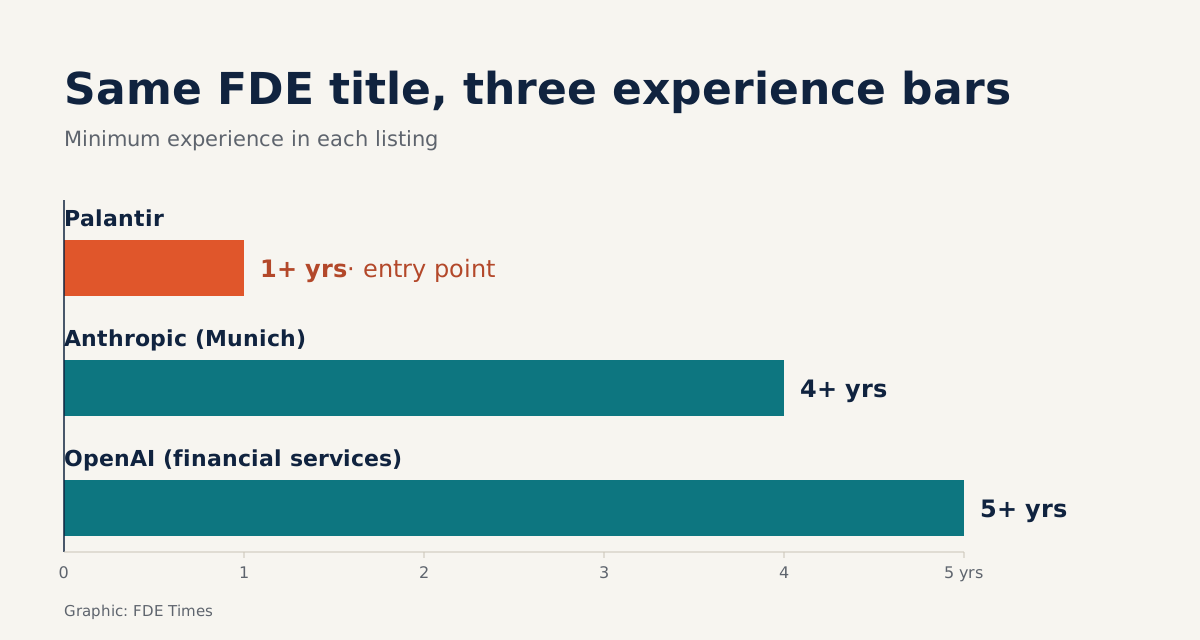
Three job ads carry the same title, Forward Deployed Engineer, but ask for three different numbers. Palantir wants at least 1 year of experience after university. Anthropic wants 4 or more years in a technical, customer-facing role, while OpenAI, for an FDE role in financial services, wants 5 or more.
That makes “how long does it take to become an FDE?” hard to answer in weeks. No eight-week course turns 2 years of experience into 4. What extra weeks of study can buy is something else: evidence for exactly the requirements a recruiter will scrutinise.
If you have 2 to 8 years as a software engineer, you probably already qualify for at least one tier. The job is to work out which tier you are in, see what is missing for the next one, and spend evenings and weekends filling precisely that gap.
Same title, three different jobs
Set side by side, the three ads differ in more than years. Each one shows what the company will hand you from the first week.
One limitation needs stating clearly: there is only one ad per company here, with Anthropic’s role based in Munich and OpenAI’s in financial services. The “tiers” below are a reading of three specific ads, not a general rule for every FDE role at AI labs.
| Palantir | Anthropic (Munich) | OpenAI (Financial Services) | |
|---|---|---|---|
| Minimum experience | 1+ years after university | 4+ years in a technical, customer-facing role | 5+ years in engineering or deployment, partly customer-facing |
| Coding skills | Python, Java, C++, TypeScript/JavaScript or similar | Production experience with LLMs: prompt engineering, agents, evals | Production-grade full-stack code, Python, JavaScript or equivalent |
| What you deliver | Engineering combined with direct work with stakeholders | MCP servers, sub-agents, agent skills inside customer systems | Own everything from first prototype to stable production, across multiple deployments |
| Travel | Up to 25%, flexible to personal preference | 25-50% | Up to 50%, required |
| What you must prove | Good code, ability to work with non-technical people | Shipped LLMs to production and measured their quality | Personally taken multiple customer projects to production |
The Palantir column is the entry point. The ad stresses direct contact with customer stakeholders, from technical teams to leadership, and the ability to work well in teams that mix technical and non-technical people. Beyond code, they want to see that you are comfortable sitting at the same table as people who do not read code.
The other two columns are the AI-lab tier, at least in these two ads. Here the years come with a very specific condition: they must involve customers or production.
Anthropic names the deliverables outright: MCP servers, sub-agents, agent skills. OpenAI states that you own the work from the first prototype until the system runs stably, and that you do so across multiple deployments.
The gap between tiers is not about programming languages
On the coding row, the differences between the three companies are small. Python and JavaScript appear in both the Palantir and the OpenAI ads. An engineer with 3 years of backend experience will very likely clear this row.
The other two rows create the gap: customer-facing experience and production experience with LLMs. Paraform, a recruiting platform, writes in its guide to the FDE role that technical depth alone is not enough to last. In its view, stakeholder management and adaptability matter just as much.
Paraform also makes a point worth noting for anyone considering the switch. Background, it says, matters less than temperament, and you do not need to have worked in consulting. Engineers who have done hackathons, worked at early-stage startups or carried an on-call pager tend to adapt fastest.
Some of your customer skills may therefore already sit in your current job, simply untold. A night on call explaining to the operations team why the payments system went down is also a session of working with stakeholders under pressure.
How far do your existing years count?
Picture a backend engineer with 4 years of experience who has never held a title with the word “customer” in it. Read literally, Anthropic’s ad rules this person out, because it specifies that the years must be in a customer-facing role.
If, during those 4 years, they carried an on-call pager, sat with the sales team to build an urgent integration, or ran demos for partners, that is good material for a CV and an interview.
But do not assume a recruiter will count those years as equal to years in a genuinely customer-facing role. They show aptitude; they do not replace the requirement.
The task is to write it up clearly, not to embellish or rename job titles.
For each such episode, write down who needed the solution, what they did not understand, how you turned their vague request into a working system, and what the final outcome was.
If you cannot write down an outcome, the story is not usable yet.
Likewise, an engineer with 2 years of experience should not try to squeeze into OpenAI’s 5-year ad. The right tier for them is an ad like Palantir’s, where the threshold is 1 year and what gets assessed is good code plus the ability to collaborate.
Applying to the right tier earns you years with real customers, and those are the years that later open the door to the AI-lab tier.
Twelve weeks of building evidence alongside a day job
The plan below is a suggestion for someone in a full-time job. Each phase is designed to produce exactly one kind of evidence the table above shows to be missing.
Weeks 1 and 2 are for reading job ads the way you would read a spec. Pick three ads across both tiers, then sort every requirement into three groups: have evidence, have it but not on the CV, and do not have it. The third list is the scope of work for the next ten weeks.
Weeks 3 to 6 go into building a small agent with evals, because this is what Anthropic’s ad names most explicitly: prompt engineering, agent development, evaluation frameworks.
Pick a real workflow at your company, such as triaging support tickets, and write the test cases before writing the prompt. One agent with a quality scorecard across versions is worth more than ten demos that measure nothing.
In weeks 7 to 9, wrap that agent as an MCP server so other tools can call it, then hand it to a real user who is not an engineer.
This phase targets OpenAI’s requirement to own the work from prototype to production, only at small scale. The hardest part will be the moments when the user asks for something different from what you built, and those are also the stories most worth taking into an interview.
Weeks 10 to 12 are for packaging. Write a short piece describing the problem, the user, the eval numbers and what you changed after feedback. Then rework your CV so that each bullet starts with a specific person or team you helped, not with the name of a technology.
Travel is part of the job
One line in all three ads tends to get skimmed by career-switchers: travel. Palantir says up to 25% and flexible to personal preference. Anthropic says 25-50%, to build directly alongside customers. OpenAI says up to 50% and states that it is required.
This figure says more about the nature of the work than any other line in the description. Under OpenAI’s ad, you might spend one week in every two at a customer’s office. If family circumstances do not allow that, a role with more flexible travel is the more sensible choice, even with a lower experience requirement.
So in the first interview, ask directly about the team’s actual travel ratio. Stating your limits early is far better than accepting the job and only then discovering the schedule does not work.
The right unit of measure is deployments
Back to the original question. For someone with 1 year of experience, good code and a willingness to work with non-technical people, the main requirements in Palantir’s ad are already within reach. Twelve weeks then serve mainly to turn them into evidence a recruiter can see; they do not guarantee an offer.
For someone aiming at the AI-lab tier, the distance is measured in how many times you have put a system in the hands of real users and taken responsibility for it.
Twelve weeks cannot replace four years of experience. But they are enough for your first deployment, and every deployment after that counts towards your record.
Was this article useful?
Thanks for the feedback!