Negotiating an FDE offer: base is locked by level, so push on level and equity
At the same FDE level, base salary barely moves, but equity can differ by as much as $200K. That makes where you start the conversation matter.

In brief
- FDE base pay is largely locked by level, with a midpoint of about $195K in job postings that disclose salary.
- At the same level, equity can differ by $50K–200K depending on the compensation committee. Negotiate it first.
- If you are placed at the wrong level, no amount of base negotiation makes up for it. A competing offer is the strongest lever.
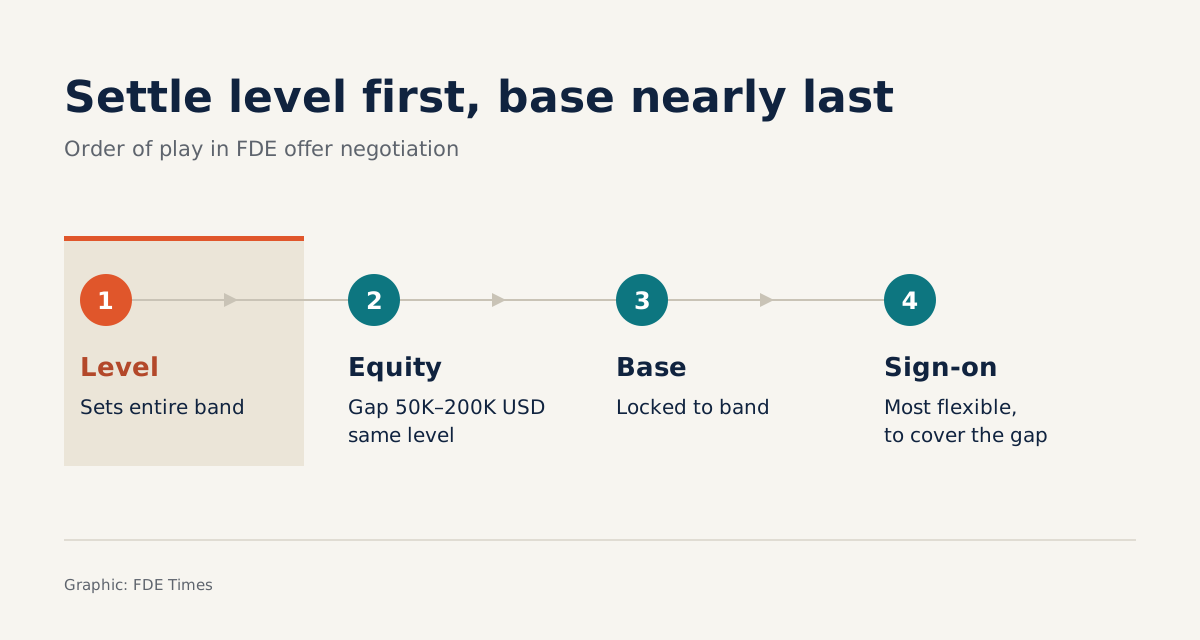
In FDE job postings that disclose salary, base pay clusters around $195K and is largely capped by level. Yet at that same level, equity can differ by $50K to $200K, depending on the compensation committee. If you put all your effort into asking for more base, you are pushing on the least flexible part of the package.
Both figures come from getperspective.ai’s 2026 guide to FDE salary negotiation. Combined with what other guides say about pay bands and levels, they point to a sensible order of priorities: settle the level first, then equity, and leave base until near the end.
If you are about to receive your first FDE offer, or are thinking of moving over from software engineering, this order will affect your earnings more than asking “could you move the base up a little?”
It also uses the same skill you need on a customer site: knowing who has the authority to decide, what constrains them, and then making a request that falls within what they can say yes to.
Why does asking for more base usually go nowhere?
Formation, writing about offer negotiation at FAANG companies and startups, describes the mechanism clearly: each level has its own pay band, and recruiters work only inside that band. Formation also notes that base is usually the least flexible part of the package. When you ask for more base, you are asking the person across the table for something they have almost no power to stretch.
Imagine the recruiter has already set your base near the top of the band. If you keep pressing on base, you might get a few more per cent at most. In exchange, you have spent all your bargaining on the item least worth it.
Any FDE who has worked with customers knows this situation. When a customer says the budget is fixed, you do not haggle over price; you renegotiate scope. Negotiating an offer works the same way: find where there is still room to move, and do not push where things are already set.
Level shapes the whole package, so discuss it first
According to Formation, level governs the entire compensation package: it sets both the base range and the equity range. Machine Learning at Scale, in its piece on offer negotiation in machine learning, also puts level first, under the heading “Level Matters Most”. Leon Staff puts it bluntly: if you are placed at the wrong level, no amount of base negotiation will close the gap.
The reason lies in how bands work. Move up a level and both ranges, base and equity, shift up together. According to Leon Staff, negotiating level is how you unlock a higher earnings ceiling. Negotiating within a band only moves you between a floor and a ceiling that are already fixed.
For an FDE, the evidence for a level should be scope of work, not just years of experience. That means deployments you owned from discovery to production, the number of customer stakeholders you worked with directly, and the technical decisions you made yourself without waiting for sign-off.
Ask the recruiter what level the offer is at and what the next level requires, then match each criterion against what you have done.
Equity is where the committee has room to give
Once the level is settled, the biggest variation lies in equity. According to getperspective.ai, equity within the same level can differ by $50K–200K depending on the committee. Machine Learning at Scale likewise observes that equity is easier to increase than base. getperspective.ai’s guide therefore advises negotiating equity first and valuing it on a fully diluted basis, against both the 409A valuation and the preferred price.
Try a calculation with hypothetical numbers. The offer lists 40,000 shares, and the company says there are 200 million fully diluted shares in total, so you would own 0.02%. If the preferred price is $10 a share, the grant looks like $400K. But if the 409A price is $3, the same grant is worth only $120K.
The same equity grant yields two figures more than three times apart. So do not accept the headline number a recruiter reads out over the phone. Ask for four data points: the number of shares, the fully diluted total, the 409A price and the most recent preferred price.
Only with all four can you compare two offers and have grounds to ask for more equity within the range the committee is allowed to approve.
The strongest lever is another offer
getperspective.ai regards a competing offer as the most effective lever, even if you do not intend to accept it. The reason is simple: the committee has the authority to increase equity, and it needs a reason to use that authority. A real offer on the table gives it one.
The sign-on bonus, according to Formation, is the most flexible part of the package. Save it for the end of the negotiation: once level and equity have hit their limits, sign-on is where a remaining gap can still be closed. One practical piece of advice: do not invent an offer. Recruiters may ask for details, and credibility lost before signing is hard to win back.
| Lever | Flexibility | Question to ask | Evidence to bring |
|---|---|---|---|
| Level | Sets the whole band | What level is the offer at, and what does the next level require? | Deployment scope, number of stakeholders, decisions you made yourself |
| Equity | Varies by $50K–200K within the same level | Number of shares, fully diluted total, 409A price, preferred price? | A competing offer, your ownership-percentage calculation |
| Sign-on | Most flexible | Is there room in the sign-on to close the gap? | What you forfeit by leaving your current job |
| Base | Least flexible, locked by band | Where does this figure sit in the band? | Of little use once the level is settled |
Start preparing with your CV, not when the offer arrives
Because level sets the whole band, you should build your case for level well before the recruiter calls with an offer. The safe approach is to make sure your CV and the stories you tell in interviews both show the scope of your work.
“Took part in deploying a system for a customer” is not enough. “Owned the deployment for a customer, from discovery to production” is the kind of evidence that carries weight when you argue for a higher level.
When reading a job description, check whether it states a level or a salary range. If it does, treat that range as a hint about the band and the base ceiling you can reach. If it does not, the question of level should be one of the first you put to the recruiter, before any numbers are discussed.
Good FDEs do not argue with a customer’s constraints; they find what can still be opened up within them. Negotiate your own offer the same way.
Was this article useful?
Thanks for the feedback!
4 sources
- Forward Deployed Engineer Salary Negotiation 2026: Data-Backed Guide (getperspective.ai) · 2026-06-17
- How to negotiate FAANG offers vs startup offers (Formation) · 2026-05-11
- Negotiating ML job offers (Machine Learning at Scale) · 2024-07-25
- Why You Should Negotiate Your Level, Not Just Your Salary (Leon Staff) · 2026-07-30