One client or a hundred? What really caps an FDE's workload
No company publishes the number, but the playbooks agree that the ceiling depends on each account's stage and how much of the work has become reusable tooling.

In brief
- No public data says how many projects an FDE runs at once. The 3–8 range is an inference, and no company has published it.
- A deep build phase can take up most of an engineer's time, while a stable account needs far less, so capacity has to be planned by stage.
- The ceiling rises only when repeated work is turned into product and every engagement has a clear exit.
How many clients does a forward deployed engineer usually run at once? No public document answers the question. The aggregator site theforwarddeployed.io admits the public record leaves a gap here, and most first-hand accounts describe only “one deep embed at a time”.
The original models all lean toward one. PostHog describes its FDEs doing product discovery and development with one customer at a time. According to Rocketlane, Palantir’s FDSEs embed deeply with exactly one customer at a time. Yet Atlassian says its FDEs have worked with more than 100 enterprise customers.
The paradox matters because it decides how work gets assigned to you. Carry eight accounts at once with all eight in a deep build, and burnout is guaranteed.
Understand what pushes the ceiling up and what drags it down, on the other hand, and you can negotiate scope, design tooling and give better answers when a recruiter asks.
Counting clients is the wrong question
A more useful question is what stage each account is in. An analysis on the zarifautomates.com blog of when to hire FDEs puts it bluntly: a deep build phase can take up most of an engineer’s time, while a stable account needs far less.
The accompanying advice is to plan capacity by stage rather than by a fixed number of accounts, and to protect time for productization and documentation.
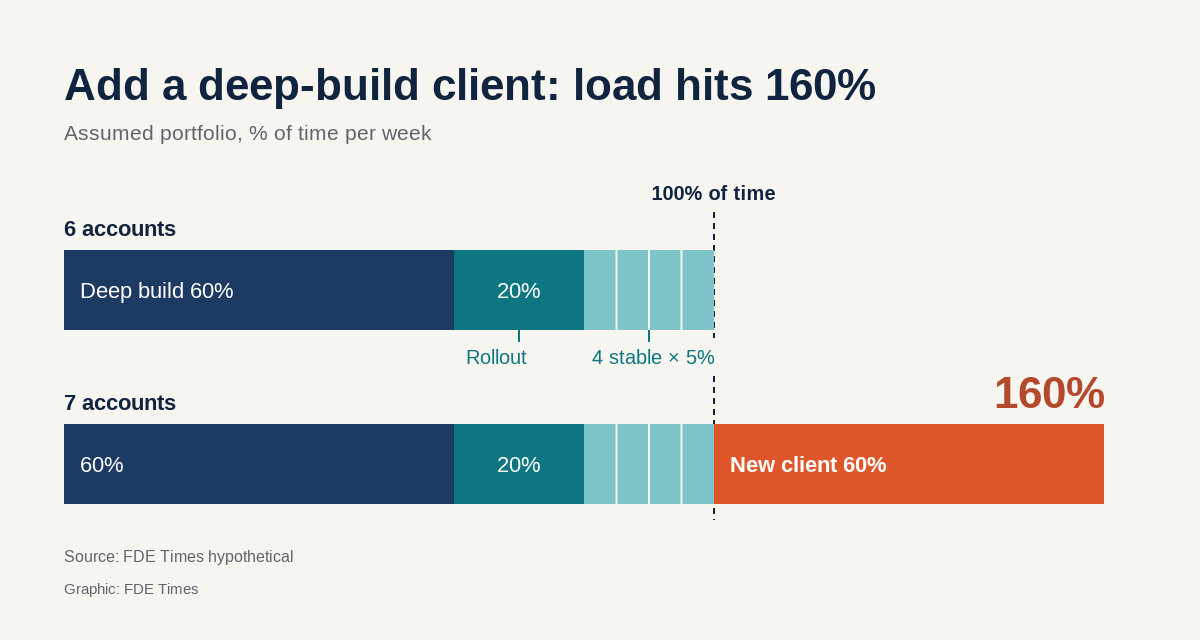
Take a hypothetical portfolio. You have one client in a deep build, taking roughly 60% of your working week. One client in rollout takes about 20%. Four stable clients take 5% each. That adds up to six accounts and exactly 100% of your time, with nothing left for productization.
Now sales closes a new client, and it goes straight into a deep build. On paper the portfolio grows from six to seven. In practice your load jumps to about 160%. Counting accounts hides that jump; looking at stages reveals it at once.
The portfolio decides whether it is three clients or eight
The range of 3–8 projects is an inference drawn from the stage logic above. No company has published it as data.
The low end fits a portfolio with one or two clients in a deep build, where every new client has to take time from an existing one. The high end is feasible only when most accounts are stable and tooling handles the repeated work.
The load is not always split person by person, either. According to theforwarddeployed.io, Palantir’s customer teams usually number just 4–5 people, moving fast and working autonomously. When you read “one FDE, one client”, the real picture is often a small team sharing one large account.
Set the models side by side and different mechanisms turn out to hold the ceiling in place:
| Model | Clients at a time | What holds or raises the ceiling |
|---|---|---|
| PostHog | One at a time | A small team chooses carefully where to invest time; repeated patterns become internal tools |
| Palantir | One per FDSE | Customer teams of 4–5 share the load |
| Atlassian | More than 100 enterprise customers in total | The platform turns one team’s solution into a capability every customer can use |
| Perspective AI playbook | Rotating portfolio | Handover within 120 days of go-live; target of 70%+ of code in the core repo |
The table shows that one client and a hundred clients do not contradict each other. They are two points on the same curve, and the curve climbs as client work is turned into product.
How does tooling raise the ceiling?
The zarifautomates.com piece offers the neatest rule: work repeated across accounts is a product requirement rather than a services problem. That is the mechanism that raises the ceiling. Each time a piece of work leaves your task list and goes into the product, the deep build at the next client gets shorter.
PostHog’s handbook makes this part of the job: build reference implementations, sample examples and internal tools so later engagements run faster. Atlassian goes further, designing an entire platform so that one team’s solution becomes a capability every customer can use.
The Perspective AI playbook proposes a concrete measure, the reusable-asset ratio: the amount of code that goes into the product repo compared with code sitting in each client’s own repo. The target is more than 70% in the core repo by month 12.
Back to the example: if most of what you wrote for the sixth client already lives in the core repo, the seventh may take only 30% of your week instead of 60%.
Knowing when to leave a client matters as much as taking a new one
Tooling shortens the deep build. Without an exit, though, your portfolio keeps thickening because old accounts are never handed back. Perspective AI proposes that most engagements be handed over to customer success and product engineering within 120 days of go-live. That way the portfolio rotates instead of piling up.
Rocketlane also stresses that healthy organizations agree scope, milestones and exit criteria before each FDE assignment. Bear in mind that Rocketlane sells PSA software.
Its claim that FDEs spend 40–60% of their time on administrative work should be treated as unverified marketing. Even setting that figure aside, the principle of agreeing the exit up front holds.
In the example, the four stable accounts take 20% of your week. If two of them are handed over on schedule, you win back about 10%. That time should go into moving code into the core repo: an investment in the next client, rather than slack to fill with more work.
Recruiters want to see you raise the ceiling
When interviewing for an FDE role, ask more than “how many clients does each person handle”. Ask how the company plans capacity, when an engagement counts as finished and who takes the handover. A job description that mentions exit criteria, reusable tooling or contributions to the product repo signals an organization that has thought about scale.
On a CV, “managed 8 enterprise clients” says very little. A stronger line describes the mechanism: you spotted a piece of work repeated across several clients, turned it into a tool or module in the product, and cut the next engagement short by a stated amount of time.
Use your own real numbers. Recruiters want evidence that you can raise the ceiling, beyond simply tolerating a heavy load.
If you already work as an FDE, keep a stage-based workload table and update it every week. It lets you turn down the seventh client with data rather than gut feel. It also lets you point to exactly where the product team needs to invest.
A good FDE does not measure themselves by how many clients they are carrying. The better measure is how much less of their time the next client will need.
Was this article useful?
Thanks for the feedback!
7 sources
- What Is a Forward Deployed Engineer? The Job Explained (theforwarddeployed.io) · 2026-07-13
- WTF is a forward deployed engineer? (and why everyone is hiring them) · 2026-02-11
- Forward Deployed Engineer (FDE): The Essential 2026 Guide · 2025-12-10
- When Should You Hire a Forward Deployed Engineer? · 2026-08-08
- How to Build a Forward-Deployed Engineering Function: A 2026 Founder's Playbook · 2026-05-14
- Forward deployed engineering overview (PostHog Handbook)
- Meet the Forward Deployed Engineer - Inside Atlassian · 2026-10-07