Becoming an FDE without a computer science degree: what Palantir, Anthropic and Google actually require
Anthropic and Google say "or equivalent experience" outright, and Palantir lists academic fields only as "preferred". What decides your application is the set of requirements that have no alternative.

In brief
- Anthropic and Google allow equivalent experience in place of a bachelor's degree. Palantir lists academic fields only as 'preferred' and states no degree requirement.
- The hard requirements differ by company: Palantir wants 1+ years of post-university work. Anthropic wants LLMs in production and 4+ years in customer-facing technical roles. Google wants 8 years of software development and experience with MCP and generative AI agents.
- A relaxed degree requirement does not mean easy entry: Palantir's fellowship for people who skipped university took only 22 of more than 500 applicants.
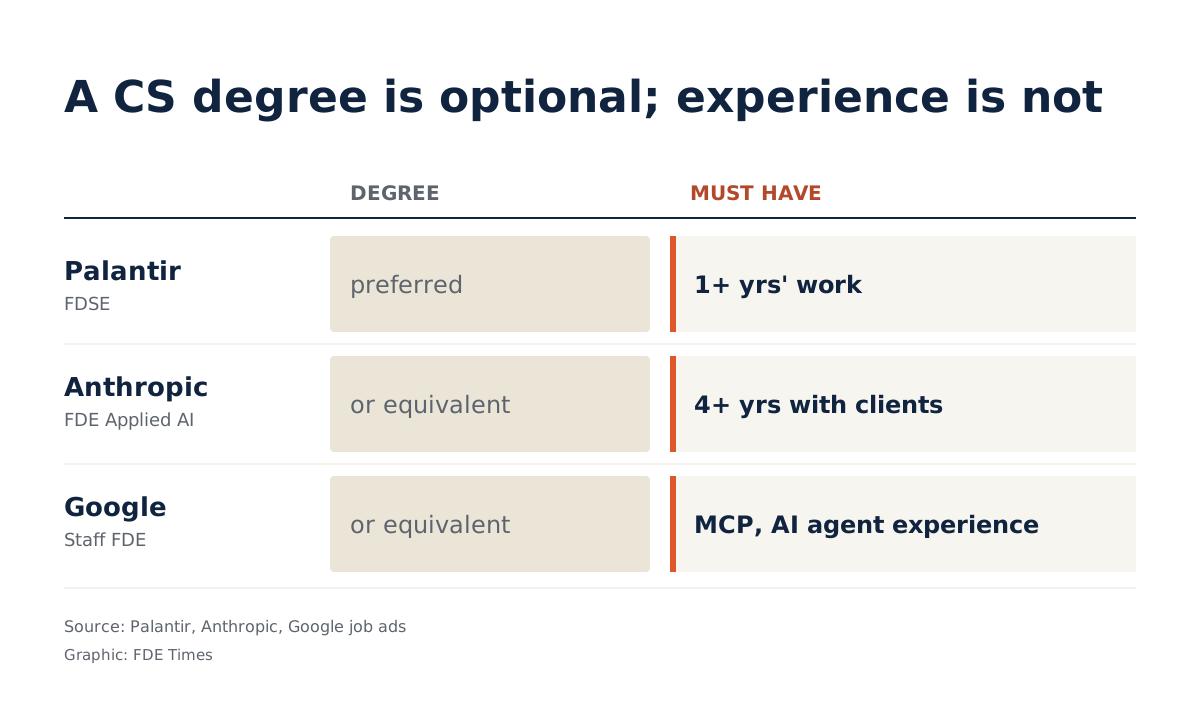
In Palantir’s posting for a Forward Deployed Software Engineer, a technical background in fields such as computer science, mathematics or physics is listed only as “preferred”. On experience, the posting asks for at least one year of relevant work after university. The page states no degree requirement and has no “equivalent experience” clause.
Anthropic and Google word it differently: both write “or equivalent experience” right next to the bachelor’s degree line. So people without a CS degree still have a way in. But right beside that lenient degree line, each company sets requirements that carry no “or” at all.
If you studied economics or physics, taught yourself to code or left university early, the practical question is not whether you may apply. It is what will replace the degree on your CV, and whether that matches what the posting actually demands.
The degree line is softer than you think
Anthropic’s posting for an FDE in Applied AI says it plainly: at minimum a bachelor’s degree in a related field or equivalent experience. Another Anthropic FDE posting goes further.
That one accepts a bachelor’s degree, or a combination of education, training and experience at an equivalent level. Your field of study can be demonstrated through coursework, training or professional experience.
For its Staff Forward Deployed Engineer role, Google puts “bachelor’s degree or equivalent practical experience” under minimum qualifications. A master’s or PhD sits only under “preferred”. Palantir’s FDSE posting for new graduates likewise lists fields such as computer science or electrical and computer engineering only as preferences.
The notable exception is Palantir’s FDSE internship for US government work. Candidates must be studying for or already hold a technical degree, although AI experience can come from coursework, projects or extracurricular activities. Read each posting carefully: within the same company, each level sets its own rules.
Palantir goes further than its postings. According to Fortune, the company launched the Meritocracy Fellowship, a paid four-month stint for recent high-school graduates who have not gone to university. CEO Alex Karp has called having worked at Palantir the most valuable “credential” in tech, far ahead of anything else.
But look at the ratio: more than 500 applied and only 22 were chosen. The fellowship is not an FDE hiring process, so no FDE acceptance rate can be inferred from it. It only hints at something worth weighing: dropping the degree from the requirements does not mean the company is any less selective.
So where is the real filter?
Read four postings side by side and strike out the degree line, and what remains has one thing in common. Every requirement is something you have to prove yourself, not something someone grants you.
| Posting | Degree line | Hard requirements | Evidence you can prepare |
|---|---|---|---|
| Palantir, full-time FDSE | Technical background in CS, Maths, Software Engineering, Physics, Data Science only “preferred”; no degree requirement stated | 1+ years of work after university | At least a year of real work, with a clear account of the parts you did yourself |
| Palantir, FDSE internship for US government | Studying for or holding a technical degree, preferably CS, Maths, Software Engineering, Physics | AI experience; coursework, projects or extracurricular activities all count | A personal AI project with a README stating the problem and the results |
| Anthropic, FDE Applied AI | Bachelor’s in a related field or equivalent experience | LLMs in production, including advanced prompt engineering and agent development; 4+ years in technical roles working directly with customers | An agent with real users; years of technical work alongside customers |
| Google, Staff FDE | Bachelor’s or equivalent practical experience; master’s, PhD only “preferred” | 8 years of software development; experience with MCP, generative AI agents and generative modelling, all under minimum qualifications | An MCP server you wrote and an agent that uses it |
The last column is where people without a CS degree can unexpectedly gain the upper hand. A degree certifies that you studied algorithms. It does not certify that you have put an agent into production or built an MCP server, and those are exactly what Anthropic and Google place in the part with no “or”.
Three things a degree cannot certify
To be fair: according to Aaron Levie, CEO of Box, quoted by Gergely Orosz in The Pragmatic Engineer, FDEs need deep technical skills, and people in the role have often majored or minored in CS. But Levie names two more things: systems thinking and business understanding. Neither is printed on a degree.
Picture an engineer who studied economics, taught themselves Python and has spent three years on the backend at a logistics company. The current CV opens with “BA in Economics”, followed by a list of technologies. A screener reads the first line, sees an off-field degree and may well stop there.
Yet those three years can easily be retold as evidence. The projects section links to a repo: an agent that answers questions about order status, pulling data through an MCP server the engineer wrote. That repo matches exactly the MCP and agent requirements Google lists under minimum qualifications.
The repo includes about 50 test questions with correct answers, and the README records the accuracy rate before and after a prompt change. The postings do not ask for an eval set like this. Even so, it is the most compact way to show your agent works outside a demo environment, and the closest thing to what Anthropic calls LLM experience in production.
The experience section also stops listing technologies and instead tells the story of an incident. The operations team reported bad data; you sat with them, found the cause, fixed the bug and changed the way they work.
Anthropic’s posting does not say whether serving internal users counts towards the 4+ years of “customer-facing” work, so do not assume it does. But the story is still the best material for showing you know how to work with people who have a problem. The “BA in Economics” line moves to the bottom of the page.
If you have ever built a small product on your own, even one that failed, put it on your CV. You had to wire systems together yourself and work out who needed the product and why. That is evidence for exactly the two abilities Levie names that a degree cannot certify.
Years of experience are the real ladder
Among the hard requirements, the biggest gap between the three companies is years of experience. Palantir wants 1+ years of work. Anthropic wants 4+ years of customer-facing technical work. Google, at Staff level, wants 8 years of software development.
So if you are in your second year of work, Palantir’s FDSE role is a more realistic rung than the role at Anthropic or the Staff seat at Google.
Levie predicts that new graduates will increasingly find FDE roles they have a chance of landing. That is a prediction, not data, so pick postings by the years you actually have.
One detail is worth noting. The phrase “after university” in Palantir’s posting shows the company still pictures a familiar path, even though it states no degree requirement. Have two sentences ready that explain your route, brief and without apology.
A degree is something others grant you once. Evidence you have to build yourself, keep up to date and be able to show with a single link. For FDEs, that is the part of the posting with no “or”.
Was this article useful?
Thanks for the feedback!
8 sources
- Palantir Technologies - Forward Deployed Software Engineer
- Palantir Technologies - Year at Palantir - Forward Deployed Software Engineer, Internship - USG
- Palantir Technologies - Forward Deployed Software Engineer, New Grad - Commercial
- Forward Deployed Engineer, Applied AI @ Anthropic | General Catalyst Job Board
- Forward Deployed Engineer @ Anthropic | General Catalyst Job Board
- Staff Forward Deployed Engineer, Developers and Experiences @ Google | anitab.org Job Board
- The Pulse: Forward deployed engineering heats up again · 2026-05-24
- Palantir says college is no longer a reliable training ground—so it hired 22 high school students instead · 2025-11-05