Four FDE hiring guides ask for the same thing: evidence from real production
When hiring guides tell interviewers to ask about real deployments, the advantage goes to engineers who started documenting their client work months earlier.

In brief
- Paraform calls hiring FDEs like any other engineering role the most common mistake, because algorithm tests only measure abstract problem-solving.
- The hiring guides want evidence: production code, a hard problem the candidate chose, a video walkthrough of a real deployment and ROI figures with a baseline.
- FDE jobs are concentrated in fewer companies than the hype suggests, so read postings closely before applying to see what the role really involves.
According to Paraform, the most common mistake in hiring forward deployed engineers is treating the search like any other engineering hire. The warning is aimed at employers, but candidates are the ones who should study it.
Paraform, a recruiting platform, has written two guides on the subject. Christian & Timbers and Goodspeed have each written one more.
For candidates, this changes how to prepare. The question is no longer which problem you can solve in the interview room. It is what you have done for customers, and what you have kept that proves it.
Algorithm tests measure the wrong thing
Paraform explains that whiteboard exercises and algorithm tests measure problem-solving under abstract conditions. FDE work is rarely that abstract. Think of dirty data, a customer’s legacy systems or a stakeholder who changes requirements halfway through: no LeetCode problem can simulate them.
So Paraform puts the technical bar somewhere else: find people who write production-grade code, not proofs of concept that collapse under load. If your strength is building demos quickly, take note: serious recruiters are being told to screen out exactly that kind of output.
Paraform also offers a question about persistence: describe the hardest technical challenge you chose to take on yourself, not one you were assigned. The question filters for people who go looking for hard problems. At a customer site, that trait separates an FDE from an engineer who only works through tickets.
They want evidence, not stories
The other guides push further in the same direction: recruiters want something they can verify. Christian & Timbers, an executive search firm, says outstanding FDE candidates must show they have repeatedly owned production systems across six areas.
The key word is “repeatedly”. One successful project could be luck. Five are much harder to explain that way.
Goodspeed, in its hiring guide for the UK market, is more specific still: ask candidates to record a video walkthrough of a real customer deployment, and never accept a polished portfolio. Then, before signing a full-time contract, always run a paid trial sprint lasting one to two weeks.
The table below matches those requirements with what candidates should have ready:
| What recruiters are told to check | Who recommends it | What the candidate needs ready |
|---|---|---|
| Production code, not a PoC that breaks under load | Paraform | A system you have run, with a load incident and how you handled it |
| The hardest challenge you chose yourself | Paraform | A specific story about a problem you took on that nobody assigned |
| Repeated ownership of production across several areas | Christian & Timbers | A list of deployments, stating clearly which parts you owned |
| ROI figures with a baseline and a measurement period | Christian & Timbers | Every result paired with a starting point and a time window |
| A video walkthrough of a real deployment | Goodspeed | An unedited screen recording covering the architecture and the trade-offs |
| A paid trial sprint of one to two weeks | Goodspeed | Readiness to do real work in week one and get up to speed fast in an unfamiliar codebase |
Impressive numbers will be checked
One Christian & Timbers recommendation is worth writing down: big numbers must come with the original baseline and the measurement period. If interviewers follow this advice, every figure on your CV can be questioned.
Imagine your CV says “cut claims processing time by 60% for an insurance client”. An interviewer following that advice will ask: 60% compared with what, measured from which month to which month, and who measured it?
If you answer “from about 5 days to 2 days, measured across all claims in the first quarter after go-live, with data from the client’s own system”, the number holds up.
If all you can say is “their team told us so”, the 60% works against you. That suggests a habit worth building now: when a deployment starts, record the baseline before you touch anything. Looking for a baseline after go-live is usually too late.
Before applying, read the posting closely
Employers have reasons to be careful, and so do you. Valletta Software concluded that FDE jobs are concentrated in a much smaller group of companies than the hype suggests.
Palantir has the densest concentration: in Valletta’s count in September 2026, 77 of the company’s 310 open positions were forward deployed, roughly a quarter. But Valletta also noted that many of those listings are evergreen, so they are better read as a long-term candidate pipeline than as a hiring spree.
For applicants, that means a posting that stays up for months does not necessarily have a seat waiting right now. The second detail matters even more: Valletta found that every Databricks FDE role sits in a unit the company’s own hiring data labels Professional Services Operations.
Valletta suggests that sitting under the services organisation may limit an FDE’s influence on the product roadmap. That is not necessarily bad, but it is a different job from the picture of an FDE positioned between the customer and the product team.
So when you read a job description, do not stop at the title. Check which unit the role sits in and who it reports to, then ask directly in the first interview: how does the customer feedback you bring back reach the product team?
Candidates should prepare the other way round
The consequence for candidates is clear: a strong FDE profile is not built in the week before an interview but accumulated over each deployment. If you are a software engineer who wants to move into FDE work, the sensible path is to find work in your current job that touches real production and real users.
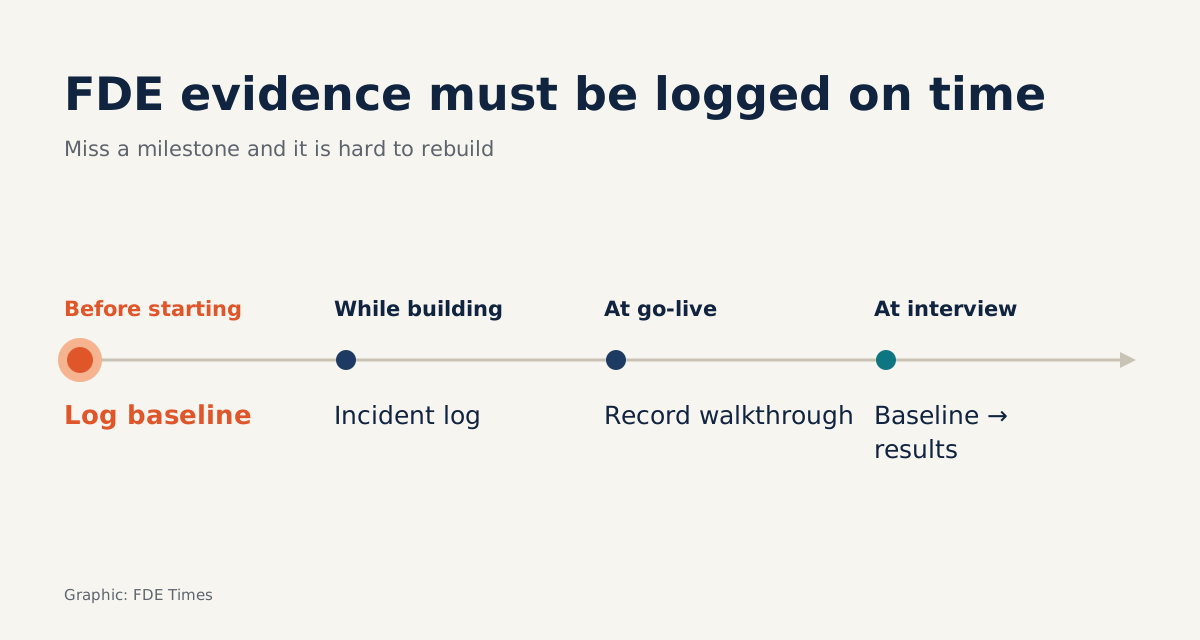
Each kind of evidence has its own moment to be captured. The baseline must exist before you touch the system, the log of incidents and trade-offs must be written while you build, and the screen recording should be made just after the system goes live, while you still remember why the architecture looks the way it does.
Miss any of those moments and that piece of evidence is very hard to reconstruct later.
The one-to-two-week trial sprint Goodspeed recommends is the final test, and it rewards exactly the skill FDEs use every day: walking into an unfamiliar codebase, understanding the context quickly and shipping something that really runs before the week is out.
You can practise this now by picking up an issue in an open-source project whose code you have never read, and timing yourself.
As the whiteboard recedes, the deciding question in FDE interviews will become ever simpler: what did you do for customers, and what do you have to prove it?
Was this article useful?
Thanks for the feedback!
5 sources
- How to hire a forward deployed engineer in 2026 | Paraform · 2026-09-04
- How To Hire Your First Forward Deployed Engineer 2026 | Paraform · 2026-04-22
- Forward Deployed Engineer Jobs: Who Is Really Hiring · 2026-09-08
- How to Hire Elite Forward Deployed Engineers · 2026-09-10
- How to Hire a Forward Deployed Engineer (2026 UK Guide) · 2026-05-07