FDE recruiters want a number with a baseline, not your stack
Hiring teams for forward deployed roles look for a deployment result they can check, such as "cut from 6 weeks to 9 days," ahead of tool names.
In brief
- Aced's FDE resume guide says every bullet needs a number, for example cutting deployment time from 6 weeks to 9 days.
- Palantir treats Python, Java and C++ as baseline requirements; what it looks for is someone who owns critical projects end to end.
- Big numbers get checked: Christian & Timbers asks candidates to give a starting baseline and a measurement period.
“Reduced deployment time from 6 weeks to 9 days.” The FDE resume guide from Aced (formerly Exponent) offers this line as a model, set beside a vague phrase along the lines of “improved efficiency.” Its advice is blunt: every bullet should end with a number.
It sounds like a familiar resume tip. In practice it describes how FDE hiring teams read applications. They are not hunting for the person who has touched the most tools. They want someone who has put a system into operation at a customer site and can prove it changed something.
Many developers, particularly in outsourcing shops, still organize their resumes by stack: which project, Spring or FastAPI, Kafka or RabbitMQ. That format suits the keyword filters for a backend role. Submitted for an FDE position, it hides the very thing the recruiter most needs to see.
Frameworks are the minimum bar
Palantir’s job posting for a Forward Deployed Software Engineer makes the priorities plain. Programming languages appear as a baseline requirement: strong coding ability and proficiency in languages such as Python, Java and C++.
The job description itself is about something else: working directly with customers and owning the execution of critical projects from start to finish.
Palantir also lists Ownership as a value in its own right, defining it as seeing a project through from beginning to end and getting past whatever obstacles come up. A list of frameworks cannot demonstrate that. It shows you have passed through those tools; it says nothing about what you carried to the finish line.
Aced makes the same point: FDE recruiters rank ownership and customer impact above pure technical complexity.
So the Skills section should include only relevant skills you can discuss credibly, rather than everything you have ever used.
Over-listing will come back to bite you in the interview, when the interviewer picks the very name you understand least.
Google’s formula still works
FDEs did not invent this way of writing. In 2015 Laszlo Bock, then head of people operations at Google, answered in a Reddit AMA that every accomplishment should be written as “accomplished X, as measured by Z, by doing Y.” His general advice was to make the impact of your work clear.
Applied to FDE work, the three parts become more specific. X is a change on the customer’s side: a faster process, fewer errors, or a decision made sooner. Y is what you built or led yourself. Z is the number, and in FDE work it almost always has a before and an after.
Aced’s sample bullets follow this pattern. One line about a data pipeline says time to first insight fell from 3 months to 3 weeks. Others measure the latency of a RAG system or the hours saved by a reusable set of tools. None of them opens with a library name.
Rewriting a bullet, step by step
Take a hypothetical developer at an outsourcing company in Hanoi who has just finished a project for a logistics client. The current bullet reads:
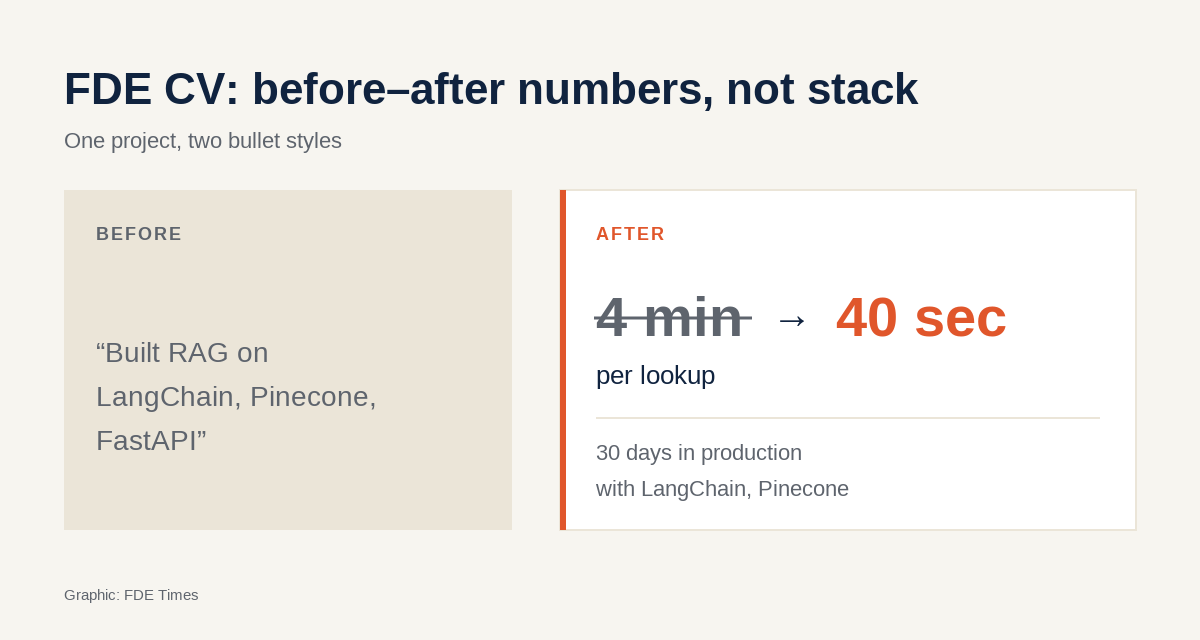
“Developed a RAG system with LangChain, Pinecone, FastAPI.”
Three tool names, no customer, no result. Now run it through Bock’s formula. X: the customer support team looks up shipping policies faster. Y: the developer sat with that team to collect real questions, built a retrieval pipeline, then wired it into the tool they use every day.
Z: say each lookup used to take 4 minutes and takes 40 seconds after deployment, measured over the first 30 days in production. Put the three parts together and the new bullet reads:
“Cut the customer support team’s shipping-policy lookup time from 4 minutes to 40 seconds per query (measured over the first 30 days in production) by gathering real questions from the team, building a retrieval pipeline and integrating it into the tool they use daily.”
Set the two lines side by side and the difference lies in the subject. The old line is about tools; the new one is about the customer’s operations team. The figures of 4 minutes, 40 seconds and 30 days are only illustrative; real numbers must come from the logs, tickets or reports of your own project.
LangChain and Pinecone can stay in the Skills section, provided you can explain why you chose them. They simply stop being the point of the line.
The number will be questioned
This is where many people go wrong, assuming that any added number makes a resume stronger. A number gets you the interview, but in the room it becomes a claim you have to defend. Paraform, a recruiting platform, states plainly that resumes do not tell the truth about FDE readiness, so interviewers will dig into every figure.
Suppose the interviewer reads the logistics bullet above and stops at “4 minutes.” The first question is almost certain to be: where was the baseline measured? Next: who confirmed the post-deployment number? And finally: of all this work, which part did you do yourself?
A model answer might go like this: “The baseline came from the support team’s ticketing tool logs for the two weeks before deployment.
The post-deployment number came from the same logs over the first 30 days in production, and the client’s team lead signed off on the report. I built the retrieval pipeline and the integration myself; a colleague handled the interface.”
That answer works because it contains exactly three things, the measurement source, the time period and the person who confirmed it, plus a clear boundary around the candidate’s own share. Christian & Timbers, an executive search firm, asks for precisely this: the bigger the claim, the more it needs a starting baseline and a measurement period.
The firm sets the bar one step higher. An FDE’s technical work should lead to a workflow running in production with measurable results, and companies should look for people who have deployed agentic AI several times, tied to documented financial outcomes. So the next question may well be: have you done this again at a second customer?
Line up the hiring criteria in a table and it becomes clear what each bullet has to answer, on paper and in the interview:
| Hiring side | What they check | What the bullet needs | What you must be ready to answer in the interview |
|---|---|---|---|
| Palantir | End-to-end project ownership | Which part you owned, how far you took it | Which obstacles you overcame yourself |
| Aced | Customer impact over complexity | One number per line | Every skill listed in the Skills section |
| Christian & Timbers | Production workflows, repeatable results | A system that went live and got past the demo stage | The starting baseline and the measurement period |
| Paraform | The resume is a weak signal | A story you can retell in detail | What you did, and in what order |
Those questions expose three common mistakes that make a polished bullet collapse in the interview.
Inflated percentages. A line such as “increased performance by 300%” sounds impressive, but a single “300% of what?” gives it away. A small, honest number is far safer.
Claiming the team’s result as your own. If you stumble when asked which part you did yourself, the number loses its value. The ownership Palantir looks for means seeing your own work through to the end, which is different from putting your name on a shared achievement.
Numbers without a baseline. “Reduced processing time by 70%” without saying from what, or over what period, cannot be verified, and the interviewer will treat the line as if it did not exist.
Where to start
A common obstacle for outsourcing developers is having no data because the client keeps it all. The fix lies in the work itself: on your next project, record the baseline in the first week, such as how long the current process takes, how often it fails and how many manual steps it needs. Without a before, there will be no Z later.
When reading an FDE job description, watch for phrases like “end-to-end,” “working directly with customers” and “production.” When they appear, order your bullets by customer outcome and leave the stack in the background. If the description is nothing but framework names, it may be a backend role under a different title.
Before sending the resume, reread every number and ask yourself the three questions above: where was it measured, who confirmed it, which part was yours. Drop any number that cannot answer all three, because an FDE recruiter will keep asking until it does.
The best FDE resumes read like a series of handover reports: which customer, what changed, how it was measured. As for the stack, the interviewer will ask about it once they already want to hear more.
Was this article useful?
Thanks for the feedback!
6 sources
- Forward Deployed Engineer Resume: Examples & Skills (2026) - Aced (formerly Exponent)
- Forward Deployed Engineer Resume: Examples & Skills (2026) - Aced (formerly Exponent)
- Palantir Technologies - Forward Deployed Software Engineer
- How to Hire Elite Forward Deployed Engineers · 2026-09-10
- How To Hire Your First Forward Deployed Engineer 2026 | Paraform · 2026-04-22
- Advice for Job-switchers and Newbies from Google's Hiring Chief · 2015-04-30