Data mesh or fabric depends on the client's org chart, not its stack
Mesh, fabric and a central warehouse each assume a different way of organising people; pick the wrong assumption and even a good stack stalls.
In brief
- Data mesh is first of all an organisational change: domains own their data, treat it as a product and share responsibility for governance.
- Data fabric is technology-led. It says nothing about who owns the data, and it can run alongside a mesh to support it.
- A central warehouse or hub still suits clients with one strong data team and weak domains. Its bottleneck is that same central team.
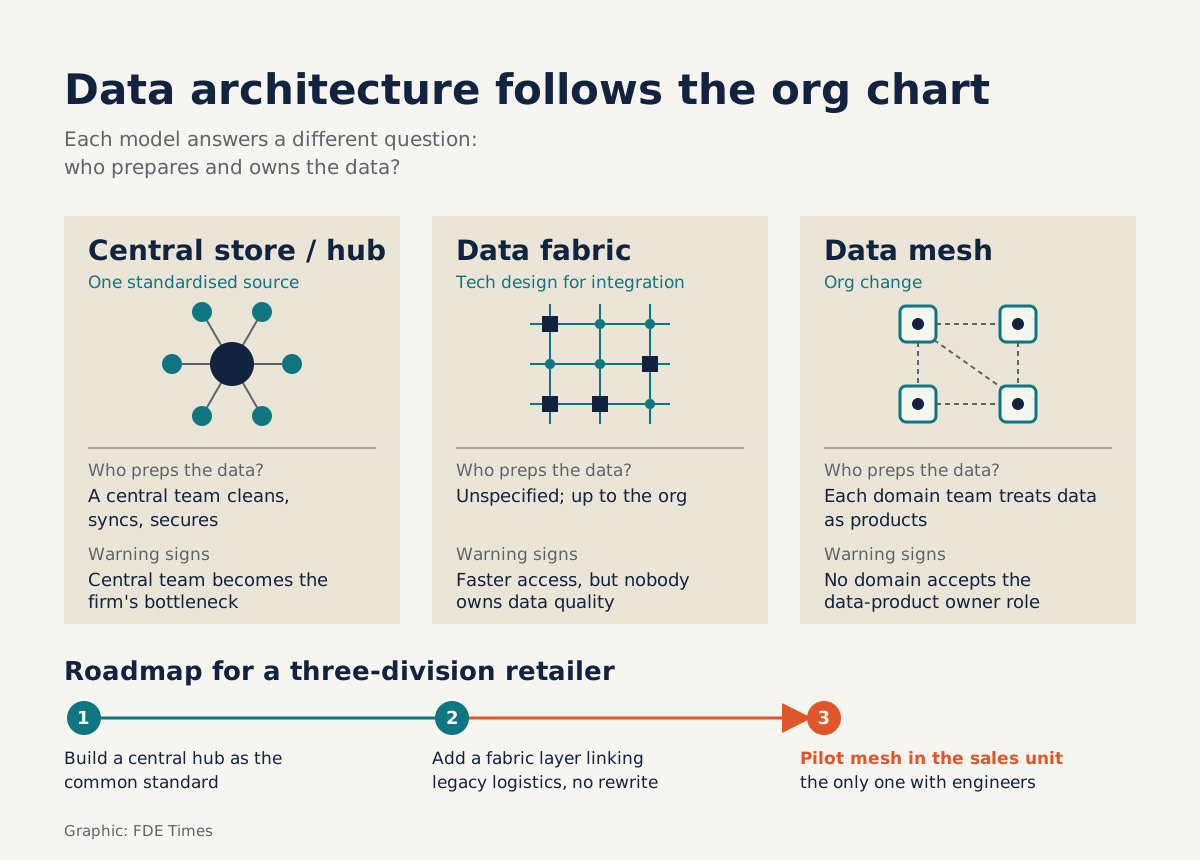
In the 2020 article that laid the foundations of data mesh, Dehghani did not start with a tool. The problem she described was about people: the centralised data warehouse model forces one central team to clean, harmonise and encode all the data that flows in.
That is a problem with the org chart, not the database. Yet when an FDE sits down in a meeting and the client asks “should we do data mesh?”, the answer usually turns to vendors, tools and cloud costs.
A better answer starts somewhere else. Mesh, fabric and a central warehouse are not three versions of the same thing. Each assumes the client’s company is organised in a different way, and if you pick the wrong assumption, even the best stack will get stuck.
Data mesh changes the structure before the tools
AWS defines data mesh as a decentralised data management model for hard data-sharing problems. The important detail is in the next sentence: responsibility for managing data is split by business function or domain rather than given to a single team.
Dehghani’s original article sets out four principles. First, data ownership and architecture are distributed by domain. Second, data is treated as a product. Third, there is a self-serve platform. Fourth, “federated computational governance”: governance is federated across the parties and enforced in code.
Now reread those four principles as the person who has to implement them. According to AWS, each domain team must apply product thinking to the datasets it provides, and governance becomes a responsibility shared across the organisation.
In other words, the sales team needs someone who understands the schema, commits to a level of quality and answers when another team complains about their data.
If the client does not have those people, mesh is just a nice diagram on a slide. That is why the first question about mesh is always “which domains are capable of owning their data?”, not “which catalogue tool should we use?”.
Mesh does not abolish the central team; it changes its job
Even when the domains are well staffed, mesh brings a burden that is easy to underestimate, and it sits inside the four principles. A self-serve platform does not build itself: someone has to build and run it for every domain to use.
Federated governance has a cost too. When responsibility is shared, the domains have to agree common standards and write them as code to enforce them, and every change to a standard means another round of coordination across several teams.
It follows that mesh moves the burden rather than removing it. The central team stops cleaning data for everyone else and starts building the platform and the rules. When you cost the work for a client, put this item on the table from the start.
Fabric does not ask who owns the data
IBM describes data fabric as an architecture that enables broad access to data, and stresses that it is not a piece of software but a design approach. That is worth remembering when a vendor offers to sell you a packaged “data fabric”.
James Serra, in a 2021 article, offers the most useful distinction for choosing an architecture by organisation: fabric is technology-centred, while mesh focuses on organisational change. He adds that fabric is mainly about integrating data technically, and does not specify who does that work or who owns the data.
Because it leaves ownership alone, fabric is often easier to get a client to agree to: you do not have to persuade any division head to take on new responsibilities. IBM also argues that fabric can run alongside mesh and often helps mesh work better, so the two are not mutually exclusive.
That same feature is also fabric’s limit. If the client’s real pain is that nobody is accountable for data quality, an integration layer, however sophisticated, only helps everyone reach bad data faster.
The central warehouse is not obsolete
Amid all the debate about decentralisation, it is easy to forget how much the centralised model solves. A data hub, as Wikipedia describes it, does more than store data the way a lake or an ordinary warehouse does. It also deduplicates, controls quality, handles security and provides a standardised set of query services.
For a company with a single five-person data team and other departments that mostly work in Excel, that is exactly what they need. The bottleneck Dehghani describes only really hurts once the number of domains and data sources exceeds what one central team can handle.
The table below sets the three models side by side according to the organisational question each answers. The “good fit when” row is a suggestion inferred from each model’s characteristics, not a hard rule.
| Question | Central warehouse / hub | Data fabric | Data mesh |
|---|---|---|---|
| Who prepares the data? | One central team cleans, harmonises and secures it | Not specified; up to the organisation | Each domain team, treating datasets as products |
| Where does governance sit? | Centralised | Does not specify who owns it | Shared across domains, enforced in code |
| Nature of the change | A single place serving standardised data | A technology design for integration and access | Organisational change |
| Good fit when | Few domains, one strong data team | Many scattered sources, no appetite to restructure | Domains have the people and capability to own data |
| Sign of a wrong choice | The central team becomes the whole company’s queue | Faster access, but nobody is accountable for quality | No one in the domain takes the data product owner role, or no one runs the self-serve platform |
Picture a retail chain
Suppose you are sent to a retail chain with three divisions: sales, logistics and marketing. Sales has its own engineering team and is used to building APIs. Logistics runs on a legacy system that only one person understands at table level. Marketing pulls its figures from manually exported files every week.
If you propose mesh for all three divisions from day one, you are asking logistics and marketing to apply product thinking to data when they have nobody to do it. The project will stall at the meeting about who owns what.
A more sensible path is to build a central hub as the common point of standardisation, and add a fabric-style integration layer to connect the legacy logistics system without rewriting it. Then pick sales as the first pilot domain for mesh, because it is the only place with people able to take on the responsibility.
This is not a compromise. It is consistent with IBM’s view that fabric and mesh can coexist, and it keeps every step tied to a real team on the org chart.
Which questions should open a discovery session?
With data, getting to know the client before you commit to an architecture should start with people, not infrastructure.
In your first session with a client, you can ask four questions. Who cleans the data today? How long does a request for new data wait in the queue? When a number is wrong, who gets the call? Does any domain already have its own engineers? These four answers are usually enough to tell you which column of the table above the client is in.
For developers looking to move into FDE work, this is a skill worth practising and showing. When you read a job description, look for phrases such as “work with stakeholders across business units” or “data ownership”. They signal that the job requires you to read an organisation, not just write pipelines.
One CV line, before and after
Take the retail chain project above. The before version, a common type: “Built data pipelines for a retail chain using tool X.” This line only shows that you can use a tool.
The after version: “Retail chain with three divisions, only sales had its own engineers: built a central hub, connected the legacy logistics system through an integration layer, piloted data ownership in the sales division.” The order is organisational context, architectural decision, reason.
A recruiter reading the second version will see that you understand what these three architectures are betting on. Tools change with every vendor season, but the question of who in the client’s company is willing to be accountable for the data always has to be answered first.
Was this article useful?
Thanks for the feedback!