AI Engineer, ML Engineer and FDE: same toolkit, different accountability
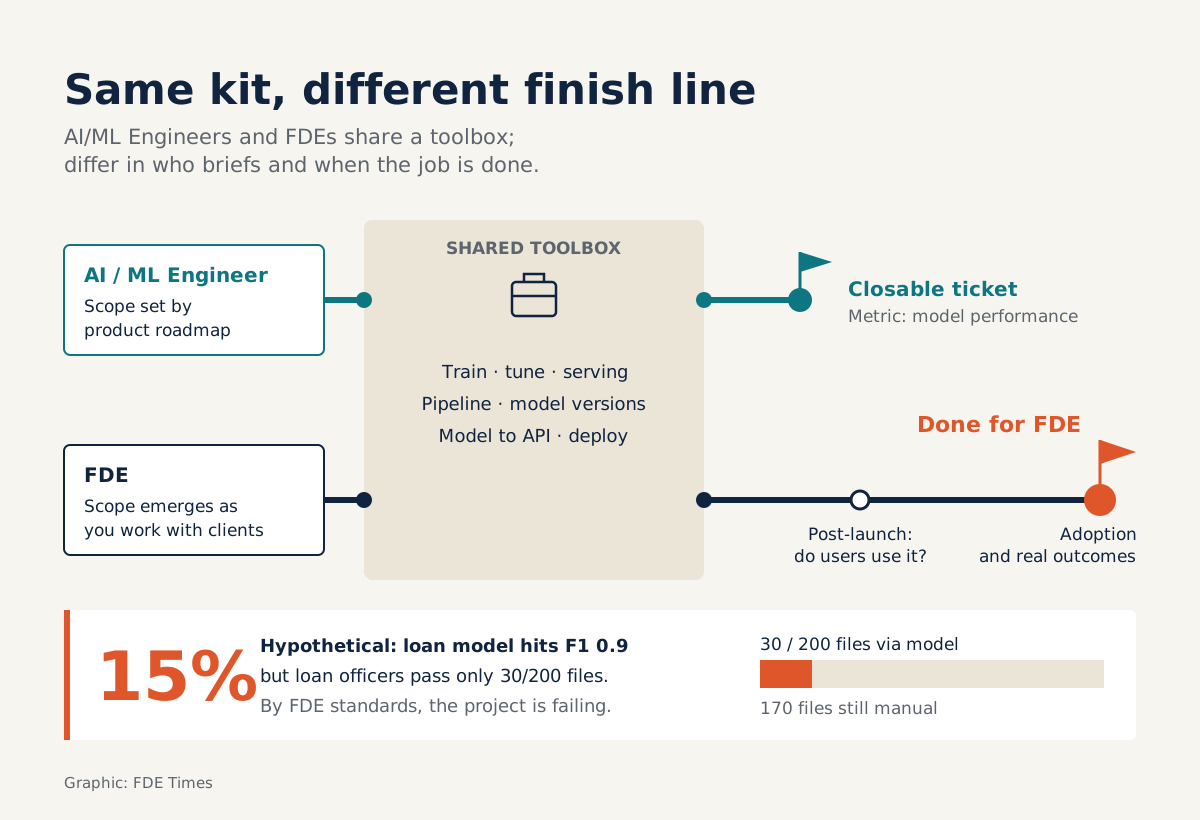
Employers use these job titles interchangeably, and AI and ML Engineers work with the same tools. What sets the FDE apart is who defines the problem and what counts as done.
In brief
- AI Engineers and ML Engineers share frameworks, pipelines, versioning and monitoring. Without these skills, an FDE would struggle to deploy anything at a customer site.
- The difference is accountability. AI and ML Engineers build for internal customers. FDEs work alongside a specific customer and work out the scope of the problem themselves.
- For an FDE, a good model that nobody uses still counts as a failure, and the FDE's responsibility continues after launch.
Open Workable’s AI Engineer job description template and you will find a familiar line: proficiency in TensorFlow or PyTorch. ML roles ask for exactly the same tools.
Simplilearn goes further and admits that employers often use these titles interchangeably.
If the tools are the same and the titles are used loosely, the obvious question is how AI Engineers, ML Engineers and Forward Deployed Engineers actually differ. The answer is not in the tech stack. It is in who you answer to, and when your work counts as done.
For a developer who wants to move into FDE work, this distinction shapes how you prepare. If you think of an FDE as “a better AI Engineer”, you will spend your time learning more frameworks. What is usually missing is something else: the habit of working with real users and measuring results by how they use the product.
The skill sets almost completely overlap
The overlap is bigger than many people think. Descriptions of the AI Engineer role, from TechTarget to Codecademy, largely agree. This is the person who develops and trains AI systems, and the job calls for the skills of both a software engineer and a data scientist, plus data engineering.
The work also runs all the way to production: building deployment pipelines, versioning models, monitoring performance in real time, managing data flows and infrastructure, and turning models into APIs that other applications can call.
The ML Engineer sits on the same axis, differing only in depth. Coursera places ML engineers within the data science team, as the people who research, build and design ML systems. Simplilearn draws the line this way: ML engineers usually go deeper into training, optimising and serving models, while AI engineers cover a broader range of applications.
One goes deep, the other goes wide, but they reach into the same toolbox.
It follows that FDEs need that toolbox too. It is hard to picture anyone deploying an AI system in a customer’s environment without knowing how to build pipelines, manage versions and monitor models. So the difference must lie elsewhere.
Who sets the problem?
Futurense, a career guidance site, identifies the clearest structural difference. For an AI engineer, accountability points inward to the company, and the product roadmap decides the scope of the problem. For an FDE, the scope is discovered gradually by working with the customer.
FDE Academy, a blog about the FDE profession, makes the same point from the ML Engineer side. An ML engineer’s customers are inside the company. An FDE works right alongside a specific customer.
That sounds like a question of org charts, but it changes the nature of the technical work. When the problem comes from a roadmap, someone has already done the hardest part for you: deciding which problem to solve. When you have to find the scope yourself at the customer’s site, customer discovery becomes part of the engineering. Pick the wrong problem and even the most elegant pipeline is worthless.
Change the metric and “done” changes too
Futurense writes that an FDE’s success is measured by real-world outcomes, not just model performance. FDE Academy puts it more bluntly: a technically excellent model that goes unused is still a failure by FDE standards. FDEs are measured by user adoption and business results, and they remain accountable after launch.
Take a hypothetical case. A bank needs to classify loan applications, 200 of them a day. The engineering team trains a model that reaches an F1 of 0.9 on the test set, packages it as an API and deploys it. For a team working from an internal roadmap, the ticket could close here.
Now suppose the loan officers run only 30 of the 200 applications through the model. The output does not match the form they use, so they fall back on doing it by hand because it is quicker. The usage rate is 15%. The F1 score has not changed and the model is still good, but by FDE standards the project is failing.
So the FDE’s next step is not to retrain the model. The FDE has to sit with the loan officers, see at which step they bypass the model, and then fix the output format or the integration point. That is still engineering work. The difference is that the problem is defined by the users’ workflow, not by the dataset.
Put AI Engineers and ML Engineers in one column, since both serve internal customers, and the boundary with the FDE becomes much clearer than it is from reading each definition on its own. The success-metric row in the left column is an inference from the way FDE descriptions set themselves against “model performance alone”:
| Criterion | AI Engineer / ML Engineer | FDE |
|---|---|---|
| Technical focus | ML: training, optimising, serving; AI: building, testing, deploying, turning models into APIs | The same foundation, applied to getting the system running at the customer |
| Customer | Internal, usually in the data science or product team | A specific external customer, worked with side by side |
| Who sets the scope | The product roadmap | Discovered gradually while working with the customer |
| Success metric | Leans towards model performance | Usage and real-world outcomes |
| After launch | The ticket can close | Still accountable |
Read job descriptions for accountability, not titles
Because the titles are used interchangeably, the title on a job description tells you almost nothing. Instead, look for answers to the three questions in the table above. Who is the customer? Who sets the scope? How is success measured?
A job description titled “AI Engineer” that mentions working on customer sites, interviewing users and usage metrics is really closer to an FDE role. Conversely, one titled “Forward Deployed” that talks only about model benchmarks and the internal roadmap may just be an ML Engineer role with a new label.
Pay attention to the verbs as well. “Improve accuracy” points towards the model. “Ensure the customer can operate it” points towards outcomes.
How to prepare
The foundation you already have still counts. If you have built pipelines, versioned models or turned models into APIs, you already have the part common to all three roles. Don’t drop PyTorch to chase generic soft skills.
What you need to add is two specific habits. The first is finding the scope of the problem yourself: before writing code, talk to the people who will use the product and write down how they work today. The second is measuring usage after deployment, rather than stopping at offline metrics.
If you have worked on outsourced projects or directly with overseas clients, you may already have material for both without having called it by the right name. On your CV, replace a line like “trained a classification model reaching F1 0.9” with one that describes who used it, which workflow changed and what you fixed after launch.
The second line speaks the language FDE Academy uses to measure FDEs: user adoption and business results.
In interviews, turn the question around: “If the model works well but the customer doesn’t use it, whose problem is that?” The answer will tell you what the role really is, more clearly than any title on the job description.
Was this article useful?
Thanks for the feedback!
8 sources
- AI Engineers: What they do and how to become one · 2024-10-10
- What is an ML Engineer? · 2026-07-21
- AI Engineer Job Description · 2024-04-26
- What does an AI Engineer do? · 2025-05-05
- How To Become an AI Engineer (Plus Job Duties and Skills) · 2026-06-16
- How to Become an AI Engineer: Duties, Skills, and Salary · 2026-09-03
- Forward Deployed AI Engineer or AI Engineer Role: The Structural Difference That Defines Your Career Path · 2026-06-15
- Forward Deployed Engineer vs Machine Learning Engineer · 2026-07-18