Why hundreds of LeetCode hours buy little in an FDE interview
At Distyl AI and Databricks the heaviest round is 45 to 60 minutes with an interviewer playing a client who deliberately withholds information.
In brief
- According to one interview guide, Cognition has dropped coding and system design in favor of live client simulations. Distyl AI still tests coding, while Databricks rarely sets classic algorithm problems.
- The decomposition round, pioneered by Palantir, is deliberately vague. Candidates are graded on their questions, how they break the problem down and how well they settle scope.
- The most common mistake is proposing a solution too early. Career switchers should practice clarifying requirements as methodically as they once practiced LeetCode.
According to an interview guide from Exponent/aced.io, Cognition’s hiring process for forward deployed engineers drops two rounds that engineers aiming for big tech often spend a year preparing for: coding and system design. The final rounds are live client simulations instead, such as pitching a proposal to an executive or a call to work through a case.
Many will read this as “FDEs don’t need to be strong coders”. That reading is wrong. At Distyl AI and Databricks the coding round survives, but it has changed in character and is no longer the main filter.
The round that carries the most weight is the one in which the interviewer plays the client and hands over a deliberately incomplete brief. If you have put hundreds of hours into LeetCode to prepare for a move into FDE work, those hours will earn you fewer points than you expect.
The good news is that the skill graded most closely can be trained. Few people train it on purpose.
Cognition is the exception, not the rule
Distyl AI still has a coding round. An analysis on techinterview.org of how the company hires FDEs advises candidates to prepare Python and notes that the problems will be close to day-to-day work. The coding round there checks whether you can do the job of an engineer sitting inside a client company; it does not test algorithms.
Databricks is heading the same way. According to the Exponent/aced.io guide, the graph, algorithm and concurrency problems familiar from Databricks’ software engineer interviews rarely appear in the FDE loop. In exchange, the process adds a separate decomposition interview.
A post on the AI Engineering Insider Substack sums up the trend in a few words, “less LeetCode, more practical engineering”, with coding problems such as parsing a messy CSV file or writing a rate limiter.
Educative’s FDE course lists client simulation as one of four round types that appear consistently in FDE hiring, with a process that typically runs 4 to 6 rounds over 3 to 5 weeks.
Cognition dropping code, then, is the most extreme case of a broader trend. Code is still tested to see whether you meet the bar, but what decides whether you get the offer happens in a different round.
The real filter often has no code at all
The Substack post calls the decomposition round the main filter outright. The candidate receives an ambiguous business problem with no clear spec, works on it for 45 to 60 minutes, and there is no single right answer.
According to techinterview.org, the round usually involves no code: a mock client hands you a fuzzy problem and waits to see how you handle it.
The format is not new. According to an aced.io guide to decomposition questions, Palantir invented and popularized it, and many companies hiring FDEs now run their own version.
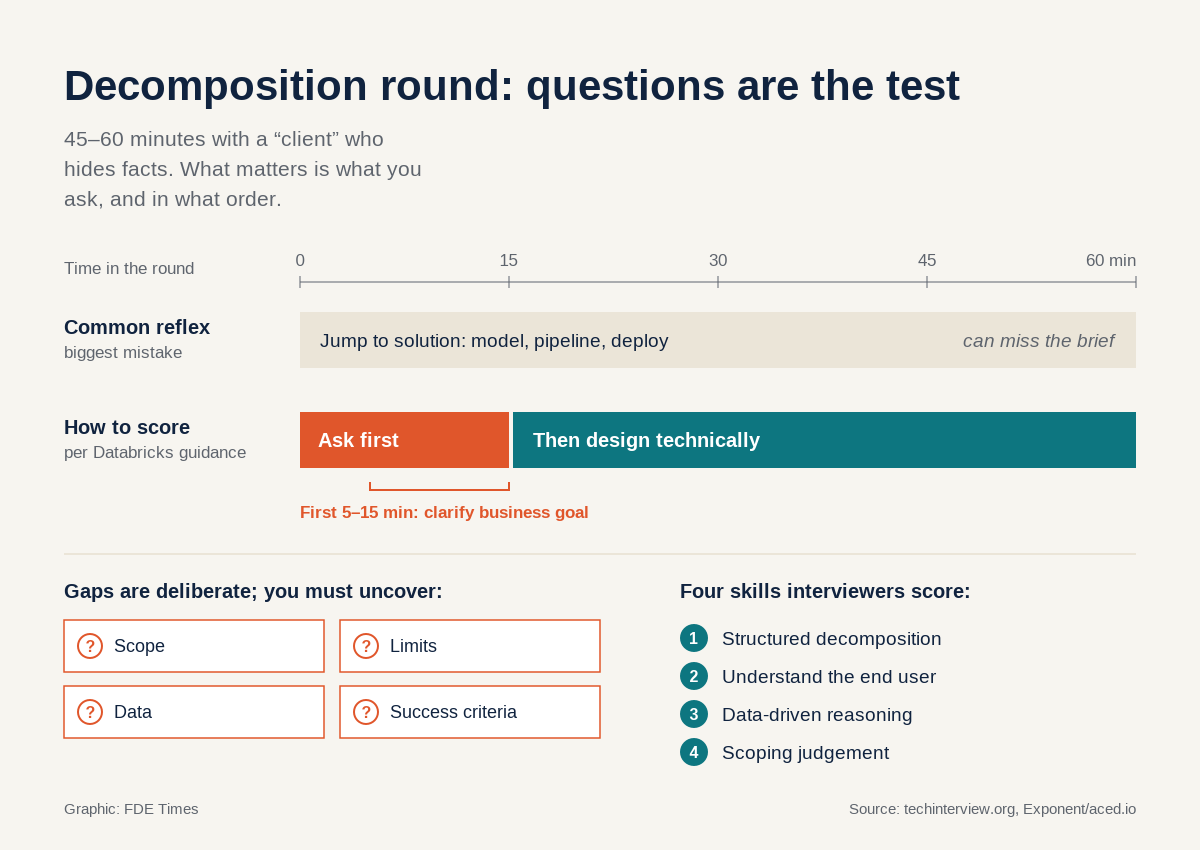
What makes the round hard is that the brief is incomplete by design. The aced.io guide states plainly that uncovering the missing scope, constraints, data and success criteria is itself part of what gets graded.
At Distyl, the interviewer playing the client will not volunteer extra detail, so candidates are graded on the questions they ask.
What do interviewers grade when there is no code?
According to techinterview.org, interviewers grade four skills: structured problem decomposition, empathy for the end user, data-driven reasoning and scope judgment. None of them shows up in a function that runs correctly. All of them show up in what you ask and in what order.
The most common mistake, according to the same source, is offering a solution as soon as the problem has been stated, before asking who the user is and what “done” means. It is a natural reflex for a good engineer. Years of being rewarded for solving fast teach you to assume the brief is correct and complete.
Take a made-up case. The “client” is a logistics company that says it wants to use AI to cut the number of late deliveries. An inexperienced candidate goes straight to a delivery-time prediction model, a data pipeline and a deployment plan. The answer sounds very technical, but it may be solving the wrong problem.
A strong candidate asks first. Who suffers when an order is late: the end customer, the driver or the customer service team? What counts as late? Where does the trip data live, and how clean is it? Three months from now, which number would show the project had worked?
The right answer might need no AI at all, just an early warning sent to the dispatcher.
The guidance for Databricks’ decomposition round gives a concrete figure: spend the first 5 to 15 minutes clarifying the business goal, and only then move to technical design. Skipping that questioning step is what techinterview.org calls the most common mistake.
Three companies, three weightings
Put the three processes side by side and it is clear the companies are not dropping technical skill. They are shifting the weight toward judgment.
| Cognition | Distyl AI | Databricks | |
|---|---|---|---|
| Coding round | Reportedly drops both coding and system design | Still there, in Python, close to day-to-day work | Rarely includes graph, algorithm or concurrency problems |
| Client-centered round | Final rounds are live client simulations: an executive pitch, a case-analysis call | Decomposition, with the interviewer playing the client, treated as a key round | A separate decomposition session, starting from a business goal |
| What to prepare | Presenting and handling situations in front of a client | Asking questions, because the interviewer will not volunteer detail | Spend the first 5 to 15 minutes clarifying the goal before designing |
All three put the candidate in front of a client who does not yet know exactly what they need. The only difference is how much coding they also want to test.
The design has a logic to it. An FDE who writes code a little slower than colleagues can still deliver a project. An FDE who builds a beautiful system that solves the wrong problem sinks the project, and the failure happens in full view of the client. The interview is aimed at the second kind of risk.
What should career switchers practice?
For many developers in Vietnam, especially those in outsourcing, requirements arrive through a business analyst or project manager as tickets that have already been written. You may be very good at turning a spec into code, yet rarely have to ask the client whether the spec is right. The decomposition round tests the skill you use least.
That skill can be trained, and in the way you once trained for LeetCode: with problems, a timer and someone grading. Ask a colleague to play the client, tell them to answer only when asked, then score yourself against the four criteria above. After five or six sessions you will see how strong your urge to propose a solution early really is.
Do not abandon code entirely: Distyl still runs a Python coding round, and accounts of FDE interviews suggest coding problems are now practical engineering rather than LeetCode. Change how you practice instead: fewer algorithm puzzles, more tasks like parsing dirty data, writing a rate limiter or calling an API with retries, and write them as code that will run at a client site.
When reading a job description, look for words such as “decomposition”, “customer simulation” or “case study”. They tell you which round will carry weight. On your CV, instead of “developed module X in Python”, describe a time when the initial requirement was vague: what you asked, how the scope was settled and what the outcome was.
An FDE recruiter reading that line will see the very skill their interview is looking for.
The coding round has not disappeared, but now it only shows whether you meet the bar to continue. To get the offer, you need to perform well in the conversation with a mock client who does not know what they need.
Was this article useful?
Thanks for the feedback!
7 sources
- Cognition Forward Deployed Engineer Interview (Exponent/aced.io guide)
- What the forward deployed engineer interview really tests · 2026-08-05
- How Distyl AI hires forward deployed engineers · 2026-08-05
- Databricks Forward Deployed Engineer Interview (Exponent/aced.io guide)
- How to Answer Decomposition Interview Questions: The Definitive Guide (2026)
- The four interview rounds (Educative, Forward Deployed Engineer course)
- Cracking the Forward Deployed AI Engineer Interview · 2026-07-21