Adobe hires FDEs for video, backend and mobile: a bet on integration at the customer
Job descriptions that look unrelated show Adobe placing engineers at the exact point where its products must fit into customers' systems.

In brief
- A July posting calls the FDE team in Digital Experience newly formed; a June video posting says the role is neither pre-sales nor consulting.
- The video, backend and mobile tracks demand very different skills, but all sit where the product touches customer systems.
- Candidates should pick one junction, try the work and produce a number, rather than prepare for FDE in general.
“We are not pre-sales engineers. We are not consultants.” Adobe states both sentences outright in its posting for a Forward Deployed Creative Technologist in video, dated 3 June 2026. For a role that sits beside the customer, that is a deliberate denial.
Postings dated 28 July extend the hiring to backend, principal and management levels, and call the FDE team in the Digital Experience division “newly formed”. On 24 September another posting sought people with deep iOS or Android skills to work on the Mobile SDK for Adobe’s largest enterprise customers.
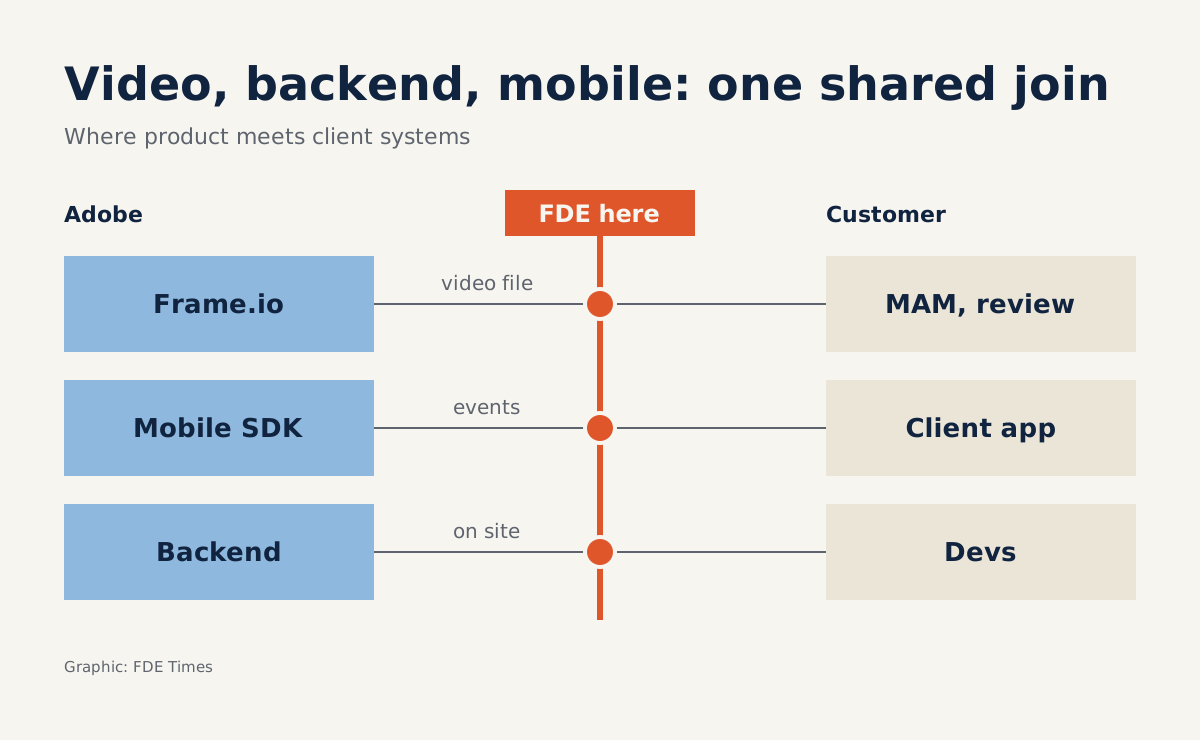
At a glance, these are entirely different jobs. Yet they share one position: the place where Adobe’s product touches the customer’s systems. If you are aiming for FDE work, remember this: do not prepare for a job title, prepare for a junction.
The products are mature, so why put people beside the customer?
The question is worth asking of a software company as long-established as Adobe. The Forward Deployment Engineer posting gives the aim as bridging core products and customers’ real needs, with engineers working on site or remotely.
The notable word is “between”. None of the descriptions cited here talks about rebuilding Premiere or rewriting Frame.io. They describe routes that cross several tools and systems, so the first question to ask is which stretch Adobe controls and which belongs to the customer.
A reasonable reading, then, is that the more mature the product, the further the hard part moves to the edge. A good feature can still be useless if its output cannot enter the approval process, data store or app the customer has long relied on.
A video campaign shows where the gap lies
The video posting is very specific: how creative teams hand work through Premiere, After Effects and Frame.io on its way to a MAM and the review-and-approval stage. Candidates must also be proficient in Firefly Services and Workflow Builder. That is a map of the work, not just a list of tools.
Imagine a marketing team pushing 200 video variants through that chain in every campaign. Suppose 10% lose metadata on the way into the MAM, such as the campaign name or usage rights. That leaves 20 variants to track down by hand; at 15 minutes each, that is 300 minutes, or 5 hours per campaign.
A variant-generation demo can look superb while those 5 hours remain untouched. Customers will not see the value in the model. They will see it in whether reviewers still have to fix things by hand.
In that position, do not start with the workflow. Walk the chain with a real asset, record which data field drops at which stage, measure the minutes of manual repair, and only then automate the most time-consuming stage.
Is mobile an extension of Firefly?
It is easy to over-infer here. In March 2024 Adobe brought Firefly to the Express app in beta for Android and iOS, so a mobile FDE post sounds like the next chapter in the story of AI on the phone.
But the four SDK areas listed in the posting do not mention Firefly: personalization, engagement, analytics, messaging. The role revolves around integrating the Mobile SDK for large enterprise customers, whereas Express is Adobe’s own app.
The mobile role is better read in the same way as the video track: an engineer standing where Adobe’s product attaches to the customer’s systems, except that what passes through is events rather than video files.
Suppose a customer’s app resends purchase events on retry, so analytics reports 1,200 orders while the backend records 1,000. That 20% discrepancy is enough to make the customer’s team doubt every personalization report downstream.
The first job in that situation is not tuning campaigns. Reconcile the events against the customer’s system of record, fix the deduplication, and only then return to messaging or personalization.
Four different profiles, one hiring logic
Read together, the postings show that Adobe is not looking for an all-purpose “FDE”. The last column of the table is a practice suggestion for you, not part of the hiring requirements.
| Track | Junction | Key requirements | How to prove yourself |
|---|---|---|---|
| Video, Creative | Premiere, After Effects, Frame.io through to the MAM and approval stage | Firefly Services, Workflow Builder | Automate one handoff stage and measure the minutes of manual repair before and after |
| Backend | On site with the engineering teams of large customers | Large-scale distributed systems | Diagnose a retry fault or bottleneck in a system you did not write |
| Mobile | Mobile SDK in enterprise customers’ environments | iOS (Swift/Objective-C) or Android (Kotlin/Java) | Integrate an SDK into a sample app and reconcile events against the backend |
| Creative AI management | Between the FDE team and customers | 50/50: code, demos; hiring, coaching | Lead a small project while still writing the code and giving the demo yourself |
The table also explains why the denial at the top of this article is more than rhetoric. Someone who can only present a product would struggle in any row: the backend posting describes hands-on technical work and on-site collaboration with the engineering teams of big names, which means the person across from you can read code too.
The measure is whether the customer comes back
The Principal FDE, Creative AI posting settles the criterion in one blunt sentence: “The only measure that matters here: do customers get real value, and do they come back for more?” That sentence is both a commitment and a filter for candidates.
The measure fits how Adobe describes the manager: “50/50, player-coach”, half coding and demos for customers, half hiring and coaching. A manager who still gives demos will find it hard to talk about customer value in generalities.
The feedback loop into the product also appears in the Engineering Manager posting for EMEA: the team shapes the roadmap with Adobe’s Product, Engineering and Research groups. That is the strongest reason for a long-established company to need FDEs: what the team learns at customers must become changes in the product.
But keep some scepticism. A job posting says only what a company wants, not what has happened. In an interview, ask: what is the most recent example of a product change that originated with an FDE, and who measures whether customers come back?
How new is “newly formed”?
One detail does not quite fit. The 28 July posting calls the team newly formed, but the EMEA posting, removed since 30 January 2026, already mentioned a team of “AI native” engineers, with the manager reporting to a Global Director of FDE. So a global management structure for FDE was in place before July.
These may be two different groups, or “new” may refer to a phase of reorganisation; the available facts are not enough to conclude. For candidates, the practical question is simpler: which team are you joining, who do you report to, and does a playbook exist or will you be the one writing it?
Either answer can be good. A team still taking shape gives you more power to define the job, in exchange for less process to lean on. Just do not accept the job without knowing which case you are in.
What to bring to your application
The advice from these descriptions that applies at any company is to choose one junction and see it through. An Android engineer might start with an analytics SDK, a backend engineer with a distributed fault, someone close to video editing with the video handoff chain.
In your CV, replace “experience working with customers” with a structured line: whose system, which junction broke, the numbers before and after. “Reduced event discrepancy between SDK and backend from 20% to under 1%” is the kind of sentence an FDE manager can probe straight away, provided the number is yours.
When reading a posting, look for three things: named customer systems, specific languages required, and how results are measured. A posting missing all three has not told you what the job really is, so ask clearly before applying.
Adobe may have spent many years making its products good. Now it is hiring people to take responsibility for a much shorter stretch of road, one that does not appear on the product’s map: from the export button to the moment the customer comes back a second time.
Was this article useful?
Thanks for the feedback!
8 sources
- Senior Forward Deployed Engineer (Backend) – Frame.io / Adobe (Accel jobs board) · 2026-07-28
- Forward Deployment Engineer – Frame.io / Adobe (Accel jobs board) · 2026-07-28
- Forward Deployed Creative Technologist, Video – Frame.io / Adobe (Accel jobs board) · 2026-06-03
- Principal Forward Deployed Engineer, Creative AI – Frame.io / Adobe (Accel jobs board) · 2026-07-28
- Manager, Forward Deployment Engineering, Creative AI – Frame.io / Adobe (Accel jobs board) · 2026-07-28
- Engineering Manager, Forward Deployed Engineering - EMEA (Built In)
- Forward Deployed Engineer, San Jose – Adobe (Talentify) · 2026-09-24
- New Adobe Express Mobile App Brings Firefly Generative AI Models Directly into Mobile Workflows · 2024-03-07