Palantir's FDSE job posting never once mentions Foundry
Palantir hires people who quickly grasp a client's biggest problems, and inside Foundry the layer to learn first is the Ontology, a digital twin of the organization.
In brief
- Palantir defines Foundry as an operating system for enterprise data, built from datasets, an Ontology and applications.
- The Ontology, a digital twin of the organization, is the layer an FDE must understand most deeply because it turns raw data into business concepts.
- Palantir's FDSE job posting does not mention Foundry; it talks about client problems, because the platform is a tool and the skill being hired is understanding the problem.
Palantir’s official job posting for a Forward Deployed Software Engineer does not mention Foundry once. FDE Academy, a training site unaffiliated with Palantir, argues the opposite emphasis: the FDE role exists precisely because Foundry and its predecessor, Gotham, needed engineers stationed with the client.
The two positions are less contradictory than they look. FDE Academy treats Foundry as the place where most FDE work happens. Palantir’s posting describes someone who works directly with clients to quickly understand their biggest problems, with no mention of mastering a particular tool.
So the way into Foundry is through the problem it was built to solve. For anyone aiming at an FDE role, three things matter: what Foundry is made of, which layer an FDE touches, and what to learn before getting an account.
Three layers, and the middle one is where the value sits
Palantir’s official documentation, updated on July 2, 2026, defines Foundry as an operating system for enterprise data that allows data to be integrated from any source. The 10-K for fiscal year 2024 uses the same language: Foundry creates a central operating system for an organization’s data.
“Operating system” is a deliberate comparison. It implies something every other application runs on top of, rather than a place where data is stored.
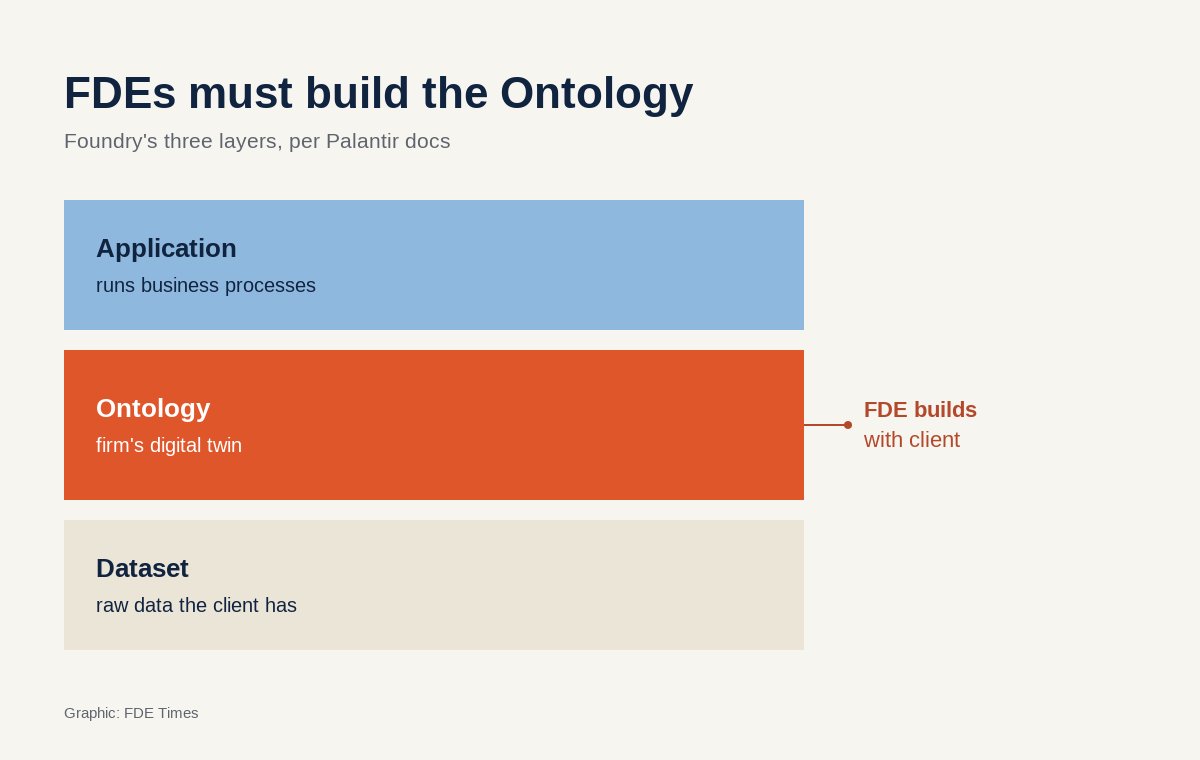
The architecture is described as two data layers plus an application layer. Raw data lives in datasets. Above them, the Ontology maps datasets and models to real-world concepts, and the Ontology documentation calls this layer a digital twin of the organization.
At the top sit applications, which draw on both layers to run business workflows. Applications do more than read the Ontology; they consume both datasets and the Ontology. The middle layer does not replace raw data. It adds a layer of meaning that raw data lacks.
FDE Academy calls the Ontology the thing that truly separates Foundry from an ordinary data platform. That is a third party’s assessment; Palantir’s documentation only describes the Ontology as a digital twin of the organization and draws no comparison with other platforms.
A day on a deployment
Take a hypothetical factory in Binh Duong province, Vietnam, whose machine data lives in three places: an ERP system, manufacturing execution software, and a maintenance team’s Excel spreadsheet. At the dataset layer, the first job is to bring all three sources into Foundry, exactly as the promise to “integrate data from any source” suggests.
At the Ontology layer, you declare the factory’s real concepts: Machine, Production Shift, Incident. A Machine has a serial number and a location; an Incident links to one Machine and one Shift. At the application layer, the maintenance team opens a screen showing which machines have incidents and which shifts are affected, and acts on it directly.
The hard part has nothing to do with which button to press. It is deciding what “Incident” means: does a technician call it an incident when a machine stops for five minutes, or thirty? That is a customer discovery question, and no documentation will answer it for you.
That may be why Palantir’s job posting talks about client problems rather than the platform.
The same posting says FDSEs work in small teams with minimal supervision and own end-to-end execution of high-stakes projects. In the factory example, “end-to-end” means one person touches all three layers, from dirty datasets to the screen workers use.
Foundry does not stand alone
Foundry is one of Palantir’s four platforms. AIP, the generative AI layer, is packaged with Foundry, Gotham and Apollo; Apollo is the control layer for delivery. For an FDE, Foundry is where modeling and workflow building happen, while shipping software into client environments and wiring AI into workflows belong to other layers of the same suite.
Palantir’s ambitions also extend beyond any single client. The 10-K says Foundry is becoming the central operating system not only for individual organizations but for entire industries. If so, one client’s Ontology is a piece of a larger picture rather than a finished product, and the FDE is the person who builds each piece.
What to learn before you get an account
Foundry is hard to practice the way you would practice an open-source library, but the skill underneath it can be practiced right away. Take a system you have worked on and write out its business objects, properties, relationships and actions, as if you were declaring an Ontology.
If you cannot explain to someone outside the industry why you chose one object over another, you are not finished.
On your CV, avoid writing “built ETL pipelines.” Describe a time you pulled data from several sources into a model that non-technical people used to make decisions. In job descriptions, look for phrases such as “own end-to-end,” “small teams” and “minimal supervision”: that is the language of Palantir’s FDSE posting.
The posting does not mention Foundry or its layers. But anyone who owns a project end to end should be able to work across all three layers, rather than excel at only one.
Foundry may be where the work happens. What Palantir pays for is someone who can turn a messy factory into a digital twin its workers trust; the platform simply holds and runs that twin.
Was this article useful?
Thanks for the feedback!