Kong is hiring FDEs to pull customers off legacy API platforms
The job ad also lists the skills an engineer needs before putting an API gateway in front of a client's legacy systems.
In brief
- Kong Gateway is an open-source reverse proxy under the Apache 2.0 license, extended with plugins and configured declaratively with decK.
- Once clients call through the gateway, you have one place to make changes without touching the client's legacy backend.
- Kong itself is hiring FDEs to move customers off legacy API management platforms, and asks for 8 or more years of experience.
Kong reposted its Forward Deployed Engineer opening on November 20, 2026, and one of the duties is spelled out plainly: lead projects that migrate customers from legacy API management platforms to Kong. The person hired must also build their own tooling to do the migrations.
The ad calls this a strategic, customer-facing engineering role within Professional Services. Kong’s FDEs work with enterprise customers to design, build and deploy solutions based on Kong, across cloud, hybrid and on-premise environments. The listing on Built In adds that the role covers AI infrastructure as well as API infrastructure.
The lesson in this ad holds even if you have no plans to apply to Kong. If your client has a backend nobody wants to touch, putting an API gateway in front of it is worth considering. Kong is a good one to learn on because its code is open and its documentation public.
An API gateway is a reverse proxy
The official documentation describes Kong Gateway as a lightweight, fast and flexible cloud-native API gateway. The same documentation defines an API gateway as a reverse proxy that lets you manage, configure and route requests to your APIs.
Mashape open-sourced the project in 2015, according to Marco Palladino, Kong’s CTO and co-founder. The GitHub repository uses the Apache 2.0 license.
Two features make Kong a good fit for work at a client site. The first is plugins: the GitHub README says plugins add advanced functionality to the Gateway, and the Plugin Hub lists plugins from both the community and Kong Inc. The second is decK, a tool that manages configuration through declarative state files.
Kong’s documentation never mentions “legacy systems”. That use follows from the reverse-proxy role itself. Clients call the gateway, the gateway forwards requests to the backend, and so every change can be made in this middle layer without editing the code behind it.
A minimal example: putting a legacy orders service behind the gateway
Take a hypothetical client with an orders service running at orders-legacy.internal:8080. Its author left long ago, and nobody wants to touch it.
Your job is to route clients through Kong so there is somewhere to add functionality later. The decK state file might look like this, though you should check the syntax against the decK documentation for the version you are running:
_format_version: "3.0"
services:
  - name: orders-legacy
    url: http://orders-legacy.internal:8080
    routes:
      - name: orders-route
        paths:
          - /orders
The file declares two things. The service points to the legacy backend. The route says that requests with the path /orders go to that service. You sync the file to the gateway with decK, switch clients to the gateway’s address, and the legacy backend keeps running exactly as before.
The bigger payoff comes in the steps that follow. The file lives in git, so every routing change goes through a pull request and can be applied by CI/CD.
This is the automation work Kong’s job ad asks for. When the client needs new functionality, you attach a plugin at the gateway. When the orders service can finally be rewritten, you change the url and clients change nothing.
The gateway cannot fix what sits behind it
This is a limit to make clear to the client from the start. If the legacy backend is slow or error-prone, putting a gateway in front does not make it healthier. Requests take an extra hop, and the client gains one more production component to operate and monitor.
The configuration file also becomes an asset that needs care. One misdeclared route in decK can cut off a whole group of clients, so reviewing and testing the file deserves the same rigor as code.
Moving off a legacy API management platform is harder still, because every policy running on that platform has to be mapped to the new configuration. That Kong writes into the job ad that its FDEs must build migration tooling suggests this mapping is hard to do by hand at enterprise scale.
So at the client site, the first task should be an inventory. List every endpoint, who calls it and who owns it. Only with that list in hand will you know which routes to move first and where the risk lies.
What Kong looks for, and what to learn first
Kong’s ad asks for 8 or more years of experience and a broad set of skills: Kubernetes; AWS, Azure or GCP; automation and CI/CD; plus Python, Go, Java, JavaScript or Lua.
That is a senior profile. If you have been working for two or three years, treat it as a map of the gaps to fill rather than a bar that rules you out.
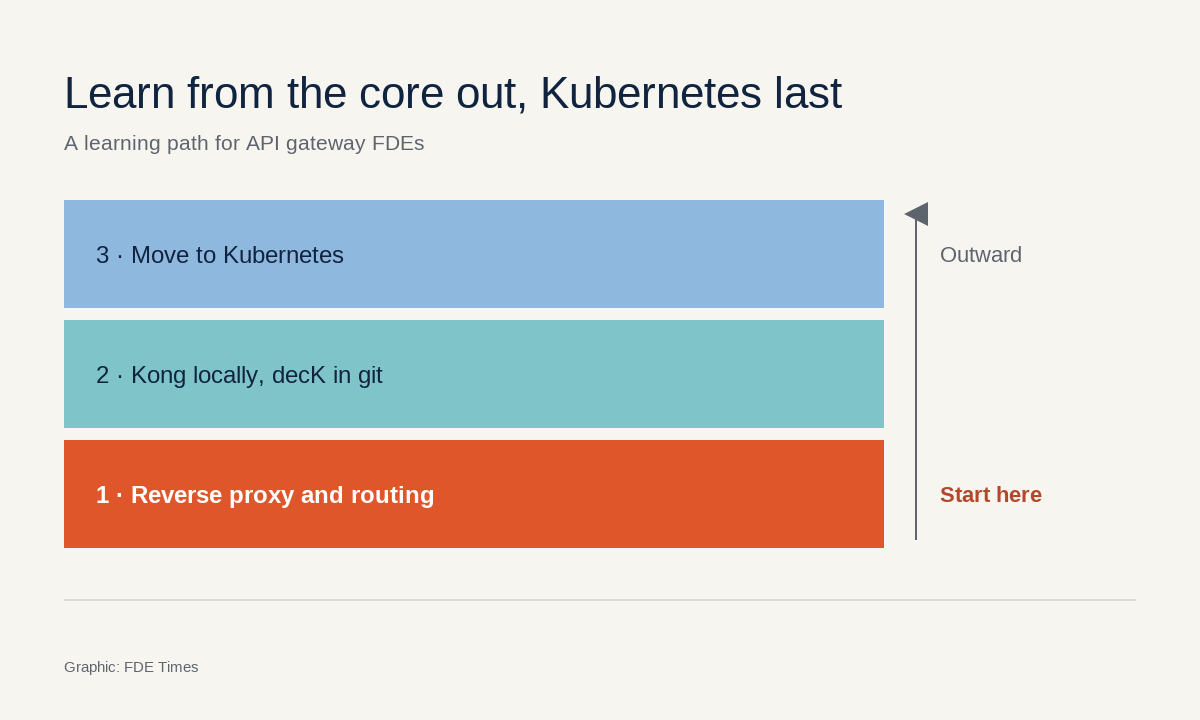
A sensible order is to work from the core outward. Start with reverse proxies and routing. Then run Kong locally and manage its configuration with decK in git.
Finally, move it onto Kubernetes. When you read other companies’ FDE job ads, look for similar terms to anticipate the actual work, then ask about it in the interview.
On your CV, don’t just write “experience with API gateways”. Describe the specific work: which system you put behind a gateway, how many clients you moved, and how you kept anyone from being disrupted. Those details show an employer that you have changed a real system without bringing it down.
Was this article useful?
Thanks for the feedback!