Writing an FDE job ad: six sections learned from Palantir, OpenAI and Anthropic
A job ad that spells out what the hire will deliver, how far their responsibility runs and how much they will travel attracts the right candidates. Read in reverse, it also tells you what your own CV needs to prove.

In brief
- Palantir opens with the company mission; OpenAI states the FDE team's purpose in one sentence. Either way, candidates understand why the team exists.
- A good ad lists concrete deliverables, such as MCP servers and sub-agents, and says who on the customer side the engineer will work with.
- The logistics section should carry numbers: up to 25% travel, security requirements specific to each segment, and a salary range such as $135,000–$200,000.
One line in Anthropic’s Forward Deployed Engineer job ad states exactly what the hire will hand to customers: MCP servers, sub-agents and agent skills. The ad does not stop at a vague phrase like “support integrations”. Reading that line, a candidate can picture a week in the job straight away.
Writing a line that specific is not hard, but you need a framework that tells you which question each section must answer. This guide builds a six-section framework, each section modelled on a passage from a real Palantir, OpenAI or Anthropic posting.
There are two moments when you will need it. If you are an FDE about to become a team lead, sooner or later you will have to write a job ad for your own team. And if you want to move into FDE work, understanding how a job ad is put together tells you what your CV needs to prove.
What will you build, and what do you need?
The end product is a job ad of about one page with six sections: mission, team purpose, scope of responsibility, specific work, requirements and logistics. As a running example, imagine you work at a hypothetical startup that sells invoice-processing agents to banks.
All you need is a terminal and a text editor. Palantir’s ad is posted on Lever and can be fetched through the posting API. The OpenAI and Anthropic ads open in a browser, via Built In, Greenhouse and General Catalyst’s jobs page.
Step 1: Read the originals before you write
Download Palantir’s ad to see how they divide it into sections:
curl -s "https://api.lever.co/v0/postings/palantir/dab396d4-2f14-4796-aac0-0d82883dccf0" \
  | python3 -m json.tool > palantir_fdse.json
Check: open the file and look for the section headings. The paragraph on the company mission comes before any detail about the role. After that you will find “Core Responsibilities”, “What We Require”, “What We Value” and a separate section on pay. For the other two ads, noting down the section names is enough.
Step 2: Start with why the team exists
Palantir opens with a paragraph on what its software is doing: drug development, supply chains, finding missing children. OpenAI is briefer, with a single sentence in its “About the team” section: the FDE team works with customers to turn research breakthroughs into production systems.
## About the company
[One paragraph: what problem the product solves, for whom, with 2-3 real examples]

## About the team
The FDE team works with [type of customer] to turn [product capability]
into [result running in production].
For the hypothetical startup, the team sentence might read: “The FDE team works with banks to take the invoice-reading agent from demo into their real reconciliation workflows.” Check: the sentence must name the customer, the product and the end result. If one of the three is missing, rewrite it.
Step 3: Say up front how far the hire’s responsibility runs
Palantir puts autonomy in the opening sentence of its responsibilities section: you will work in small teams and own the end-to-end execution of high-stakes projects. Candidates know their scope before they read the individual tasks. That ordering is worth copying.
Anthropic, in its role overview, says it expects FDEs to work autonomously and to thrive in ambiguity. Anthropic’s Technical Deployment Lead ad goes further and marks out the scope: from SOW through to production deployment.
## The role
You will work in a team of [size], owning the work from [starting point]
to [end point]. You will have to make your own calls when [type of ambiguous situation].
Check: the reader must be able to answer the question “when is my job done?”. For the hypothetical startup, the job is done only when the agent is running on the bank’s real reconciliation data, not when the demo is approved.
Step 4: Write responsibilities as deliverables and people
This is the section most prone to drifting into generalities. Palantir interleaves technical work with direct work alongside stakeholders on the customer side, from engineering teams up to leadership.
The first line in OpenAI’s list is working closely with strategic customers to understand the details of their business problems and technical requirements. Anthropic names each type of deliverable.
Vague line
- Support customers with integration
- Communicate well with stakeholders
- Build AI solutions
Rewritten line
- Write an MCP server connecting the agent to the bank's invoicing system
- Present reconciliation results to the head of operations every two weeks
- Build a sub-agent that triages faulty invoices before they reach a human reviewer
The easiest trick to apply is to give each line a verb, a deliverable and a person on the customer side. Check: strike out the company name. If the line would still fit any engineering role, it is not specific enough.
Step 5: Separate hard requirements from nice-to-haves
Palantir splits these into two distinct sections, “What We Require” and “What We Value”. Its years-of-experience bar is low: one year or more of relevant post-graduation work experience.
OpenAI places a hard experience threshold next to a behavioural trait: a bias for getting hands-on, and a willingness to iterate and refine with customers. Anthropic’s “You May Be a Good Fit If You Have” section includes a years threshold, but also says outright that it encourages former technical founders to apply.
## Required
- [Experience threshold, stated as a number]
- [A behaviour observable when working with customers]

## Nice to have
- [Domain, tools]
- [Non-traditional background you want to invite]
Check: for each line in the required section, ask whether some kind of strong candidate would be unfairly screened out by it. If so, move that line down to nice-to-haves.
Step 6: Write the logistics in numbers
Palantir states its travel ratio within the requirements section: up to 25% of the time at customer sites, with flexibility depending on personal circumstances. Anthropic states travel as a range.
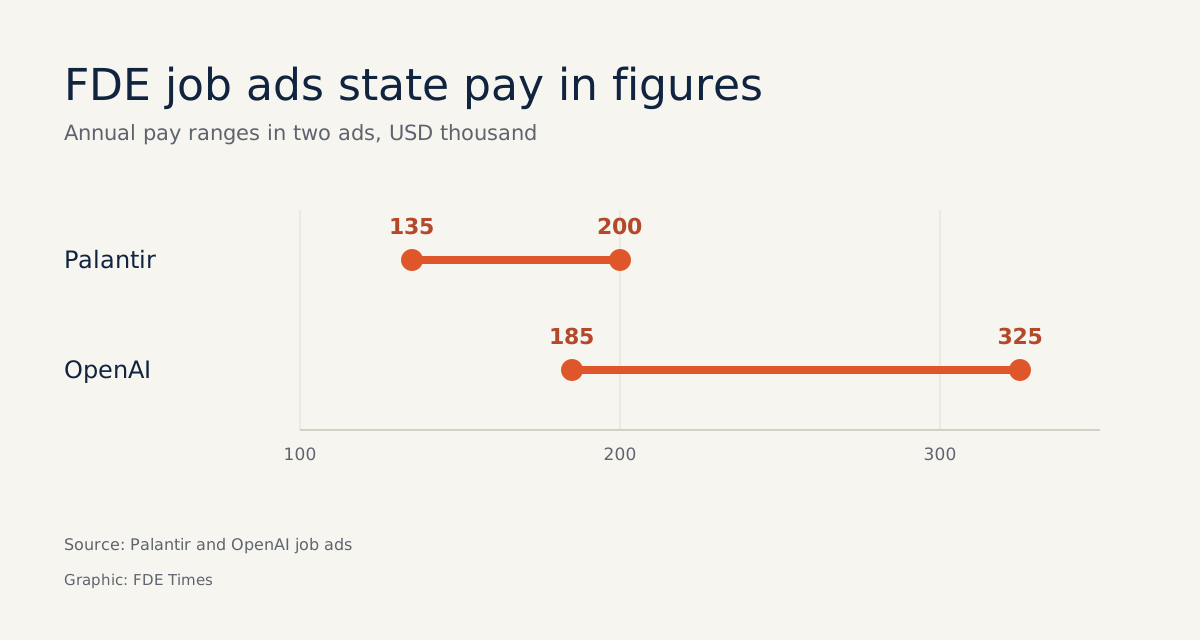
Pay is also given in numbers. Palantir’s separate salary section estimates $135,000 to $200,000 a year. OpenAI’s ad for its San Francisco role states $185,000 to $325,000, and Anthropic’s Technical Deployment Lead ad also includes a pay range.
Palantir’s version for its US government segment shows how the same framework can vary by domain. It adds a hard requirement for an active security clearance at Top Secret level or above, plus a requirement to work on site.
## Logistics
- Travel: up to [X]% at customer sites, [degree of flexibility]
- Domain-specific requirements: [clearance, on-site work, languages]
- Salary: [low end] – [high end] / year
Check: every line in this section must contain a number or a yes/no condition. With that information, candidates can tell for themselves whether they fit before they apply.
Common mistakes
The first mistake is letting behavioural criteria sink into adjectives like “dynamic” or “proactive”. OpenAI writes it as a verifiable behaviour: iterating and refining with customers. At interview, you can ask about exactly that behaviour.
The second is using one ad for every domain. A better approach is to keep the core and add hard requirements specific to each domain, as Palantir adds a security clearance for its government version.
The third is hiding the travel. An FDE who discovers only after accepting the job that they must spend more time at customer sites than expected is unlikely to stay long.
Where does this skill show up in real work?
Writing a job ad exercises exactly the skill of a customer kickoff: turning a vague need into scope, deliverables and acceptance criteria. A team lead who can write “from SOW to production” for a job ad can write the same line for a project proposal.
If you are applying, read the ad in reverse. Each specific responsibility should match a line in your CV, with a deliverable and a person on the customer side you worked with.
For example: “built an MCP server connecting internal systems, demoed to the head of operations”. If you have been a founder, put that at the top of your CV, because at least one company has said explicitly that it is looking for that profile.
A job ad that describes the hire’s first week attracts the right people. A CV that does the same makes a recruiter stop and read.
Was this article useful?
Thanks for the feedback!
5 sources
- Forward Deployed Software Engineer – Palantir (Lever posting API)
- Forward Deployed Software Engineer - US Government – Palantir
- Forward Deployed Software Engineer - SF (OpenAI) – Built In
- Forward Deployed Engineer – Anthropic (General Catalyst job board)
- Technical Deployment Lead – Anthropic (Greenhouse)