New-grad FDE roles: how to read the 2027 job postings and build the right CV
Palantir, C3 AI and Applied Intuition are all hiring graduates from December 2026 through 2027, and their postings talk about customers as much as about code.

In brief
- Palantir, C3 AI and Applied Intuition all have FDE roles specifically for people graduating between December 2026 and 2027.
- The coding requirements in the postings are fairly broad: a computer science foundation and one strong language such as Python or C++. The rest describes working directly with customers and managing relationships with many stakeholders.
- FDE Academy argues that one deployed project with real users and a case study is worth more than eight polished demos.
You are in your final year and come across a posting that reads “Forward Deployed Engineer, New Grad”. Many people scroll straight past, assuming that working alongside customers and owning decisions is reserved for people with five years on the job.
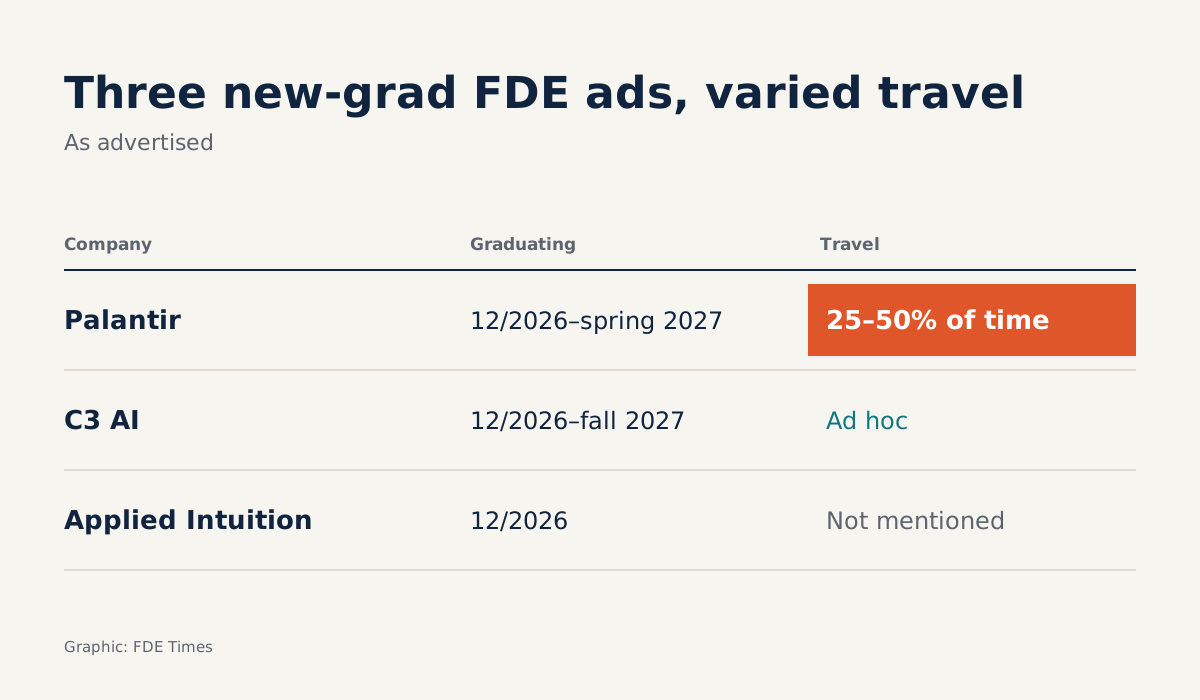
That assumption is wrong. C3 AI has an FDE role specifically for people graduating in December 2026 or in summer or autumn 2027. Palantir is hiring new-grad Forward Deployed Software Engineers for its Commercial business, for graduates in December 2026 or spring 2027, and Applied Intuition has a new-grad FDE posting for the December 2026 class.
So the real question is no longer whether a new graduate can be an FDE. It is whether your application shows the work these postings describe.
FDE Academy, a training site for the profession, argues that the gap for new graduates is mostly one of preparation rather than talent, and that preparation starts with reading the posting properly.
The coding bar is broad; the hard part is the customer
Read the three postings closely. The programming requirements are fairly broad. C3 AI wants hands-on experience with data structures, algorithms, cloud and relational or NoSQL databases, plus one object-oriented language. Applied Intuition wants a bachelor’s or master’s degree (in progress or completed) and strong programming skills, citing C++ or Python as examples.
The remaining lines are the ones worth noticing. Palantir expects new hires to own relationships with every stakeholder, from users struggling with their daily work to the executives who make decisions, and to build applications, LLM workflows and production solutions shaped by the reality of a specific customer.
Applied Intuition has FDEs work directly with customers to deploy and integrate its products in real environments, and to take ownership of decisions.
According to Paraform, a recruiting platform, FDEs need five core skills: a backend language, cloud infrastructure, data engineering, applied AI and customer communication.
Set the three new-grad postings against those five skills and the degree and the code are only the foundation. The customer work and the ownership of decisions are where you should actively build evidence, because coursework rarely asks you to do either.
How should a small project be told?
FDE Academy argues that the biggest differentiator a new graduate can offer is a project that has been deployed and is used by real people.
In its view, such a project with a case study does more than eight polished demos. The advice fits the postings, because having real users forces you to do exactly what the postings describe.
Take an example. A volunteer club at your university has ten coordinators who each week copy figures by hand from five spreadsheets into a report for the club’s head.
You write a Python tool that reads those spreadsheets and produces a draft report. You sit with each coordinator as they try it, make changes based on their feedback, then present it to the head to agree the official report template.
Technically, this is a small project. What gives it value is how you map each part of it to a line in the posting:
| Line in the posting | Weak CV wording | Strong CV wording |
|---|---|---|
| Work directly with customers to deploy | Built a report automation tool | Sat with 10 coordinators to watch how they built reports before writing the first line of code |
| Relationships from users to executives | Good team player | Gathered feedback from daily users, presented to the club head and won approval for the new report template |
| Solutions shaped by a specific customer’s reality | Owned the backend | Decided to drop two data fields nobody used after asking users, then handled deployment and support |
| Strong programming in one language | Python, Java, C++, Go, Rust | Python: read and cleaned data from 5 spreadsheets with inconsistent formats |
The numbers in the table are hypothetical; replace them with your own. You do not need to learn anything new to write the right-hand column. You only need to retell the same project in the posting’s own words.
Getting started, in order
Start by choosing your users, not your technology. Find a small group near you that does a repetitive task by hand and has one person with the authority to say “yes, let’s use this”. In your project, that person is the “executive who makes decisions” that Palantir’s posting mentions.
Next, get a usable version into real users’ hands as fast as possible, however rough. Record every conversation: what they asked for, what you decided to do, and why. Those notes will later become your case study and your interview answers.
Finally, measure one concrete thing, such as how many people are still using it after a month or how much time it saves on each report. Write a one-page case study and link it from your CV. For interviews, prepare a story about a time users wanted something entirely different from your plan, and how you handled it.
Mistakes that weaken an application
The first is a portfolio full of tutorial exercises and demos nobody uses. The second is listing six languages when the posting asks for one language done well; the list hides what you are best at.
Another is not reading the working conditions closely. Palantir states that its new-grad role involves travelling 25–50% of the time, depending on team and location; C3 AI says only that you must be willing to travel when needed, and Applied Intuition’s posting does not mention travel.
Wikipedia lists the travel requirements and the pressure to solve customer problems on short timelines among the downsides of the job, so if you do not want to be away from home up to half the time, ask about it in the first round.
The last mistake is treating an FDE role as a SWE job with a few extra meetings. Capicua, a software firm, describes FDEs as engineers who write production code directly into a customer’s infrastructure and data.
If you cannot go straight into an FDE role, choose an engineering job that puts you in contact with real systems and real users, so that in a few years your CV already has the right-hand column of the table above.
Postings for the class of 2027 are already open. If you have only a few months before the deadline, spend them on a group of real users rather than on one more language for your CV.
Was this article useful?
Thanks for the feedback!
8 sources
- Forward Deployed Software Engineer, New Grad - Commercial (Palantir)
- Forward Deployed Engineer, New Grad 2027 (C3 AI)
- Forward Deployed Engineer - New Grad (December 2026) (Applied Intuition)
- How fresh graduates can break into forward deployed engineering (FDE Academy) · 2026-06-19
- Can a fresher become a forward deployed engineer (FDE Academy) · 2026-08-03
- Forward Deployed Engineer (Wikipedia)
- What is a forward deployed engineer? A complete guide (Paraform) · 2026-09-03
- About The Forward Deployed Engineer Role (Capicua) · 2026-07-23