In Germany, the works council decides when your AI goes live
A system only needs the capacity to monitor staff for the council to gain a say, even if it never records or stores a single conversation.
In brief
- Germany's Federal Labor Court ruled that a system's capacity to monitor is enough to give the works council co-determination rights, even if conversations are never recorded or stored.
- Skip the step and the council can seek an injunction to halt the system. If the two sides deadlock, an arbitration board's ruling replaces their agreement.
- An FDE's leverage lies in configuration: fewer logs, team-level reporting only, short retention and a clear document for the council.
On July 16, 2024, Germany’s Federal Labor Court (BAG) ruled that a headset system used in retail stores was subject to the works council’s co-determination.
The system did not need to record or store any conversation. According to a summary by the law firm Gleiss Lutz, the mere fact that it was objectively capable of monitoring was enough to trigger the co-determination right.
If a headset falls within scope, the AI assistant you are about to deploy for a German client is even more likely to. It logs every prompt, ties it to a user account and adds a timestamp. That is the kind of data that can measure employees’ behavior and performance, even if nobody on the project intends to use it that way.
For an FDE, the consequence is concrete: the deployment plan gains a step that sits in no backlog. WZ-IT, an IT services provider, estimates that working with the works council costs calendar time rather than engineering effort: anywhere from a few weeks to a few months, depending on the council, how often it meets and whether it needs to hire advisers.
The law firm Mayer Brown notes that if the step is skipped, the council can seek an injunction forcing the system to stop until the procedure has been followed properly.
A council has three kinds of rights, and only one can block you
The first is the right to be informed. Section 90 of the Works Constitution Act (BetrVG) requires the employer to inform the council in good time about plans affecting work processes and operations, explicitly including the use of AI, and to consult it at the right moment.
But as lawyers at Littler explain, Section 90 grants only rights to information and consultation, not co-determination.
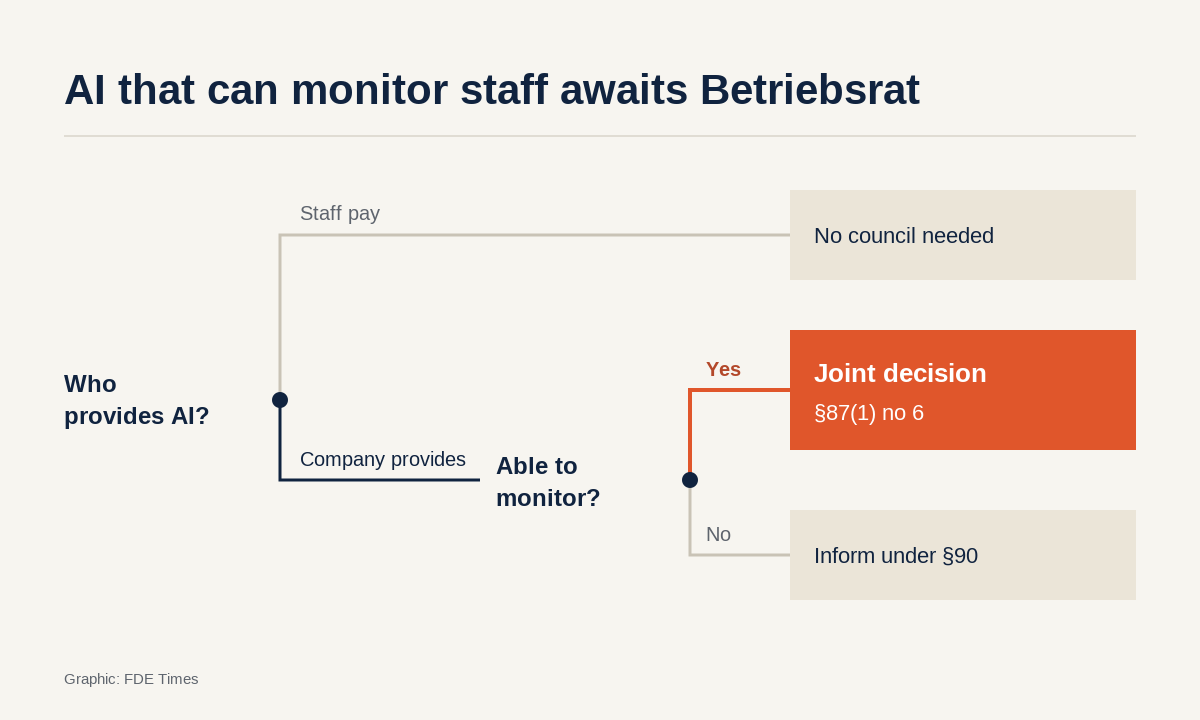
The right with the power to block sits in Section 87(1) No. 6: the council has a co-determination right over the introduction and use of technical equipment designed to monitor employees’ behavior or performance, unless a statute or collective agreement already governs the matter.
The headset ruling shows how low the threshold is. Gleiss Lutz summarizes that monitoring does not require conversations to be recorded or stored.
Section 80(3) adds a detail FDEs should remember. When the council has to assess the introduction or application of AI, bringing in an expert is deemed necessary, with the details agreed with the employer.
So be ready to field technical questions from someone who understands the system, and do not prepare only slides for a lay audience.
If the two sides cannot agree, Section 87(2) hands the matter to an arbitration board (Einigungsstelle). Under Section 76, the board has an equal number of members from each side plus a neutral chair, and the labor court appoints the chair if the parties cannot agree on one.
The board’s ruling replaces the agreement between the two sides, so neither can find a way around it alone.
The line is drawn by who provides the account
On January 16, 2024, the Hamburg Labor Court (case 24 BVGa 1/24) rejected a group works council’s application for an interim injunction to block the use of ChatGPT. Employees accessed it through a browser with personal accounts they paid for themselves, so the court did not treat it as the employer’s monitoring equipment.
Do not read the case as a license. Littler’s own authors warn that it was a special case, and that when a company provides corporate ChatGPT accounts, the legal assessment is different.
FDE projects usually sit closer to the second scenario, because the tool is deployed and provisioned by the company itself, typically with corporate sign-in, logs and an admin console.
Above German law sits a European layer. Article 26(7) of the EU AI Act requires employers using a high-risk AI system in the workplace to inform workers’ representatives and the affected employees before putting the system into service.
An example: auditing a call-center assistant’s logs
Take a hypothetical case: you deploy a RAG assistant for call-center staff at a German insurer. The most useful thing to do in week one is to open the log schema and ask each field a single question: does this field help someone measure the behavior or performance of a specific person?
| Data field | What it can measure about a person | How to narrow it |
|---|---|---|
| user_id on every request | Who uses it and how often | Pseudonymize; keep it only in an access-controlled audit layer |
| Full prompts and responses | The content of each person’s work | Do not store by default, or store without identity and with short retention |
| Timestamps and processing time | Work speed and working hours | Report only in team-level aggregates |
| 👍/👎 buttons | Satisfaction and habits | Aggregate by team, decouple from user_id |
| Admin dashboard | Per-person rankings if filters allow | Remove per-person filters, limit who can view |
The output of this table is a one-page document for the council: the tool’s purpose, the list of data, who can see what, how long it is kept, and what the system commits not to do, such as being used to evaluate employees. The expert the council brings in under Section 80(3) will read exactly this document.
Why focus on configuration? Employment lawyer Markus Janko argues that an arbitration board, as a rule, will not and indeed cannot change a planned IT system, especially standard software.
That is one practitioner’s view, not a legal rule. Still, it suggests that the real negotiation usually revolves around usage rules and configuration, which is precisely where an FDE has leverage.
Put the council into the plan from week one
At kickoff, ask directly: does the company have a Betriebsrat, who on the client side is the contact for the council, and what is the council’s meeting schedule? The answers determine the real go-live date, so you need them before promising any date to the sponsor.
Then build the log audit described above and let the client’s legal team read it first, since they are the ones who reach the legal conclusions.
The Section 90 notice should go out early, at the planning stage, rather than waiting for a finished demo. In the plan, treat the council’s consent as a precondition: a pilot on real data and go-live both start only once that consent is in hand.
Finally, make minimal collection the default configuration. Expanding logging after an agreement is far easier than explaining why a dashboard is ranking individual employees.
The skill can also strengthen a résumé. When a job posting mentions DACH, works council, Betriebsrat or co-determination, it signals that the role may value someone who has been through this process.
On a CV, a line such as “designed a minimal logging configuration and took an AI assistant through the works council process” shows you can anticipate what lies outside the code.
The mistakes that delay go-live
The most common mistake is the argument that “the system doesn’t record or store conversations, so it isn’t monitoring.” The headset ruling rejected exactly that reasoning. The second is citing the Hamburg case to claim AI lies outside the council’s reach, when that case concerned only personal, self-paid accounts.
The third is treating a Section 90 notification email as the end of the matter. Information and consultation are one thing; co-determination under Section 87 is another. The fourth is harder to spot: locking in a go-live date with the sponsor before knowing when the council meets, then watching the plan slip because of a meeting nobody put on the calendar.
At a German client with a Betriebsrat, the real go-live date is set in the works council’s meeting room. FDEs who know that from week one will keep their promises to the client.
Was this article useful?
Thanks for the feedback!
8 sources
- Works Constitution Act (Betriebsverfassungsgesetz – BetrVG), English translation
- BAG: Einführung eines Headset-Systems ist mitbestimmungspflichtig (Gleiss Lutz) · 2025-03-12
- Part VI: Internal Investigations: Role and Rights of Employee Representatives (Mayer Brown) · 2026-10-05
- Germany: Does the Works Council Have a Say When Employees Use ChatGPT? No, According to the Labor Court Hamburg (Littler) · 2024-02-20
- Germany: Works Council Doesn’t Have a Say When Employees Use ChatGPT (Littler authors, republished on SHRM) · 2024-02-27
- Die Einigungsstelle bei der Einführung von IT-Systemen – eine Chance? · 2020-02-18
- AI assistants and the works council: planning co-determination properly (WZ-IT) · 2026-10-12
- Article 26: Obligations of deployers of high-risk AI systems (AI Act Service Desk)