The FDE interview round that decides offers has no LeetCode answer
At Databricks, a 60-minute decomposition round that starts from a vague business goal is treated as the core of the loop, while coding gets a separate slot.
In brief
- According to Educative's FDE course, the loop has four rounds: decomposition, customer simulation, technical and behavioral. Algorithms serve only part of that.
- The decomposition round is scored on four criteria: structured decomposition, empathy for the end user, reasoning about data, and judgment on scope.
- The most common mistake in this round is jumping straight to a solution. Spend the first 5–15 minutes clarifying the goal.
At Databricks, the round that carries the most weight in the forward deployed engineer loop contains no algorithm at all. According to Aced’s guide to the company’s FDE role, the decomposition round runs about 60 minutes, asks candidates to design a system from a vague business goal, and is treated as the core of the whole loop. Coding is a separate 60-minute round.
Take a candidate who has solved a few hundred LeetCode problems and walks into that room. The interviewer says: “A chain of clinics wants to use AI to cut patient waiting times. Where do you start?” There is no input, no output and no complexity constraint.
An FDE interview guide on techinterview.org puts it bluntly: if you only drill algorithms, you are studying for the least important part of the exam. Educative’s FDE course describes a loop of four rounds: decomposition, customer simulation, a technical round and a customer-facing behavioral round.
Of those four, algorithm practice mostly helps in the technical round alone.
For anyone who wants to work as an FDE, decomposition is the skill most worth training seriously.
Why is the interview mostly conversation?
The answer lies in the job itself. Anthropic’s FDE job posting describes working directly with strategic customers and frequent travel, 25–50% of the time, going on site to build products alongside them.
The same posting asks for a high degree of autonomy and the ability to handle ambiguity inside complex organizations.
No customer hands an FDE a finished spec. That is why, as the techinterview.org guide explains, the interview simulates the same situation, and why most of the time is spent talking rather than typing.
The decomposition format was created and popularized by Palantir, to see whether a candidate can find a way forward when nobody has drawn the map.
What are interviewers actually listening for?
Interviewers work from a fairly specific rubric. According to techinterview.org, they score four things: structured decomposition, empathy for the end user, reasoning about data, and judgment on scope. Educative’s course sums up the round’s purpose as testing whether you handle an ambiguous problem systematically.
Those four criteria also explain the most common mistake Aced records: jumping straight to a solution. The candidate hears the prompt and says, “I’d use RAG with a vector database.” In doing so they have skipped the end user, not asked where the data lives and not cut the scope. Three of the four criteria are gone before the interview has properly begun.
A sample session: from “cut waiting times” to a design
Back to the clinic prompt. The Databricks guide advises spending the first 5–15 minutes clarifying the goal before moving on to technical design. What follows is a hypothetical script for those opening minutes.
Candidate: “Before I design anything, can I ask: does ‘waiting time’ mean from booking to being seen, or from arriving at the front desk to seeing the doctor?”
Interviewer: “The time spent sitting in the waiting room.”
Candidate: “Who is hurt most by this: patients, receptionists or clinic managers? And how do receptionists decide the order of appointments today?”
The second question shows empathy for the end user. You are looking for the person who will use the system every day, not only the person who signs the contract. Next comes the data:
Candidate: “Does the clinic record check-in times, consultation start times and the type of service? Is that kept in management software or on paper?”
If the answer is “yes, in the management software, for about two years,” you have grounds to reason about a model that predicts consultation length. If the answer is “on paper,” the first phase of the project has to be data collection, and you need to say so.
Last comes scope, the part candidates most often forget:
Candidate: “For phase one I’d suggest a single clinic, predicting only consultation length so receptionists can tell patients how long they’ll wait. Automatic rescheduling waits for phase two, once we’ve measured whether the predictions are accurate. Does that sound reasonable?”
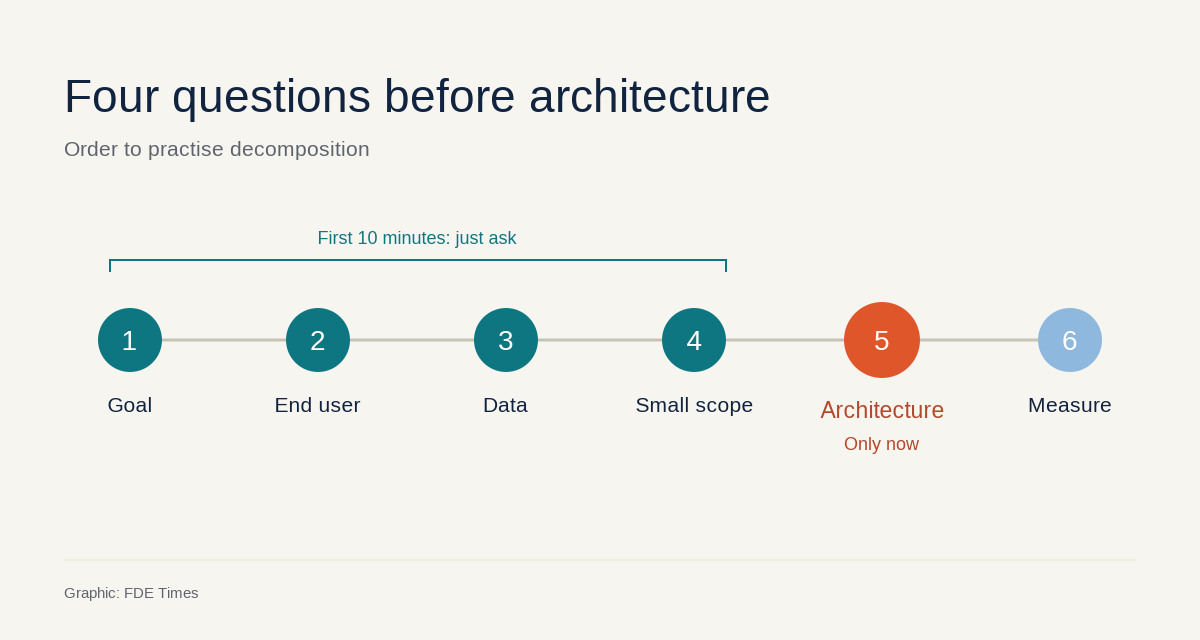
Only after ten minutes or so of this do you draw the architecture: data sources, pipeline, model, an interface for receptionists, and how success will be measured. By now every box in the design has a reason behind it, and the interviewer has heard all four criteria.
In what order should you practice?
Repeat a fixed sequence until it becomes reflex. First, restate the goal in your own words and ask how “success” will be measured. Next, identify the end user and how they work today. Then ask where the data lives, what its quality is and who owns it.
Once you have those three pieces, propose a small scope that can ship within a few weeks and say clearly what you are deliberately leaving out. Only then draw the architecture, and finish with how results will be measured.
Throughout the session, keep checking with the interviewer whether you are heading in the right direction: the round is designed as a collaboration, not a monologue.
If spoken English is not your strength, do not practice only on paper. Practice out loud, against a timer, because the round requires you to think aloud and does not grade your notes.
One tip when reading a job description: if the posting stresses handling ambiguity and working directly with customers, as Anthropic’s does, expect the conversational part to be heavy and put more hours into decomposition.
The familiar traps
The first trap is treating clarifying questions as a formality: asking three questions for show, then presenting the architecture you had in mind from the start. Interviewers notice at once when their answers do not change your design.
The second trap is taking on the whole scope. Trying to solve the entire problem in 60 minutes means leaving the scope-judgment criterion in the techinterview.org rubric blank. The third trap is thinking in silence.
The round requires you to think aloud, so a minute of silence is a minute in which the interviewer has nothing to score.
The coding round still needs preparation, but it only proves you can write code. The decomposition round shows whether you know what code to write, and for whom. In a job that means finding your own way through a customer’s ambiguity, that is where your practice hours are best spent.
Was this article useful?
Thanks for the feedback!
5 sources
- How to Answer Decomposition Interview Questions: The Definitive Guide (2026)
- What the forward deployed engineer interview really tests · 2026-08-05
- Databricks Forward Deployed Engineer Interview guide
- The four interview rounds (Forward Deployed Engineer course)
- Forward Deployed Engineer – Anthropic (General Catalyst job board) · 2026-09-14