The FDE interview: telling a bad-news stakeholder story in under 90 seconds
FDE interviewers want to hear about the projects that went wrong as well as the ones that went smoothly. A well-told bad-news story, kept within a self-imposed 90-second limit, can tell them more about you than you might expect.

In brief
- At Palantir, behavioural questions come up in almost every round, taking about 15–20 minutes of each technical round.
- A strong story has a real mistake, clear ownership, an early warning and a set of options.
- Keep each story under 90 seconds, tell the Action part with 'I', and prepare a few good stories in advance.
You have just finished drawing a pipeline diagram on the whiteboard, and your mind is still on the technical problem. The interviewer puts down the pen and asks: “Tell me about a time you had to deliver bad news to a customer.”
Expect questions like this to keep coming. Aced’s Palantir interview guide says behavioural questions are spread across almost every round rather than given a round of their own, and each technical round spends about 15–20 minutes on them. You may be asked about the same theme several times, in different forms, just when you are worn out from coding.
For an FDE, this is not a side issue. The job means standing in front of the customer when a deployment slips, when the data is dirty, when the two sides expect different things. The interviewer is testing how you would behave in the worst week of a real project.
What is the interviewer actually scoring?
ClavePrep, an FDE interview-preparation site, puts it plainly: interviewers want to hear how you react when things go wrong, not only when they go well. They want a real failure, one that was genuinely hard, not a failure polished up for show.
Aced advises treating failure questions as a test of self-awareness: interviewers score both how you talk about the failure and what you took from it. The two views meet at one point. The incident is only the setting; what gets scored is how you handled it.
A good answer therefore has to answer three unspoken questions. How early did you spot the problem? Did you own your share of the mistake or push it onto someone else? And did you bring only the bad news, or did you bring options for the stakeholder to choose from?
A model answer, taken apart
STAR stands for Situation, Task, Action, Result. ClavePrep stresses that it is a tool for giving a story structure and completeness, while Dartmouth advises keeping the focus on your own contribution and results. The University of Cincinnati recommends preparing concise stories and being ready to go deeper when asked.
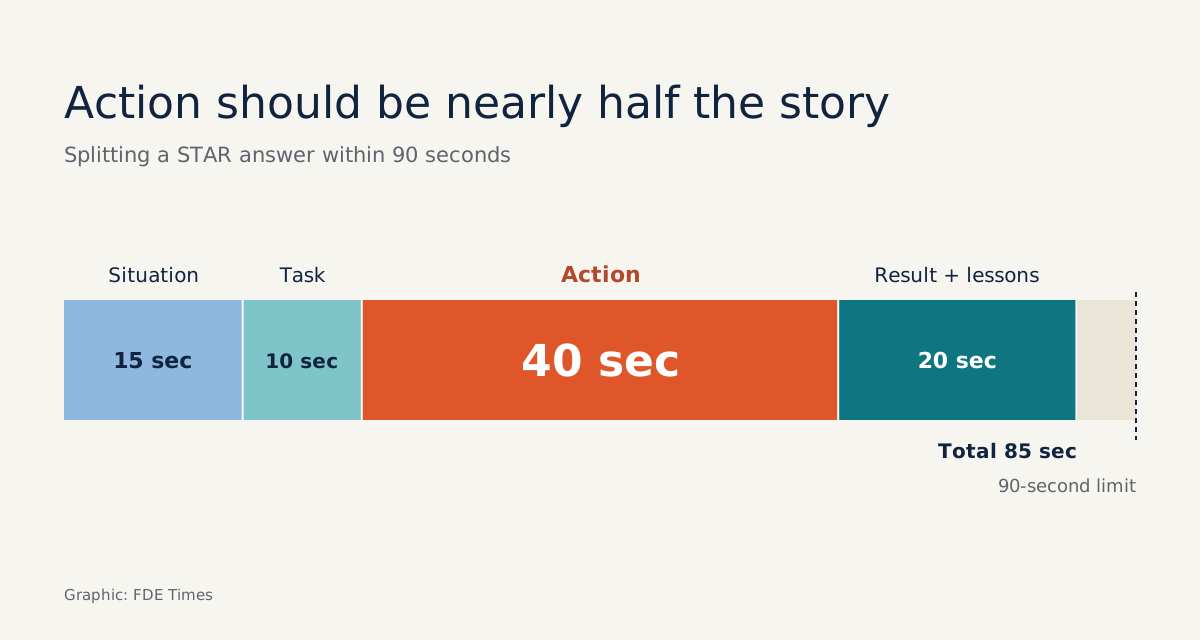
A limit of under 90 seconds is a sensible self-imposed benchmark for that advice. One way to split it: about 15 seconds for Situation, 10 for Task, 40 for Action and 20 for Result and the lesson. That makes 85 seconds, with a little room to breathe.
Picture a candidate who has worked as an FDE for a logistics customer. The scenario is hypothetical, written exactly as the candidate would say it in the interview room:
Situation. “I was the only FDE on site, responsible for connecting their warehouse management system to the forecasting platform. I had promised the head of operations a live version within four weeks.”
Task. “My job was to keep that commitment. In the second week, I found that about a third of the product codes in the historical data were duplicated or had been changed partway through.”
Action. “I owned the mistake first: I had set the deadline before profiling the data. That same day, I wrote a script to count exactly how many records were broken in each warehouse, then asked the head of operations for 20 minutes rather than waiting for the weekly meeting.”
“In that meeting, I laid out three options: keep the deadline with the half of the warehouses whose data was clean, push everything back two weeks, or keep the deadline if their team fixed the codes by hand. I said clearly that the bad estimate was mine.”
Result. “The customer chose to go live with half the warehouses first. Since then, I always profile the data in the first three days before promising any deadline.”
This answer scores in three places. The mistake is real and specifically named: promising a deadline before checking the data. The bad news was delivered on the day the problem was found, and it was turned into a decision with three options for the customer.
The detail worth noticing is the script that counted errors per warehouse. To a technical interviewer, it shows a habit of good engineers: turning “the data has problems” into concrete numbers, and then into distinct options a stakeholder can decide between.
Finally, the outcome is not perfect, since only half the project went live. That is fine, because interviewers also score what you learned from the failure. The closing line about the data-profiling habit is exactly that part.
How do you build your own story?
Start by listing every time you had to tell people something they did not want to hear: a missed deadline, a feature cut, numbers that fell short of what was promised, a wrong estimate. If you have never worked directly with customers, a PM, another team or your manager are valid stakeholders too.
Pick a story in which you genuinely share the blame, then write down the exact moment you knew there was a problem. Prepare an answer to a follow-up question that is very likely to come: how long passed between knowing and telling? If the gap was long, say so plainly and turn it into the lesson.
Next, write the Action part with your own verbs. The University of Cincinnati recommends saying “I” rather than “we”, and the reason is practical: “we decided to push back the deadline” tells the interviewer nothing; “I laid out three options and recommended the first” does.
Then time it and cut. A first draft usually spends too long on context, when Action is the part that scores. Prepare a few stories that cover bad news, stakeholder conflict, failure, mismatched expectations and an ambiguous problem.
If you are asked again in a later round, should you reuse the same story? An article on The Behavioral advises choosing the best answer to the question, even if that means reusing the same project, because quality always beats variety.
A coach on PrepLounge, by contrast, says rounds usually ask different questions, and if you meet the same person again you should mix familiar stories with new ones. The safe approach is one very strong main story plus a few in reserve.
Mistakes that turn a good story into a black mark
Weak answer
- Fake failure: being too much of a perfectionist
- Says "we" from start to finish
- Blames the data or the customer
- Raises the alarm close to the deadline
- Stops at the result, with no lesson
Strong answer
- A real mistake, named precisely
- The specific things you did, in order
- Owns your share of the blame first
- Raises it as soon as you know, with options
- A new habit you still keep
The mistake most worth avoiding is blame, even when the customer really was at fault, because it fails precisely the self-awareness test Aced describes.
You can say their data was dirty, but the next sentence should be about what you should have done differently. Remember that the interviewer is asking themselves whether they would dare put you in front of their customers.
The second mistake is a story that is too clean, in which you spot the problem, fix it and everyone is happy. It sounds like an achievement relabelled as a failure, while ClavePrep is clear that interviewers want a failure that was genuinely hard.
The same story works outside the interview room too. On a CV, a line such as “identified data defects in week two, proposed a phased rollout, held the deadline for half the scope” shows stakeholder skills more clearly than any adjective about communication.
The best bad-news story is not the one in which you look best, but the one that shows you changed how you work afterwards. Write it down before anyone asks.
Was this article useful?
Thanks for the feedback!
6 sources
- Palantir Forward Deployed Engineer (FDE) Interview Guide | Sample Questions (2026) - Aced (formerly Exponent)
- Forward Deployed Engineer Behavioral Interview: STAR Stories That Actually Work · 2026-06-30
- STAR Method for Behavioral Interviews (University of Cincinnati)
- Using the STAR Method for Your Next Behavioral Interview
- Should You Reuse Stories in Behavioral Interviews? · 2025-09-01
- Stories for Behavioural Questions (PrepLounge forum) · 2025-01-27