FDE internships and new grad roles for 2027: check your graduation date first, then write the CV
For the 2027 Forward Deployed Engineer postings aimed at interns and new graduates, the first thing to check is your graduation date, then your skills. Some postings take applications for only about six weeks.

In brief
- At Palantir alone, the FDSE internship takes people graduating in December 2027 or spring 2028, while the new grad posting takes people graduating in December 2026 or spring 2027.
- Google London's FDE internship was posted on 2 October 2026, closes on 13 November 2026, offers no visa sponsorship and requires at least 13 weeks of full-time work.
- The job descriptions centre on deployment, integration into customers' real environments and working with many stakeholders; Palantir and Applied Intuition ask for proficiency in at least one programming language.
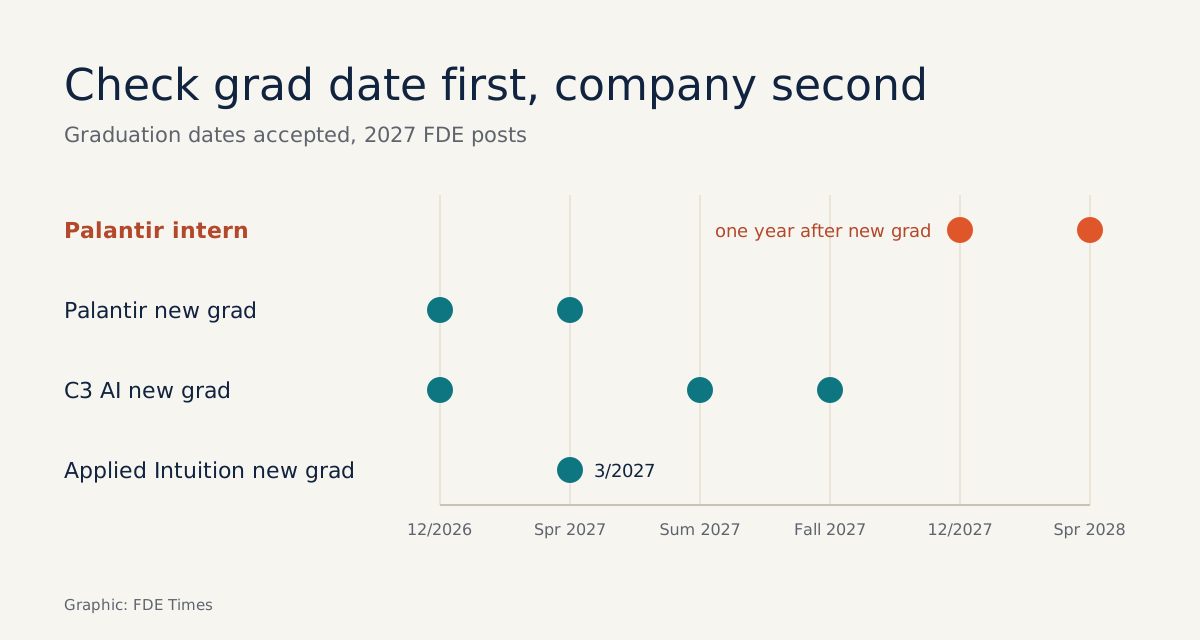
With Forward Deployed Engineer postings for interns and new graduates, the first thing to check is usually a date, not a skill.
Palantir’s Forward Deployed Software Engineer (Commercial) internship in New York accepts only people graduating in December 2027 or spring 2028. The new grad posting in the same Commercial track accepts people graduating in December 2026 or spring 2027.
Two postings from the same company sit exactly one academic year apart. Apply to the wrong one and your application will probably be rejected before anyone reads your skills section, however strong it is.
The 2027 hiring season is open. Applied Intuition posted its 2027 FDE new grad role on 8 October 2026, and Google London posted its summer 2027 FDE internship on 2 October 2026, with applications closing on 13 November 2026.
If you are a student or about to graduate and want to become an FDE, the skill you need right now is reading a job posting the way you would read a contract: work out which postings fit you, drop the ones that don’t early, then write an application that matches the work described.
Your graduation date decides which postings fit
When you read a posting, look for the graduation date first, before the company name or the skill requirements. The table below sets out five 2027 FDE postings using the wording each one gives.
| Posting | Accepts graduates from | Other conditions |
|---|---|---|
| Palantir, FDSE Commercial internship (New York) | December 2027 or spring 2028 | Travel roughly 25–50% of the time |
| Palantir, FDSE Commercial new grad | December 2026 or spring 2027 | Travel roughly 25–50% of the time |
| C3 AI, FDE new grad 2027 (Redwood City) | December 2026 or summer/autumn 2027 | Build applications on the C3 AI Agentic AI platform |
| Applied Intuition, FDE new grad 2027 | March 2027 | In the office 5 days a week, C++ or Python required |
| Google London, FDE internship summer 2027 | Penultimate-year or final-year students | At least 13 weeks full time, no visa sponsorship |
In the table, Palantir’s internship takes people who graduate exactly one academic year later than its own new grad role, while Google London takes both penultimate-year and final-year students. The new grad postings take people graduating between December 2026 and autumn 2027.
So don’t rely on the year in the title to decide whether you qualify. Rely on the line in each posting that states the graduation window.
Placing two candidates in the table
Picture two students. The first expects to graduate in December 2027, which means this is their penultimate year.
This student fits Palantir’s internship, and Google London’s internship too if they meet the other conditions. New grad roles such as C3 AI’s or Applied Intuition’s are not yet open to them, so applying now is wasted effort.
The second student expects to graduate in December 2026. They fit the new grad roles at Palantir and C3 AI. Applied Intuition’s posting says March 2027, which differs from this student’s date. When the gap is a few months like this, email the recruiting team rather than guess: an official answer is worth more than any inference of your own.
Anyone graduating in mid-2027 needs to read the words “spring” and “summer” in each posting carefully. C3 AI says summer/autumn 2027 explicitly, which is safer. Palantir’s “spring 2027” cut-off is worth checking with the company.
Beyond dates, postings list hard conditions
Clearing the graduation window does not mean you are through: an application can still fail on lines at the bottom of the posting. Google London states that candidates for the internship will not be offered visa sponsorship. If you need a work permit to work in the UK, this posting is not for you, however good your CV is.
Schedule is the second condition. Google needs interns to work full time for at least 13 weeks in summer 2027, so your summer classes or exam timetable must leave that stretch free. Applied Intuition requires 5 days a week in the office. Palantir gives advance notice of travel of roughly 25–50% of the time, depending on team and location.
These lines are not minor details. FDE work is tied to customer sites and customer schedules, so if you cannot be away for half a month at a time, know that before you apply. Don’t find out in the final interview round.
What work are the postings describing?
Read the job descriptions closely and the postings use the same group of verbs. Applied Intuition wants FDEs to work directly with customers to deploy and integrate its products into real-world environments.
C3 AI assigns the design, development and maintenance of applications on the company’s Agentic AI platform. Google wants interns to identify recurring patterns and friction points in the field as customers use Google’s AI stack.
The language requirements in these postings are fairly basic. Palantir asks for proficiency in at least one language such as Python, Java, C++ or TypeScript/JavaScript. Applied Intuition asks for strong programming skills, for example in C++ or Python. The harder part lies elsewhere: Palantir gives interns the job of working with stakeholders, from end users to executives.
So the most effective preparation is to pick one language, get really solid in it, then use it on a project with real users. That does far more for you than spreading yourself across a few more languages.
A small tool you built for a club, a lab or a local shop, where someone complained and you had to fix it, is worth more than three solo coursework projects.
Rewriting one CV line FDE-style
Take a typical student CV line: “Built a chatbot with Python and LangChain, achieving high accuracy.” This line is about technology. It does not say who used it, what environment it ran in, or what obstacle you got past.
Rewrite it around four points: whose environment, what you integrated, who used it, what changed.
For example, if it is true of what you did: “Integrated a Python chatbot into the faculty academic office’s existing Q&A system; worked with two staff members to pick the 30 most common questions; fixed PDF parsing errors after the first week of student use.” The numbers here are only illustrative; replace them with your own real figures.
The new line matches the posting almost point for point: integration into a real environment, working with users, finding friction points. For the interview, be ready to tell exactly this story in depth: where you first misunderstood the requirements, and how you went back and asked.
Mistakes that sink an application before the interview
One easy mistake is to read the year in the title and apply straight away without checking the graduation date. Nor should you wait until spring to start looking, when Google London closes applications on 13 November 2026, only about six weeks after posting. And don’t skip the lines on visas, days in the office and share of travel.
The harder mistake to spot is writing an FDE CV like an SWE CV, listing only frameworks and features. From the verbs the postings use, such as deploy, integrate into real environments and work with customers, it follows that the reader will look for signs that you have put code into someone else’s system and stayed with it until it ran smoothly.
If your CV has no story like that yet, the thing to do this semester is to create one.
Look up your graduation date against each posting tonight, and only then think about your CV.
Was this article useful?
Thanks for the feedback!