For data scientists moving into FDE, modeling is only the entry fee
ML fundamentals and debugging instincts carry over; the new work is breaking down vague problems, writing production code and owning a deployment from start to finish.
In brief
- ML experience and debugging instincts are a real advantage, since many FDE roles explicitly ask for ML or agent experience.
- The gap is rarely the model; it is problem decomposition, production code and end-to-end ownership.
- Employers value the ability to ship end to end more than the names of the companies you have worked for.
A churn model with a strong AUC and a tidy notebook gets handed to the platform team. Three weeks later it is still sitting there, because nobody has wired it into the client’s login system.
As an FDE, the person who wires it in is you. The good news is that the path is real: FDE Academy’s career material names ML engineering as a viable route into Forward Deployed Engineering at AI companies.
A 2026 analysis of job postings by Cloud Authority also found that many FDE roles explicitly mention experience in machine learning or agent development.
The harder news: according to Sundeep Teki’s 2026 FDE interview guide, the interview loop tests four things at once that are usually assessed separately. They are problem decomposition, coding, customer empathy and ownership. Modeling skill only gets you in the door. The real question is what to keep and what to learn.
What you bring is worth more than you think
An ML grounding is a direct advantage, especially when AI companies need people who understand how models, pipelines and LLM applications are deployed and integrated. You know why a model degrades, what leakage looks like, how to read a data distribution. Those reflexes are already in place; you do not have to learn them from scratch.
The second thing worth keeping is the debugging mindset. FDE Academy’s guide to moving from data engineering to FDE says plainly that debugging skills transfer. When you trace why a feature has suddenly gone all null, you are doing exactly what an FDE does when integrating with a client system that is broken: form a hypothesis, narrow the scope, verify.
The same guide also points to the core difference: data people usually work internally, while FDEs work directly with customers. The debugging mindset stays the same, but the number of systems you have to understand grows many times over.
The gap sits around the model, not inside it
Cloud Authority, citing The Pragmatic Engineer, draws a neat distinction between the two roles. A developer builds one capability for many customers; an FDE goes deep with one customer across many capabilities. When you stand on the side of a single customer like that, training the model becomes just one of many jobs you do yourself.
Palantir’s posting for a Forward Deployed Software Engineer in Warsaw describes the work as being done in small teams, with minimal supervision, owning high-stakes projects from start to finish. The same posting asks for a strong coder fluent in languages such as Python, Java and C++. Statistical skill does not substitute for that requirement.
Keep
- Understanding of models, pipelines and LLM applications
- Data debugging reflexes: narrow the scope, test the hypothesis
- Everyday Python and SQL
Learn
- Breaking down a vague problem before thinking about a model
- Production code and LeetCode-medium algorithms
- Cloud, APIs, auth, databases, monitoring
- Client constraints: VPC, SSO, HIPAA/SOC2
- Owning it when a deployment breaks
One vague problem, broken down layer by layer
Teki ranks problem decomposition as the most important skill in an FDE interview. The technical deep dive lasts about 60 minutes, involves no coding, and revolves around a real-world problem stated very loosely. This is where ML people tend to stumble, because their first reflex is usually to pick a model.
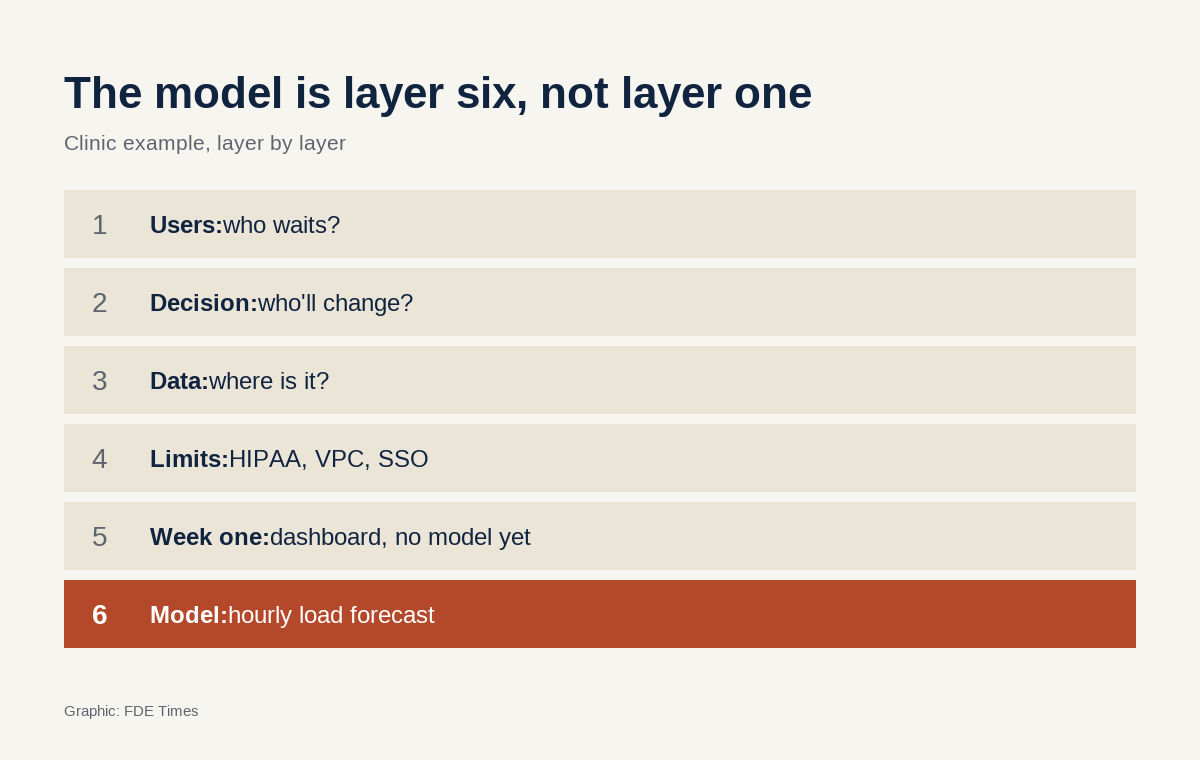
Take a hypothetical prompt: “A chain of clinics wants to use AI so patients wait less.” A data scientist will want to jump straight into predicting wait times with gradient boosting. An FDE breaks the problem down in a different order:
1. Users: who feels the wait? Patients, receptionists or doctors?
2. Decisions: who would act differently with better information? (receptionists rescheduling? the clinic adding shifts?)
3. Data: where do appointments, check-in times and consultation times live? Who is allowed to access them?
4. Constraints: medical data -> HIPAA, runs inside the client's VPC,
   login through the existing SSO
5. Week one: a dashboard of wait times by time slot, no model needed yet
6. Only then ML: forecast hourly load to suggest scheduling
Note that the model appears at the last step. The fourth layer is no accident either: Teki says the FDE system design round is tied to each client’s circumstances, with topics such as VPC, SSO and HIPAA/SOC2.
If in an interview you can say that this data must not leave the client’s infrastructure, you are answering the kind of question this system design round is aimed at, rather than just sketching a model architecture.
When a deployment breaks at 2am
Teki illustrates ownership with a very specific scene: a deployment breaks at 2am, and you do not file a ticket. For someone used to handing models off to another team, this is the biggest shift in mindset.
Back at the clinic, suppose the forecasting endpoint suddenly starts returning 401 errors. The old reflex is to alert the platform team. The FDE reflex is to trace it yourself: has the SSO token just been rotated, does the service account still have read access to the appointments table? Once it is fixed, you write up the root cause and add an alert so it is caught earlier next time.
The debugging mindset is still yours; its scope is now the whole system.
A practice plan: algorithms, one real project, a new CV
First, algorithms. Teki describes the coding round as LeetCode medium, framed as a customer scenario, and one candidate reported getting BFS and graph problems at Palantir. Notebooks do not train that reflex, so solve problems regularly and practice talking through your thinking out loud.
Second, an end-to-end project. FDE Academy recommends building a project with cloud, an API, authentication, a database and monitoring. The fastest route for ML people is to take one of your own old models, wrap it in a service with login, log predictions to a database, and build a dashboard tracking latency and drift.
Adding a small RAG layer is also worthwhile, since Teki’s skills list includes Python, LLM/RAG, cloud, SQL/pipelines and full-stack.
Third, the CV. According to Teki, the ability to ship end to end matters more than company names. For developers who have never worked at a big-name company, that is good news: every line of experience should say what problem you solved for whom, what system you shipped and how it performed in production.
When reading a job description, look for phrases such as “end-to-end”, “customer-facing” and “minimal supervision” to see whether the role needs exactly the skills you have just added.
The familiar traps for ML people
The most common trap is opening an answer with the name of a model. The interviewer wants to hear you ask follow-up questions about users and decisions; a comparison of XGBoost and transformers can wait.
The second trap is a portfolio made entirely of notebooks. Notebooks prove you analyze well, but they do not prove you can deploy, authenticate users or monitor a system. The third is underrating the algorithms round because you “do AI”. The coding round is still LeetCode medium, and Palantir’s posting still asks for a strong coder.
The last trap is talking about accuracy instead of the client’s outcomes. Nobody at the clinic is paying for AUC; they are paying for mornings when patients wait less.
An exercise for this week: pick a model you have built, write out the six decomposition layers for an imaginary client as in the clinic example, then ask yourself which layer you have never done yourself. That layer is what to learn next.
Was this article useful?
Thanks for the feedback!
5 sources
- The Definitive Guide to Forward Deployed Engineer Interviews in 2026 · 2026-01-15
- How to Become a Forward Deployed Engineer: Career Paths, Required Experience and Training Options · 2026-03-22
- Data Engineer to Forward Deployed Engineer: Skills, Gaps, and Transition Guide · 2026-04-13
- Forward Deployed Software Engineer (Palantir, Warsaw)
- The Rise of the Forward Deployed Engineer: History, Myths, and Why It's Back