FDE at Cohere: four variants in the job ads, and the evidence to prepare for each
Under one job title, Cohere hires people to build agents, people to install its platform inside customers' infrastructure and people to lead an entire rollout. Each track calls for a different kind of evidence.

In brief
- North can run in a VPC, on-prem or through Model Vault, so Cohere splits its FDEs into an agent-building track and an infrastructure-deployment track.
- The Agentic Platform track needs production Python; the Infrastructure track needs Kubernetes, Helm and experience with Azure, AWS and GCP.
- An agent project packaged with Helm, with an audit log and an infrastructure assessment checklist, shows ability more clearly than any list of technologies.
You open Cohere’s job ad for a Forward Deployed Engineer and read that the role leads the design, building and delivery of LLM-powered agents, agents that can reason, plan and act across multiple tools.
You move on to another ad with the same FDE title, and this one asks for experience administering production Kubernetes clusters and fluency with Helm. The title is the same, but the two people hired will do almost unrelated work.
Reading a job ad is an FDE skill in itself. It is exactly like reading a customer’s requirements: separate the must-haves from the nice-to-haves, then find the real problem the author needs solved.
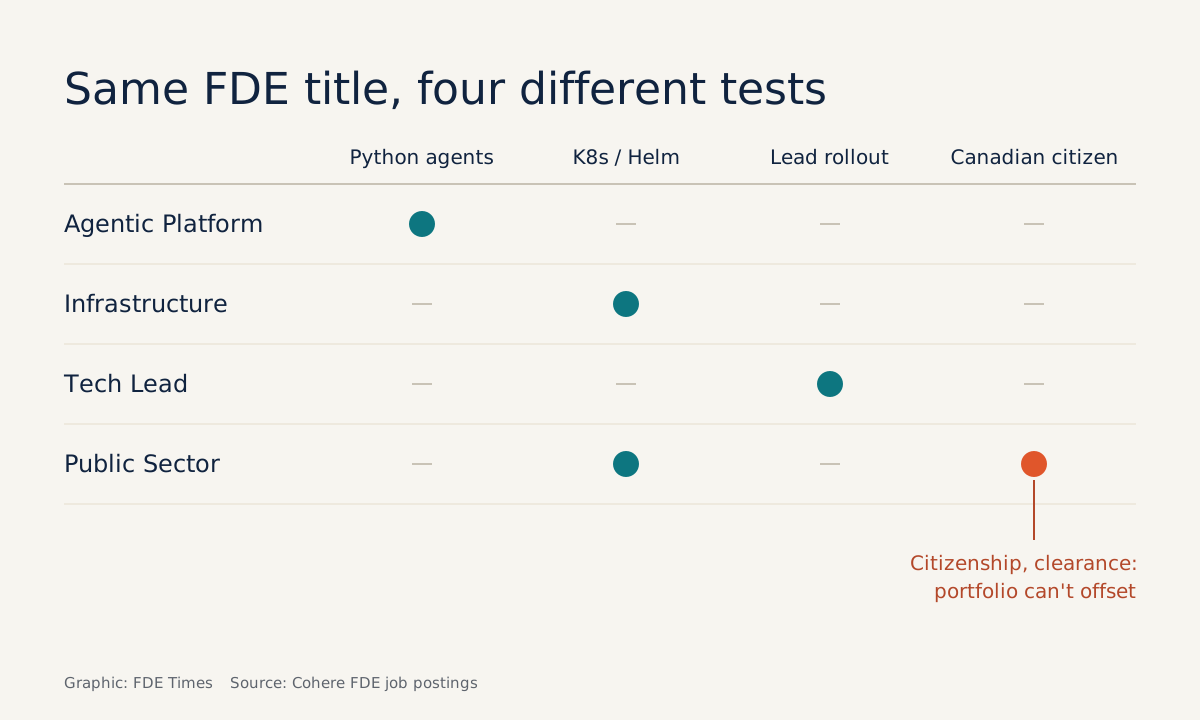
Cohere’s ads are a good exercise for practising this, because a single product has produced four kinds of FDE with four different tests.
If you are preparing to move into an FDE role, at Cohere or at any company selling an AI platform to enterprises, the decoding method below applies to most of the ads you will meet.
Why does one product need several kinds of FDE?
It all starts with how Cohere sells North. The company’s product page says customers can run North in their own VPC, in an on-prem environment, or through Cohere’s Model Vault inference platform. The same page stresses a zero-trust security framework, tight access control and auditability.
When a product can run inside a customer’s infrastructure, the work splits into two halves. The first is making North useful for a business problem: building agents and features. The second is getting North to run in a data centre that Cohere does not control.
The Agentic Platform ad covers the first half: shipping features for North and working directly with customers on business problems. The Infrastructure Specialist ad covers the second: leading the entire deployment of North on private cloud and on-prem.
Beyond these two tracks, Cohere also hires an FDE Tech Lead, who leads a team of engineers from several disciplines, including backend, infrastructure and agent development, on projects run directly with customers.
The Tech Lead owns the whole rollout of agents and tools, from planning and configuration to testing and delivery to end users. The fourth variant is an Infrastructure Specialist for the public sector, which requires Canadian citizenship and a security clearance.
What is each ad actually testing?
For the Agentic Platform track, the core technical requirement is hands-on experience building and deploying production-grade Python software.
The pluses include experience setting architectural standards for AI and agentic systems across distributed teams, and experience in heavily regulated industries.
The ad also states that expected travel is 20–40%.
The word “production” deserves the closest reading. A demo that calls a model’s API will struggle to prove this requirement. What you should show a recruiter is code that runs for the long haul: with tests, retries when a tool times out, logging, and packaging for deployment.
The Infrastructure track asks for three things: production Kubernetes and Helm; solid knowledge of cloud (Azure, AWS, GCP), networking and virtualisation; and the skill to work with a customer’s IT team to assess their infrastructure, security requirements and how they manage data.
The last point shows this is not pure operations work. Before you type the first install command, you have already had to do customer discovery at a technical level.
The public-sector version describes the FDE as the bridge between the North product and the customer’s engineering team. That is the right way to view all four ads: you stand in the middle, and your value lies in making the two sides understand each other.
Example: turning each line into evidence
Picture a bank that wants to run North in its own VPC, with an agent that looks up loan files, checks eligibility and creates tickets for the underwriting team.
This is a portfolio project that works for both tracks, because it touches agents, a heavily regulated industry and deployment inside private infrastructure. The table below matches each line in the ad with what you need to show.
| Line in the ad | What the recruiter is testing | Evidence you bring |
|---|---|---|
| Agents that reason, plan and act through tools | The agent decides which tool to call; it is not a chatbot | An agent calling 3 tools (database lookup, a mock internal API, ticket creation), logging each reasoning step |
| Production Python | Code that survives outside your machine | Tests for every tool, error handling when a tool times out, a Dockerfile |
| Experience in heavily regulated industries | Understanding of auditing and access control | An audit log recording who asked what and which records the agent read |
| Production Kubernetes and Helm | Can install, upgrade and roll back | A Helm chart for the agent itself, with two values files for two environments |
| Infrastructure assessment with the customer’s IT | Technical discovery | A checklist of questions used before installing |
The last cell is the easiest to skip when preparing on your own, so it deserves the most care.
A good checklist asks about the things that can wreck a deployment: which version the cluster runs, whether outbound internet calls are allowed, which internal registry images will be pulled from, which identity provider handles sign-in, how long logs must be kept, and which data is forbidden from leaving a given network zone.
Each of those questions maps to an incident that could happen on site. Ask in advance and the incident is solved on paper rather than on go-live day.
In what order should you prepare?
The first step is choosing a track. If your strength is Python backend work and you have built systems that call many services, aim for Agentic Platform.
If you have run real clusters, dealt with networking and been blocked by a security policy, Infrastructure is the better fit. Tech Lead is for people who have already led a multidisciplinary team in getting a product to end users.
For the public-sector version, once you meet the mandatory conditions, the core evidence is still that of the infrastructure track.
But because the ad describes the FDE as the bridge between North and the customer’s engineering team, you should also include a handover document written for that team: how to install, upgrade and roll back the deployment, and whom to contact when something goes wrong.
Next, build a project like the bank example above, but put most of your effort into the part that belongs to your chosen track. Agent builders should invest in evaluating whether the agent picks the right tool. Infrastructure candidates should try installing on an egress-blocked cluster to hit, first-hand, the errors that on-prem customers will hit.
Finally, rewrite your CV around outcomes. A line like “Kubernetes, Helm, Python, LangChain” only shows that you know the names of tools. A line such as “Packaged a Python agent calling 3 internal tools as a Helm chart, deployed it to a cluster with no outbound internet access, with an infrastructure assessment checklist used before installation” answers three requirements at once.
Mistakes that sink an application early
The easiest mistake to avoid is not reading the mandatory conditions carefully. The public-sector version requires Canadian citizenship and a security clearance, and no portfolio can make up for either. Likewise, 20–40% travel is something to think through before applying, not after the final interview.
The second mistake is bringing a prompt demo to a role that demands production. The third is common among infrastructure candidates who only know how to create clusters with a few clicks on a cloud’s managed service, while North is also installed on-prem, where you must handle the registry, certificates and network paths yourself.
Tech Lead candidates tend to slip into telling stories about code. The ad states that this person owns everything from planning until end users can use the product, so the story you need to tell is a rollout: who was trained, how it was tested, and what happened in the first week.
When preparing for interviews, do not revise only agents or Kubernetes. All four ads put you between the product and the customer’s engineering team, so practise asking the right questions of an unfamiliar IT team before touching their systems, starting with how you read the job ad.
Was this article useful?
Thanks for the feedback!
5 sources
- Forward Deployed Engineer, Agentic Platform – Cohere (U of T Startup Job Board)
- Forward Deployed Engineering Tech Lead – Cohere (U of T Startup Job Board)
- Forward Deployed Engineer, Infrastructure Specialist (North America) – Built In
- Forward Deployed Engineer, Infrastructure Specialist (Public Sector), Cohere AI – Built In
- North – Cohere