A Wharton course not meant for engineers is one FDEs should take
Start with the accounting module, so that next time you know which line of a client's financial statements your project actually moves.

In brief
- The course is written for entrepreneurs, managers and consultants, and it covers the knowledge engineers usually lack when they meet clients.
- Take accounting first: Brian J. Bushee's course takes about 16 hours and teaches you to read the three main financial statements.
- On a CV, the go-to-market capstone is worth more than the certificate itself.
The Coursera page for the Business Foundations Specialization says plainly who the course is for: entrepreneurs, small business owners, managers and consultants. Engineers are not on that list. That is exactly why FDEs should take it.
Picture a meeting with a client’s chief financial officer. They ask, “Which of our numbers does this project change?” The engineer can answer only in latency and model accuracy. Projects often stall at that moment, not in the code.
Wharton’s course is aimed squarely at that gap. It teaches the basics of accounting, marketing, finance and operations, enough for you to speak the language of the person who signs the contract.
A programme that has run for more than ten years
Wharton announced the series on 11 February 2015. It combined the four existing courses of its Foundation Series with a capstone project. The first course, Introduction to Marketing, opened on 6 April 2015, taught by three professors: Barbara Kahn, David Bell and Peter Fader.
The capstone has changed over time. The 2015 version had learners work with a corporate partner to solve a real problem. The current version asks learners to draw up a go-to-market strategy for a real business problem. Coursera estimates that most learners finish in about six months at a self-paced rhythm.
Six months is a long time for an engineer running a deployment. So the order in which you take the courses matters more than finishing all of them.
Why start with accounting?
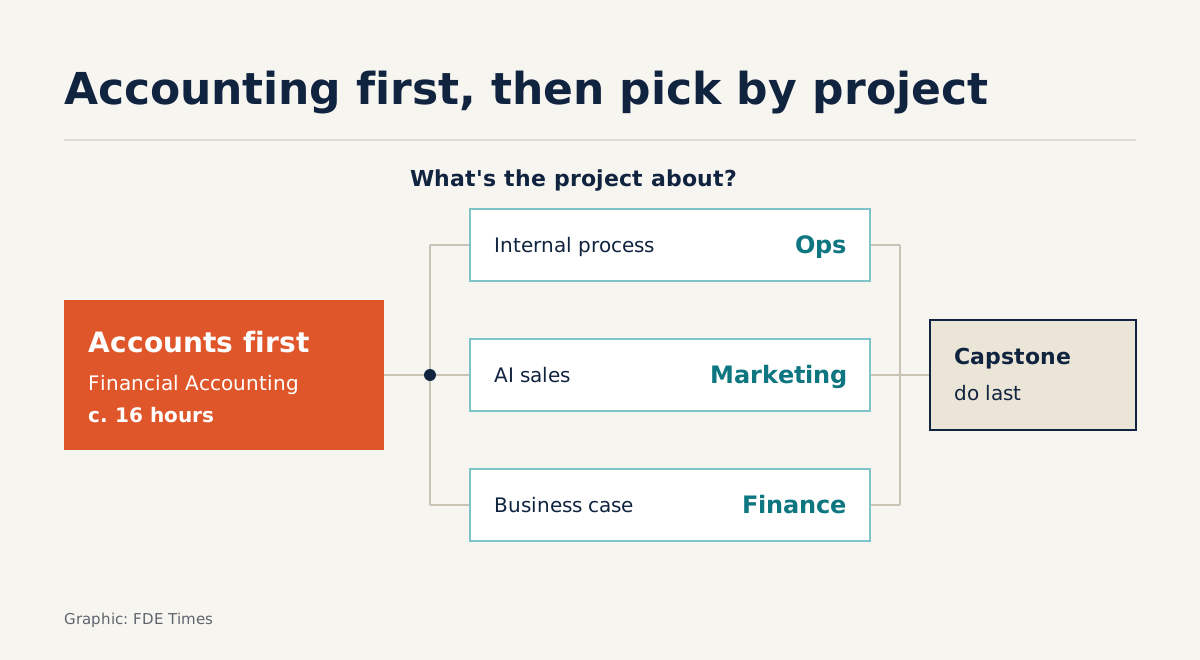
Introduction to Financial Accounting is taught by Brian J. Bushee and takes about 16 hours. Its goal is stated directly: by the end, you can read the three most common financial statements. For an FDE, this is a skill you can use with clients straight away, so it should come before the rest.
Imagine you are deploying an invoice-processing agent for a logistics company. Its income statement still shows a profit. But its cash flow statement shows negative cash from operations, because accounts receivable keep growing: its own customers are paying late.
If you cannot read those two statements, you will pitch the project as “saving labour hours”. If you can, you will see that the agent gets invoices out faster and brings cash in sooner, and that is what the CFO is actually worried about. The system is the same, but the second pitch hits the problem the decision-maker has.
A study order for people already on a project
After accounting, take whichever part sits closest to your current work. If you are deploying into an internal process such as a warehouse, customer service or document processing, take operations. If the client wants to use AI to sell better, take marketing. Leave finance for later, when you start having to write business cases for larger projects.
Save the capstone for last, and do not skip it. Treat it as an exercise in combining the four areas into one plan, which is close to what an FDE has to do when they want a client to expand a pilot.
Three ideas worth keeping
The first is that profit and cash flow are two different things. A profitable client can still be short of cash, and your project may be valuable precisely because it addresses that shortfall. You only see the difference if you can read all three statements, which is why Bushee’s course belongs at the top of the list.
The second is that each of the client’s departments works from its own set of numbers. The series covers four areas that map to four functions you will meet: marketing, finance, accounting and operations. Once you know who measures what, you can pick the metrics for your first evaluation before writing a line of code.
The third is that go-to-market is an engineering skill, not only a sales one. The capstone makes you answer: who does this product reach, through which channel, and why do they pay? An FDE who can answer that will carry far more weight in the feedback sent back to product.
How to put it on a CV
Coursera issues a certificate you can add to LinkedIn or a CV. On its own, the certificate is a weak signal. What makes an FDE recruiter stop and read is evidence that you can use the knowledge.
So rewrite your project descriptions in business language. “Built an OCR pipeline” should become “shortened the client’s invoicing cycle and reduced accounts receivable”. When a job posting asks for “business acumen” or “working with executive stakeholders”, the go-to-market capstone is what you bring to the interview as proof.
The course does not replace an MBA, and you do not need to go that far. All you need is that at the next meeting, when the CFO mentions accounts receivable, you understand immediately that they are talking about your project.
Was this article useful?
Thanks for the feedback!