The 1984 factory novel that tells FDEs what not to automate
Goldratt's The Goal shows that speeding up any step except the bottleneck leaves the customer's output unchanged and the queue longer.
In brief
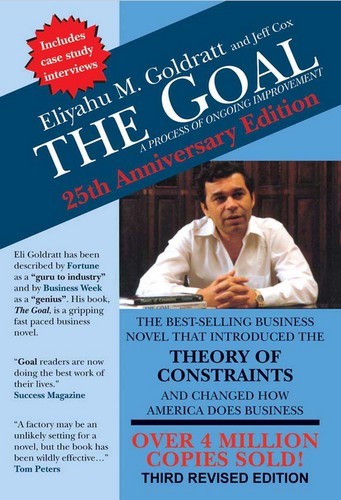
- The Goal by Eliyahu M. Goldratt and Jeff Cox is a novel about plant manager Alex Rogo, and the book that started the Theory of Constraints movement.
- The output of the bottleneck determines the output of the whole organisation, so strengthening any other step is waste.
- For FDEs, the lesson is to find where work is waiting and exploit that step first, leaving automation until last.
A novel about a factory, in print continuously since 1984, is closer to the work of an FDE than many books about AI. Many requests you receive on a customer site begin with “automate this step for us”, and The Goal explains why doing exactly that often achieves nothing.
The book was written by Eliyahu M. Goldratt and Jeff Cox and is published by North River Press. Its protagonist is Alex Rogo, a plant manager under pressure who struggles more and more to find a way to lift results.
Through his story, the novel sets out the foundational ideas of the Theory of Constraints (TOC). The TOC Institute calls it the book that started the whole movement.
The skill the book trains in an FDE is disciplined customer discovery: before writing a line of code, you need to know which step really limits the customer’s output. Skip this and you can ship an agent that runs flawlessly while the customer processes not one extra order.
Why does a great demo leave the numbers unchanged?
The TOC Institute puts forward a short proposition: every system has a constraint that limits its output, whether we acknowledge it or not. A second proposition follows: the output of the constraint determines the output of the entire organisation.
In the story, the constraint is personified in Herbie, the character who plays the bottleneck. The name is so memorable that it becomes a handy question to carry around: where is the customer’s Herbie?
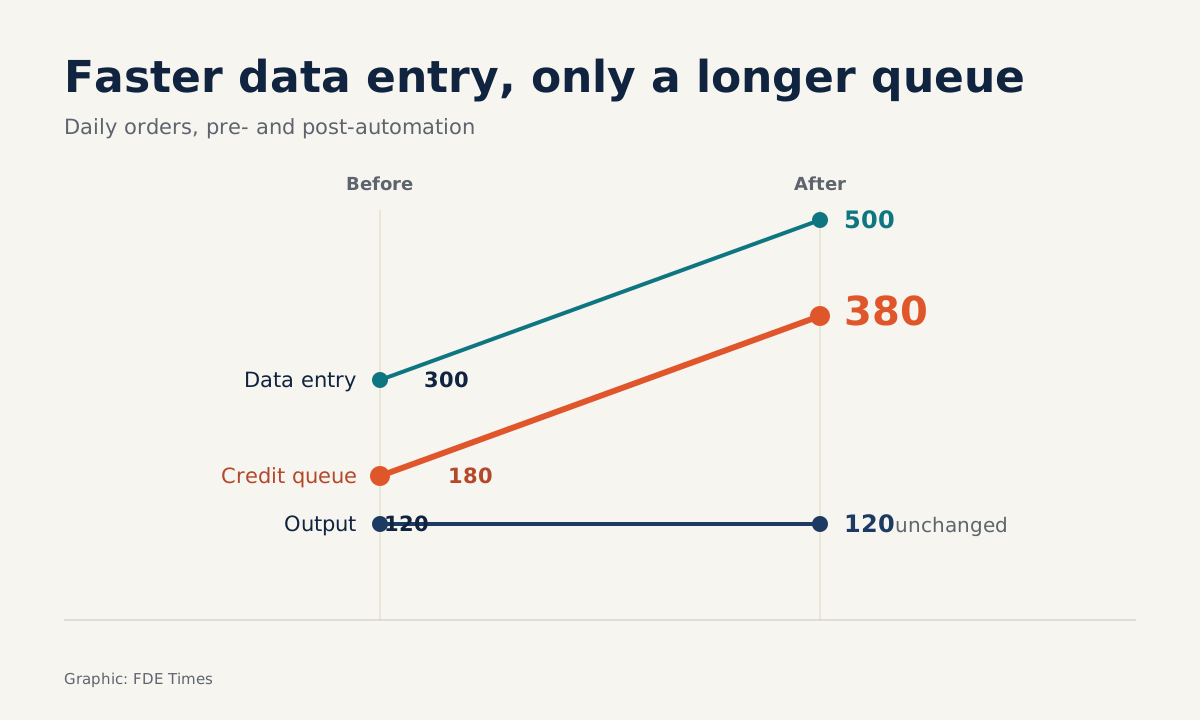
Picture a logistics customer that wants an agent to read emails and create orders. They receive 500 orders a day by email, the data-entry staff can key in 300, the credit-check team approves 120 by hand, and the warehouse can ship 400.
The real output of the system is 120 orders a day, and every day 180 orders pile up in front of the credit-check desk.
Now you automate data entry, pushing it to 500 orders. The demo is impressive. But output stays at 120, and the queue in front of credit checks grows from 180 to 380 orders a day. Operationally, you have just made things worse.
Three ideas worth taking into every engagement
The first idea is about measurement. According to the Goldratt team, the core lesson of the book is that the top goal must be to increase throughput, not to cut costs or raise local efficiency.
In the example above, nearly doubling the speed of data entry is local efficiency. Throughput does not move at all. When you write a value report for the customer, use the number of orders completed across the whole process as the measure.
The second idea follows from the first. The TOC Institute writes that strengthening any link in a chain other than the weakest one is a waste of time and effort.
For an FDE this should become a reflex: when the customer points at a step, your first question is whether that step is the weakest link, not which model to use.
The third idea tends to surprise readers most: a bottleneck is something to manage, not something to eliminate. If every system has a constraint, the sensible goal is not to remove it entirely. Your job is to know exactly where the constraint sits and to control it deliberately.
Why should automation come last?
TOC turns these three ideas into five focusing steps. For an engagement, the first four are the ones to master, and the first is to identify the constraint. The next two are to exploit the constraint, then to make every other step follow its pace.
The TOC Institute stresses that the constraint should be elevated, the fourth step, only after the other two have been done fully, and sometimes elevation is not needed at all.
Back to the logistics customer. Exploiting the constraint means looking at where the credit team spends its time. Suppose they spend hours gathering customer data from several different systems; a script that pre-assembles the file could raise the number of approved orders without touching an agent.
Following the bottleneck’s pace means data entry should not push orders faster than the credit team can process them, and the queue should be sorted by order value.
Only when the credit team is running at full capacity and it is still not enough does automating the approval step make sense. This order also helps you keep the customer’s trust: small, cheap, measurable changes come before a big project.
Who should read it, and how?
The edition to look for is the 30th anniversary edition. According to North River Press, it is the first time the story has been significantly updated.
Being a novel, the book reads quickly, and it suits engineers with 2-8 years of experience who have never worked in operations or have just moved into FDE work.
When you finish, open the TOC Institute’s page on the five focusing steps for a more compact version of the method.
The book teaches nothing about LLMs or data pipelines, so do not read it in place of those. It teaches the question to ask before you use those skills.
On your CV, state which constraint you found and how throughput changed, rather than listing what you built.
Next time a customer points at a step and says “automate this for us”, go and find their Herbie first.
Was this article useful?
Thanks for the feedback!