Shape Up and the question FDEs should ask before any estimate
Ryan Singer fixes the time at six weeks and cuts the scope to fit, a discipline every client pilot needs.
In brief
- Ryan Singer's Shape Up (37signals) is free to read on basecamp.com and was published on July 10, 2019
- Appetite is a time budget chosen up front. Time stays fixed while scope flexes to fit
- For FDEs, it is a way to settle the scope of a client pilot and keep projects from dragging on indefinitely
Ryan Singer has a rule that sounds brutal: work that is not finished in the time allotted is cancelled automatically. On episode 47 of the Rework podcast, released in July 2019, he described the mechanism as a “circuit breaker”.
For an engineer building an internal product, that rule is a matter of process. For an FDE it touches a familiar fear of the job: if nobody fixes the time at the start, the scope of a pilot swells a little with every meeting, until no one can remember when it was supposed to end.
Shape Up gives you the vocabulary to head that off in the first meeting. Its key word is appetite.
The free book many teams still skip
The full title is Shape Up: Stop Running in Circles and Ship Work that Matters, by Ryan Singer, published on the site of Basecamp (37signals). It came out on July 10, 2019, is entirely free to read online, and is presented as a spiritual successor to Getting Real.
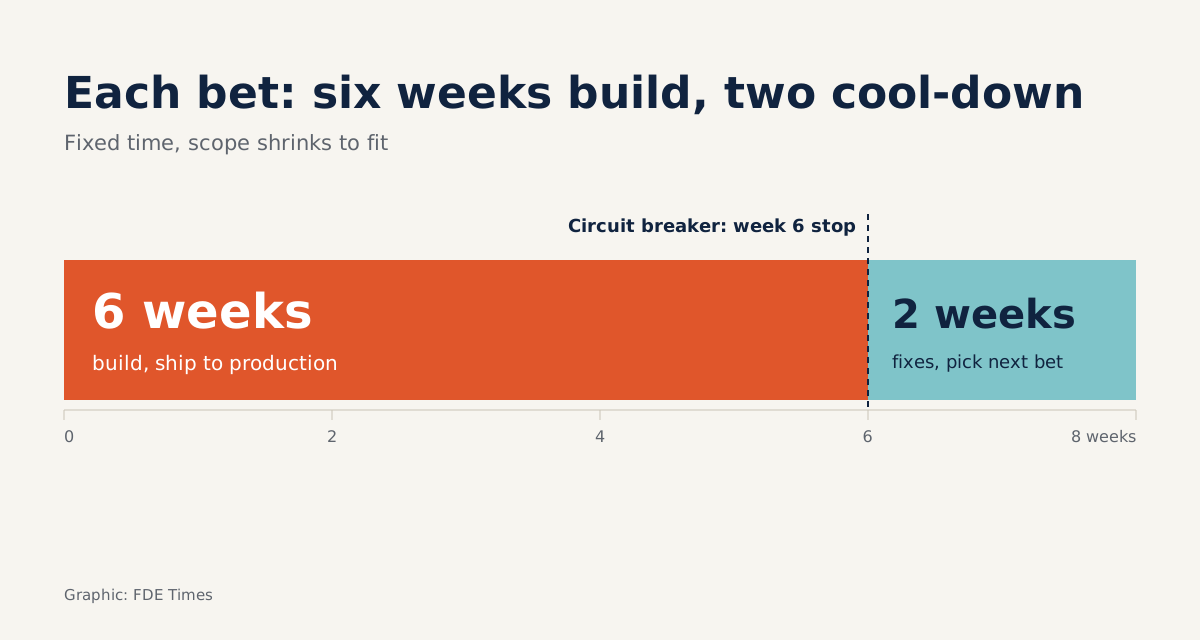
The book describes how Basecamp works. The company runs in six-week cycles. Each cycle is followed by a two-week cool-down for fixing bugs, handling work that has come up, and holding the “betting table”, the meeting that decides what the next cycle will bet on.
It is written for internal product teams, where the company decides both the time and the scope. Client work needs adjusting, because the contract may already have locked the feature list. Even so, three ideas from the book are worth applying with clients.
Idea one: ask what it is worth, before asking how long it takes
The book’s glossary defines appetite as the amount of time you want to spend on a project, and states plainly that it differs from an estimate. Singer puts it more compactly: appetite starts with a number and ends with a design. The number comes first and constrains the solution; it is never derived from the solution.
Alongside it sits the principle of “fixed time, variable scope”. The book calls this the key to defining and shipping projects.
A hypothetical example shows the difference. A client wants to pilot a customer support agent, with a dashboard, alerts and SSO login. Ask “how long will it take” and you add up four items to reach a number everyone knows will slip.
Fix an appetite of six weeks and the question becomes: which part proves the value within six weeks? Perhaps just the agent running on real data plus a simple metrics table. SSO and alerts wait for the next cycle.
And when the contract has already locked all four items? Then push appetite down to the milestone level: each milestone gets a fixed time box that both sides agreed at the outset.
Inside that box, you trade one feature for another instead of moving the deadline. The total scope in the contract stays the same; only the order and depth of each item are renegotiated at each milestone.
Idea two: why six weeks?
Basecamp settled on the number after much experimentation. According to Chapter 1, six weeks is long enough to build something meaningful from start to finish. It is also the longest stretch over which the whole team still feels the deadline looming from day one, and capping each bet at six weeks is how the book reduces risk in planning.
Appetite comes in only two sizes. A small batch runs one to two weeks; a big batch takes a full six-week cycle with the same size of team. Add the two-week cool-down and each big bet maps to an eight-week rhythm.
That rhythm suits an engagement well. In the first six weeks you build and go to production with the client’s real data.
The next two weeks go to fixing the bugs real data exposes, then sitting down with the client to choose the next bet. The client knows for certain that every eight weeks they will see a result and get to decide whether to continue.
Idea three: learn to say no, and wire in the circuit breaker
Chapter 3 advises that the default response to any raw idea should be “Interesting. Maybe some day.” The phrase does not close the door on the idea. It simply stops the idea from turning into a commitment before anyone has decided how much time it is worth.
Singer’s circuit breaker is the other half. When time runs out and the work is unfinished, the work stops; it is not automatically extended. With a client, a line such as “six weeks is the ceiling; if it isn’t done, we sit down and bet again” sounds rigid, yet it reassures them more than a schedule that keeps drifting.
Two traps when taking appetite to a client
The first trap is turning appetite into an estimate in disguise. If you add up the time for each item and call the total your appetite, the number has been derived from the solution, the very thing Singer says to reverse. The telltale sign: when scope grows, you raise the appetite to match instead of cutting scope.
The second trap is using the circuit breaker on a client who never agreed to it. At Basecamp the company decides on cancellation itself; with a client, an item that stops dead when time runs out looks like giving up if they first hear about the rule in week six.
So write the circuit breaker into the kickoff notes, along with an answer to what happens after it trips. If the client agreed beforehand, a tripped breaker is simply a clause being honored, and nobody hears it as bad news.
What to read first, and how to put it on a CV
The quickest route is to read Chapter 1 for the rhythm of cycles and cool-downs, then Chapter 3, Set Boundaries, the core material on appetite.
After that, listen to the Rework podcast episode to hear Singer explain it himself. The rest of the book can wait until you start leading a whole engagement.
The book fits FDEs best from their second year onward, when they begin negotiating scope themselves instead of taking tickets. If you are moving over from a software engineering role, it hands you the vocabulary to describe disciplined scoping.
On a CV, do not just write that you “managed scope”. Be specific: you fixed a pilot at six weeks, cut certain items to hold the deadline, and here is what happened. When an interviewer asks about scope creep, tell that exact story, including the appetite you chose and what you told the client “maybe some day”.
Every client will ask when the work will be done. Shape Up helps you ask back a harder and more useful question: how many weeks is this worth to both sides?
Was this article useful?
Thanks for the feedback!