Robert Shiller's Financial Markets: 33 hours to talk fluently with bank and insurance clients
With financial clients, FDEs rarely get stuck on code. They get stuck because they cannot follow what the client is saying. This Yale course fills exactly that gap in vocabulary.

In brief
- Robert Shiller, co-winner of the 2013 Nobel Prize in Economics, teaches this course on Coursera, Yale Online and in a 2011 Open Yale Courses recording
- Yale Online lists it at 7 weeks and 33 hours. Coursera splits it into 7 modules totalling about 34 hours
- For an FDE, the course's main value is the vocabulary and questions for discovery with financial clients, not trading skills
Picture your first working session at a bank. The head of risk talks about underwriting, brokerage and risk appetite. You take thorough notes, yet you leave the room still unsure which decision the system you are about to deploy is actually meant to support.
What is missing is not code but vocabulary. One course fills exactly that gap: Financial Markets by Robert Shiller, offered by Yale University.
If you are an FDE who wants to work with banks, insurers or securities firms, the course is worth your time. Not because it teaches you to trade, but because it helps you understand what your client is worried about.
Who teaches it, and which version should you take?
Shiller shared the 2013 Nobel Prize in Economics with Eugene Fama and Lars Peter Hansen. Yale School of Management now lists him as Sterling Professor Emeritus of Economics. In the 2011 recordings he lectures as the Arthur M. Okun Professor.
Asked why he teaches on Coursera, Shiller said he wanted to bring the kind of education once reserved for a few people at elite universities to learners around the world.
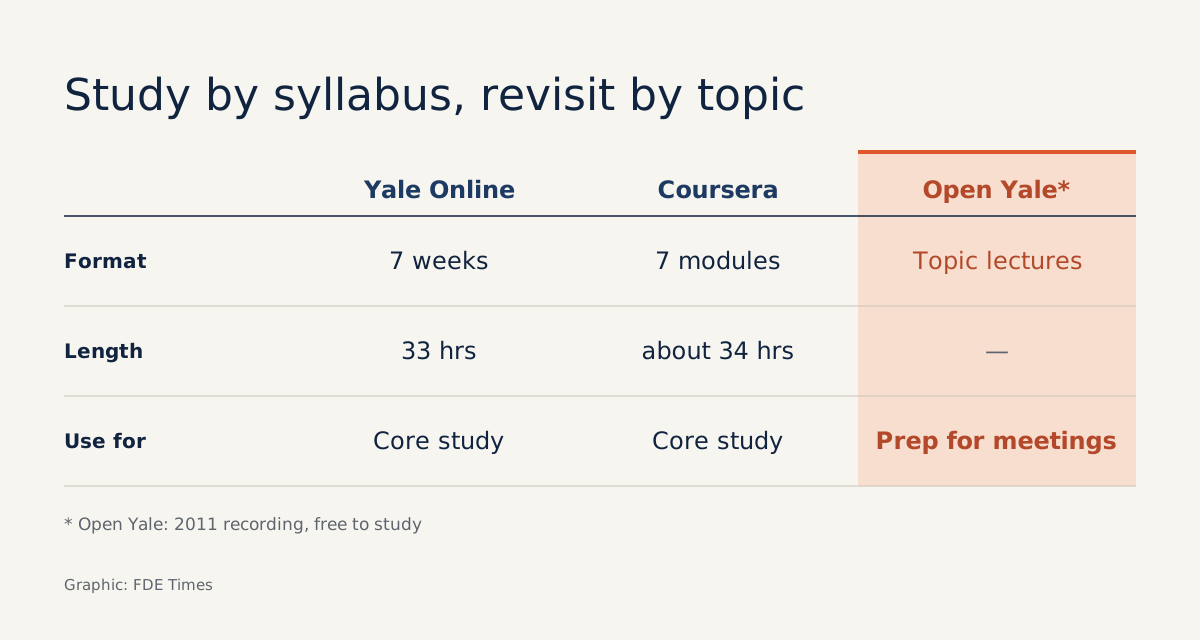
That is why the course comes in several versions. Yale Online lists it at 7 weeks and 33 hours, under 5 hours a week, which is manageable alongside a job. Coursera splits the material into 7 modules totalling about 34 hours.
The third version is ECON 252 on Open Yale Courses, recorded in spring 2011 and free to take. For an FDE it has one practical advantage: its lecture list is clearly named by topic, so you can find exactly the lecture you need before a client meeting.
What does the course actually teach?
Yale Online describes the course as an overview of the ideas, methods and institutions that allow society to manage risk and foster enterprise. The page also emphasises leadership skills grounded in financial understanding.
The Open Yale description is more specific: the course uses risk management and behavioural finance to explain how the securities, insurance and banking industries work.
That suits an FDE. You do not need to price a financial product yourself. You need to understand why the person across the table cares about it, so that you build what they actually need.
Insurance as the model case of risk management
The 2011 lecture on insurance calls it the archetypal risk management institution, and discusses both its opportunities and its weaknesses. That framing shows the lens of the whole course: every financial institution is a mechanism for handling one kind of risk.
Seen this way, each of your client’s workflows shows up as such a mechanism. Go back to the kickoff above: instead of asking “what dashboard do you need?”, ask “which risk is this process reducing, and if it goes wrong, who pays?” The answer gives you the evaluation criteria for the whole engagement.
Banks, brokers and exchanges need different questions
The 2011 version has separate lectures on banks, on investment banks, and one on exchanges, brokers, dealers and clearinghouses. On Coursera, module 6 groups investment banking, underwriting, brokers, dealers, exchanges and market innovations.
That split is a hint for FDEs: do not use one template for every client. Suppose you are deploying an agent for a brokerage. The lecture on exchanges and clearinghouses helps you ask which parties an order’s data passes through and in what order, rather than the vague “where does the data live?”
Before you visit a client, identify which kind of institution they are and review the lecture on that kind. An evening of preparation spares you questions that make the client feel they have to teach you from scratch.
Psychology is part of the system too
Behavioural finance studies how psychological factors affect investors and markets. The 2011 version has a dedicated lecture, “Behavioral Finance and the Role of Psychology”, followed by one on misbehaviour, crises and regulation. Coursera places behavioural finance in module 2, alongside forecasting, pricing, debt and inflation.
The detail an FDE should notice is that psychology sits right next to forecasting and pricing. The users of your system are professionals under pressure, with their own habits and fears.
When you design tools for an investment or risk team, watch how they actually make decisions rather than relying only on the standard process they describe in meetings.
From a lecture to a line in your glossary
To turn the course into a working tool, build a three-column table: the term, your own explanation after the lecture, and the question you will put to the client.
For example, after the lecture on exchanges, write down “clearinghouse” and restate the concept in your own words. Then add a question: “In your trade flow, which system does the clearinghouse data land in, and with what delay?”
Every good question leads to something you can build or measure, such as a data source, an alert flow or a slow report. A table of about one page is what you bring to the kickoff.
Common mistakes when taking this course
The first mistake is treating it as a personal investing course, fixating on markets going up and down and forgetting the central question: which risk is the client’s organisation handling. The second is watching every video and collecting the certificate without being able to explain any term yourself, so you are still at a loss when you meet the client.
The third is more dangerous: using a freshly learned term in front of the client before you really understand it. Asking directly “what do you mean by this term here?” is usually safer than a confident wrong statement.
In what order should you study?
If you are about to take on a financial client, start with Coursera or Yale Online for a clear seven-part path. The 2011 Open Yale version is good for revisiting a single topic, such as banking or insurance, just before you meet that kind of client.
For your career, when an FDE job posting mentions banking or insurance, check its industry terms against your glossary. On your CV, do not just list the certificate. Add a line on how you used that knowledge, for example by reframing a project’s evaluation criteria around types of risk.
Thirty-three hours will not make you an industry insider. But it is enough that the next time a client says “underwriting”, you can ask a well-placed follow-up question, and that question is where the client starts to trust you.
Was this article useful?
Thanks for the feedback!
6 sources
- Financial Markets | Yale Online
- Robert Shiller | Yale School of Management
- Financial Markets (2011) | Open Yale Courses · 2011
- Financial Markets (Coursera, Yale University)
- A conversation with Yale University Nobel Prize winner Robert Shiller · 2017-06-30
- What is Behavioral Finance? | Kaplan Financial · 2021-07-23