What an FDE should learn first in Maarek's 27-hour AWS course
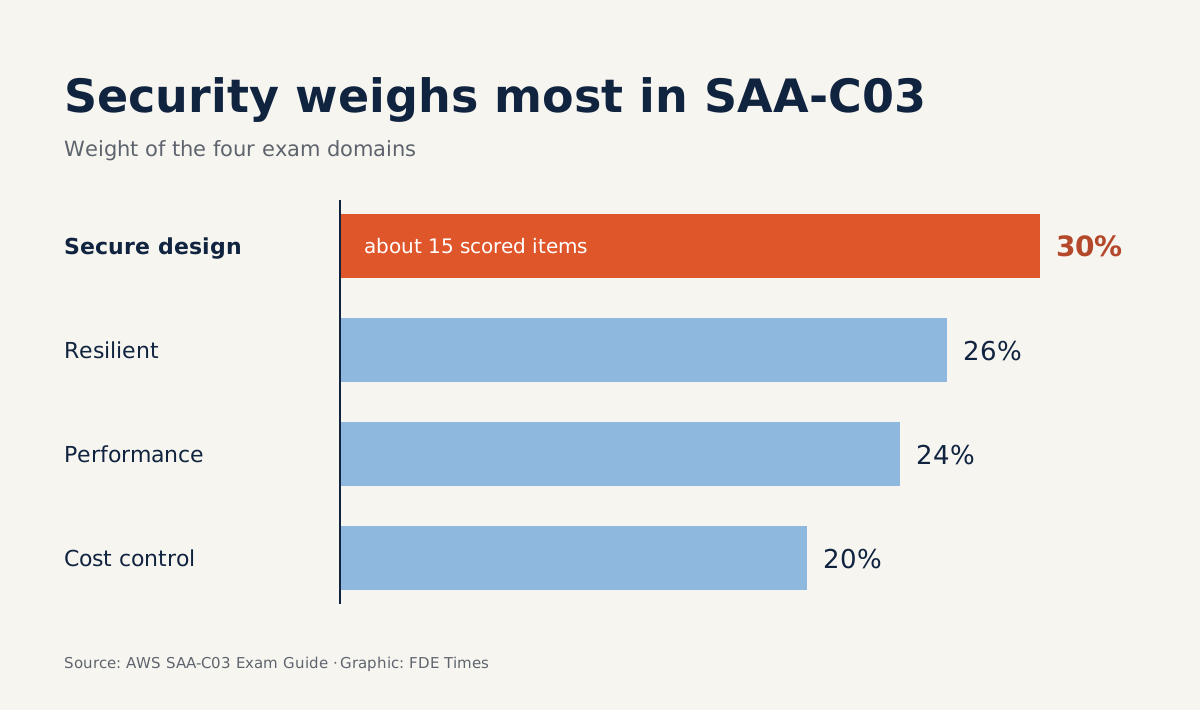
Security carries 30% of the marks on the SAA-C03 exam, and it is also the first gate you must pass at a customer.
In brief
- Stéphane Maarek's course runs about 27 hours 25 minutes, requires no prior AWS experience and uses the Free Tier for hands-on practice.
- Security accounts for 30% of the SAA-C03 score, the most of the four domains, so IAM, KMS and SSM are what an FDE should learn first.
- AWS wants candidates to have at least a year of hands-on solution design, so watching the videos alone is not enough.
The course runs 27 hours 25 minutes, with 399 lectures split into 33 sections. If you are given access to a customer’s AWS account next week, the practical question is not whether to finish it, but which part to study first.
Stéphane Maarek’s “Ultimate AWS Certified Solutions Architect Associate 2026” on Udemy is built to get learners through the SAA-C03 exam. For an FDE, though, its value lies elsewhere: it teaches exactly the services you will touch when deploying on infrastructure that is not your own.
That matters because at a customer you do not get to build the environment the way you like. You have to understand the system they already run, ask for the right permissions and propose changes their infrastructure team will approve.
Who teaches it, and what does it cover?
On his Udemy instructor page, Maarek describes himself as a solutions architect, consultant and software developer. He is an AWS Hero, holds the Solutions Architect Professional and DevOps Professional certifications, and is a co-founder of Conduktor. According to the course page on 13 November 2026, the course is rated 4.7 from about 301,000 reviews, with about 1.36 million students.
The course requires no prior AWS experience and uses the Free Tier for practice, so it suits software engineers who are new to the cloud. The early sections cover IAM & AWS CLI, EC2, ELB and Auto Scaling, RDS along with Aurora and ElastiCache, then Route 53.
Later sections extend to S3, serverless (Lambda, DynamoDB, Cognito, API Gateway), Well-Architected, disaster recovery and security with KMS, IAM and SSM. That is almost exactly the list of things you will meet when you open a customer’s console.
The exam already tells you what to learn first
AWS’s official exam guide says SAA-C03 assesses the ability to design solutions based on the Well-Architected Framework. In other words, the exam tests design skill, not just operations. It has four domains: designing secure architectures carries 30%, resilient architectures 26%, high-performing architectures 24% and cost-optimised architectures 20%.
Do the arithmetic: the exam has 50 scored questions, so roughly 15 of them are about security. In total there are 65 questions (including 15 unscored ones) to answer in 130 minutes, or about 2 minutes per question. The pass mark is 720 on a scale of 100 to 1,000, and scoring is compensatory, with no minimum score per domain.
The exam fee is $150; anyone holding a valid AWS certification gets 50% off their next exam.
Compensatory scoring means you can be weak in one area and still pass. But an FDE should not study just to scrape enough points, because the domain with the heaviest weighting in the exam is also the one customers scrutinise most closely.
Picture your first day at a customer
Suppose the customer is an insurance company that wants an agent to read documents in S3 and write the results to RDS. Before a single line of code can run, you need an IAM role that can read that specific bucket, permission to use the KMS key encrypting the bucket, and a way to fetch the database password without hard-coding it.
All three tasks sit in the security domain: IAM, KMS and SSM. The policy attached to the agent’s role can be as compact as this (the bucket, key and parameter names are examples):
{
  "Version": "2012-10-17",
  "Statement": [
    {
      "Effect": "Allow",
      "Action": "s3:GetObject",
      "Resource": "arn:aws:s3:::claims-docs/*"
    },
    {
      "Effect": "Allow",
      "Action": "kms:Decrypt",
      "Resource": "arn:aws:kms:ap-southeast-1:111122223333:key/claims-key-id"
    },
    {
      "Effect": "Allow",
      "Action": "ssm:GetParameter",
      "Resource": "arn:aws:ssm:ap-southeast-1:111122223333:parameter/claims-agent/db-password"
    }
  ]
}
Note what is missing: no s3:*, no "Resource": "*", no permission to write to the bucket.
So the sensible learning order for an FDE differs from the course’s own. Study IAM & AWS CLI first, then move straight to the sections on KMS, SSM and VPC security.
After that comes data (S3, RDS, Aurora, ElastiCache), followed by EC2 with ELB and Auto Scaling. Serverless comes next, and Well-Architected and disaster recovery go last, once you know enough to understand why an architecture is designed the way it is.
Three ideas worth keeping from the course
The first: access is architecture too. For an FDE, the 30% weighting on security is a reminder that an over-broad policy can easily get your change blocked at the customer.
The second is in the exam guide itself: the exam also tests reviewing existing solutions and proposing improvements. That is very close to what FDEs do in a customer’s environment, where the system was running before you arrived and your job is to point out what should be fixed.
The third is the course’s own limit. AWS says the ideal candidate has at least one year of hands-on experience designing solutions on AWS. Watching all 399 lectures is no substitute for building a system yourself, breaking it and fixing it.
Turn the certificate into evidence
AWS presents the certification as a way to boost the confidence of those who earn it. The advice here is not to stop at the certificate: pair it with a lab you can explain line by line.
Rebuild the insurance-company scenario above on the Free Tier and put it on GitHub with an architecture diagram, a policy like the one above and a short note on why each permission is necessary.
On your CV, list the SAA-C03 certification next to a link to that repo. In interviews, describe a time you read an existing architecture and proposed three changes.
Maarek’s course gets you to the exam room. Earning a customer’s trust with their AWS account starts the first time you ask only for the permissions you need, and nothing more.
Was this article useful?
Thanks for the feedback!