João Moura's crewAI course teaches you to divide work between agents. Production comes in the next course
Three hours of video is enough to build a crew that runs a demo. Getting it to run at a customer's site takes more study.

In brief
- The course is free for a limited time and runs about 3 hours 6 minutes, with 18 videos and 7 code examples. It is a good introduction to splitting a business workflow across several agents.
- Three ideas are worth keeping: role/goal/backstory is a job specification, loops must be bounded (max_iter), and Flows are the layer that separates a demo from a deployment.
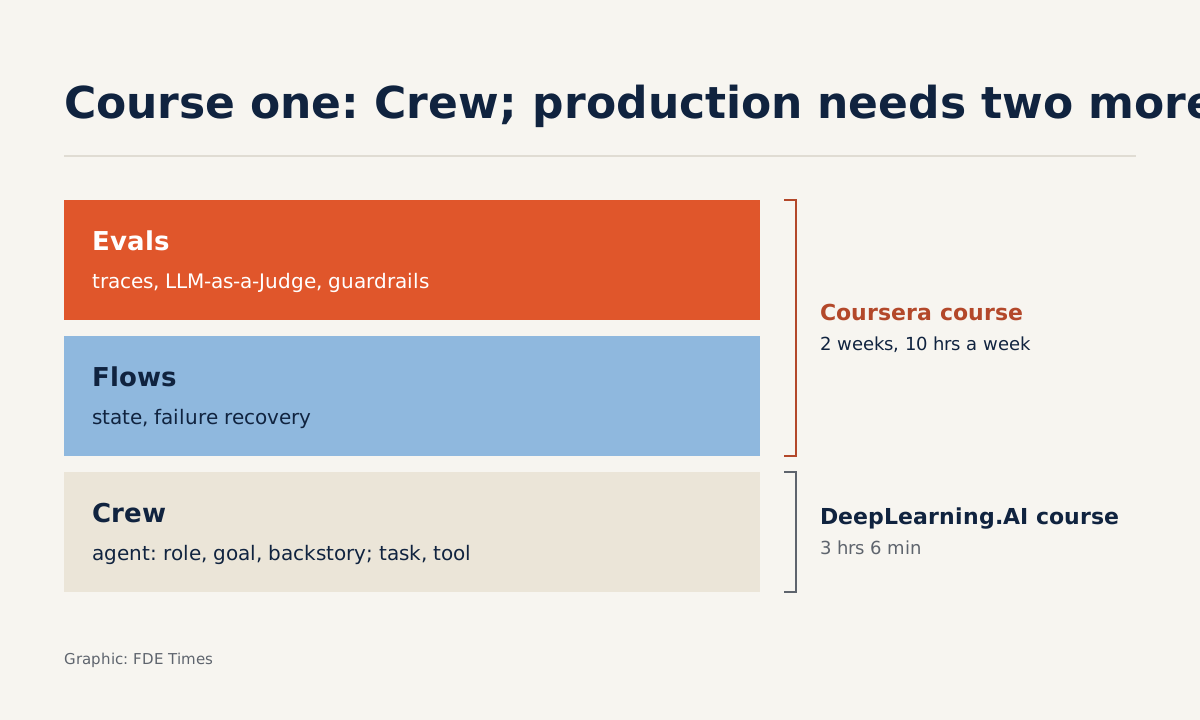
- For production skills, move on to the same instructor's Coursera course, which covers traces, LLM-as-a-Judge, guardrails and Flows.
The course has 18 videos and 7 code examples, about 3 hours 6 minutes in total. That is the whole of “Multi AI Agent Systems with crewAI”, a short beginner-level course on DeepLearning.AI taught by João Moura, founder and CEO of CrewAI. It launched in May 2024, and the official page lists an update dated 27 October 2026.
For an FDE, the question is not whether the course is good or bad. It is what those three hours give you when you face a real customer workflow. The course is very good at teaching you how to split a business process into work for several agents.
But it barely touches the things that keep a system standing once it meets real data. Know where that line falls and you know which parts to study closely and which to skim.
Three hours closer to FDE work than you might think
According to the official description, the course teaches how to design agents and organise a team of agents for multi-step tasks, then applies this to 6 common business workflows. The lessons cover agents, tools, tasks and how agents collaborate. The code examples include customer support, an outreach campaign, event planning, financial analysis and a crew that tailors job applications.
That list is exactly what customers bring you. They rarely ask you to “build agents”. They ask you to take load off the support desk, shorten the preparation of financial reports, or standardise outreach emails. The course trains the habit of looking at a workflow like that and breaking it into roles and tasks.
The course is free for now, but only for a limited time while DeepLearning.AI’s platform is in beta. Check the page again before sending the link to a colleague or a customer.
Idea one: role, goal and backstory are a job specification
The CrewAI documentation defines an agent through three fields: role, goal and backstory. The backstory supplies the agent’s context and personality. Seen through an FDE’s eyes, these three fields are a job description written for a model.
Picture a customer support crew at an insurer. A “policy lookup specialist” agent has the goal of quoting the correct clause. Its backstory states plainly that it may cite only internal documents.
To write that, you have to ask the classic customer discovery questions: who does this work today, what are they judged on, and what must they never do.
The first thing to do at the customer’s site: write role, goal and backstory with the people who actually run the workflow, not on your own.
Idea two: every loop needs a limit
The framework caps an agent’s loop with max_iter, which defaults to 20; once that is reached, the agent must give the best answer it has. Whether or not the course mentions it, an FDE has to watch this number.
Do the arithmetic: a crew has 3 agents, and each iteration calls the model at least once. If every agent runs all 20 iterations, a single request can take 60 calls before it stops. Multiply that by a few thousand tickets a day and you have the cost and latency question the customer will put to you, not to the instructor.
When you rerun the customer support example, record the actual number of iterations for each task, then lower max_iter to what is just enough.
Idea three: demo and deployment differ at the Flows layer
According to the CrewAI documentation, Flows connect Crews into a structured, event-driven workflow. Flows manage typed state and restore it automatically after an error or a restart. This is precisely the line between a demo notebook and a system running for a customer.
Getting an application-tailoring crew to run cleanly once is easy. A pipeline handling hundreds of applications that stops halfway has to know how far it got; otherwise it must start again from scratch and pay a second time.
What order to study in, and what to skip
If you are new to agents, take the whole beginner course and rerun all 7 examples. If you have built agents before, skim the concepts and spend your time on the lessons about collaboration between agents. Do not bother turning the event planning or outreach examples into finished products; they are exercises for understanding the concepts.
Then move on to “Design, Develop, and Deploy Multi-Agent Systems with CrewAI” on Coursera, also taught by João Moura. It covers using traces to monitor and debug agents, evaluating behaviour with LLM-as-a-Judge, using MCP servers, and adding guardrails, hooks and fine-grained control of execution with Flows.
Coursera lists it at about 2 weeks at 10 hours a week, far heavier than the first course, but it is the part an FDE needs most.
Turning the course into evidence on your CV
A completion certificate does not show an employer whether you can handle real data. Build a crew for a specific workflow, such as classifying support tickets from public data. Wrap it in a Flow, record traces, score it with LLM-as-a-Judge, and write a README explaining what max_iter you chose and why.
When reading FDE job descriptions, look for the words evaluation, guardrails and observability. They are what the second course teaches, and they belong in the first line when you describe your project.
Three hours with João Moura teach you how to divide work across a team of agents. The rest of the FDE job is proving to the customer that the team still does the right work when nobody is watching.
Was this article useful?
Thanks for the feedback!
6 sources
- Multi AI Agent Systems with crewAI – DeepLearning.AI · 2026-10-27
- 🌟 New Course! Enroll in Multi AI Agent Systems with crewAI · 2024-05-15
- Multi AI Agent Systems with crewAI – DeepLearning.AI short course · 2026-10-27
- Design, Develop, and Deploy Multi-Agent Systems with CrewAI – Coursera
- Flows – CrewAI Documentation
- Agents – CrewAI Documentation