25% to 50% of the time at the customer: why most FDE roles cannot be done from home
For most Forward Deployed Engineer roles, travel is part of the job. Engineers used to outsourcing work may lack the very skill those trips demand.
In brief
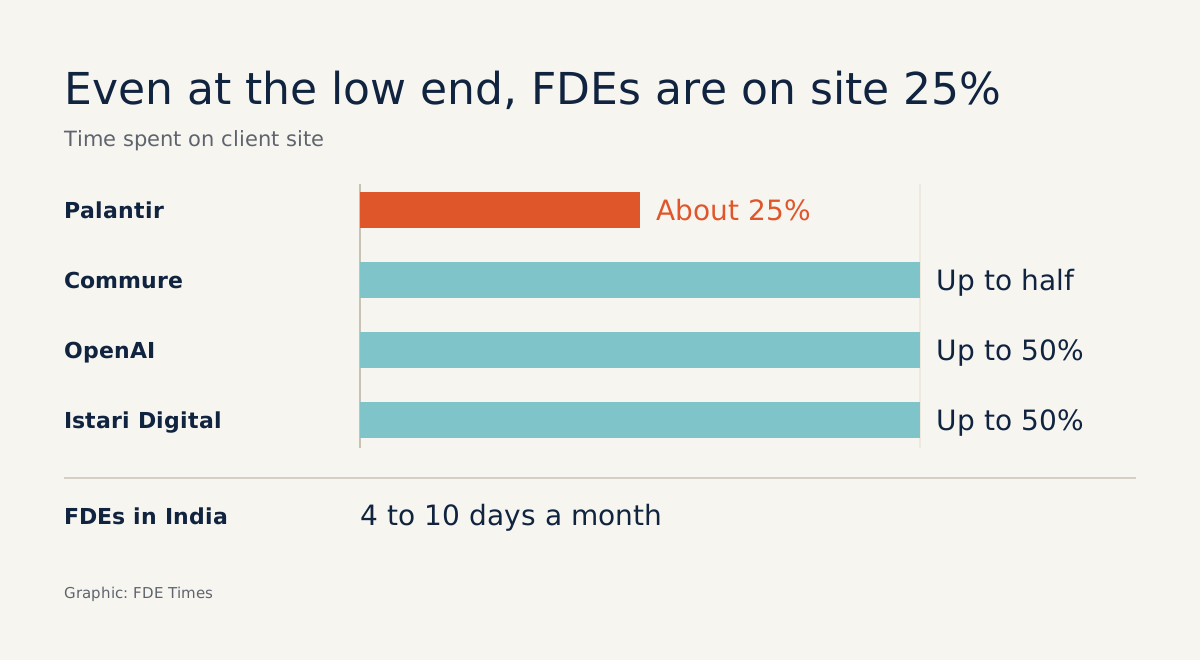
- The usual range is 25–50% of time at the customer: about 25% at Palantir, up to 50% at OpenAI and Istari Digital.
- The job is designed around working alongside customers, and some air-gapped systems cannot be reached remotely. Remote roles exist, but they are the minority.
- Vietnamese engineers used to working through an account manager should build direct customer experience before applying.
Istari Digital’s job posting for a Forward Deployed Engineer states plainly that candidates may travel up to 50% of the time, including to international customers in Australia. The next sentence is more telling: FDEs will work on-site inside customer teams to understand the problems they face.
Many Vietnamese engineers read FDE job descriptions for the technical requirements and skim past the “travel” line at the bottom. But for most of these roles, being present at the customer is part of what the job is. So for anyone hoping to enter the field, the first question is whether they have ever actually sat next to a customer. Willingness to travel comes second.
Travel levels vary, but almost everyone travels
The Pragmatic Engineer reports that Palantir expects FDEs to spend about 25% of their time at customer sites. Commure gives a higher estimate, up to half the time. The Pragmatic Engineer also notes that visiting and sitting with customers several times is fairly normal in the profession.
FDE Academy, a site dedicated to the role, gives a general range of 25% to 50%, with OpenAI reaching up to 50%. For FDE roles based in India, it estimates 4 to 10 days a month at the customer, with occasional trips around the APAC region.
For engineers in Vietnam, that is the closest available benchmark.
The amount of travel differs from company to company, but the way of working is the same: you have to be inside the customer’s environment, not picking up tickets from a distance.
| Employer | Time at customer site | Form of presence | What to note in the JD |
|---|---|---|---|
| Palantir | About 25% | Deploying the platform at customers | Even the “lightest” level is roughly one week a month |
| Commure | Up to half | Not specified | Ask which phase involves the most travel |
| OpenAI | Up to 50% | Travel to customers | Matches the top of the general range |
| Istari Digital | Up to 50%, including international customers in Australia | Working on-site inside customer teams | May involve international flights, not just domestic travel |
| FDE roles in India | 4–10 days/month | At the customer, occasional APAC travel | Closest benchmark for engineers in the region |
Why can’t it all be done over Zoom?
The first reason lies in how companies describe the role. Palantir writes that “Deltas”, its internal name for Forward Deployed Software Engineers, are responsible for deploying the platform to customers.
Deploying here means making the system work inside the real workflows of a real organisation, not shipping a build and waiting for feedback.
The second reason is technical and harder to avoid. FDE Academy argues that security and air-gapped systems are the main reason on-site work cannot be replaced by remote work. Its example: a defence contractor running an air-gapped network cannot let you log in from home.
Imagine having to debug a data pipeline running on the internal network of a hospital or a factory. There is no VPN, logs cannot leave the building, and the only person who understands the data flow is an operations engineer who works the morning shift. To get the job done, you have to go there.
FDE Academy acknowledges that some FDE roles allow remote work, but most do not. If you see an FDE job description that says “fully remote”, ask who the company’s customers are and where their data lives.
It sounds exciting, but heavy travel has a cost
Visiting customers in several cities, even several countries, sounds appealing to an engineer with three years’ experience who is used to working from one desk. But Paraform, a recruiting platform, warns that travel schedules can be very heavy, especially during the initial deployment phase, and do not always ease off quickly.
Paraform lists this among the causes of burnout.
So in interviews, do not just ask for the percentage. Ask how long a typical project lasts, and how the person before you got through the first few months.
It is also worth distinguishing two meanings of “on-site”. Visiting a customer for a few days of workshops is very different from what Istari describes: working inside the customer’s team. The second requires you to remain an employee of your own company while working day to day as a member of the customer’s team.
The account manager and the gap for Vietnamese engineers
This is exactly where Vietnamese engineers tend to stumble. Second Talent, a staffing company with a commercial interest in hiring, observes that Vietnam’s outsourcing model typically places an account manager between engineers and customers. This is a view from an interested party, so check it against the projects you work on.
If that model describes your work, you may well never have led a requirements-clarification session yourself, or answered a customer complaint directly. Requirements reach you as tickets that have already been filtered.
The real obstacle for Vietnamese engineers is therefore probably not visas or plane tickets, but a lack of experience handling an ambiguous request in the customer’s own office. You can be technically strong, but if you have never sat beside the users, the first on-site engagement can easily overwhelm you.
If you want in, start preparing now
First, read the travel line carefully in every job description. The 4-to-10-days-a-month benchmark for India-based roles is a realistic reference point when a company hires FDEs in Southeast Asia. If family circumstances or health rule out that level, you should know before applying, not at the offer stage.
Second, find ways past the account manager layer in your current job. Ask to join a demo, a requirements session, or a go-live support shift at the customer’s office.
A CV line such as “worked directly with the customer’s operations team during a two-week go-live, handling change requests on site” carries far more weight than a list of frameworks.
Third, choose customers with difficult environments where you can. None of the job descriptions above states this as a criterion, but experience in places where data cannot leave the premises, such as banks, hospitals or factories, is likely close to what FDEs face in air-gapped environments.
The line “up to 50% travel” in a job description says more than how much you will travel. It tells you the company is looking for someone who can work with customers directly, with no one in between.
Was this article useful?
Thanks for the feedback!
6 sources
- What are Forward Deployed Engineers, and why are they so in demand? · 2025-08-12
- Why Do Forward Deployed Engineers Travel? · 2026-07-25
- Do Forward Deployed Engineers Actually Work Remotely? · 2026-07-27
- Forward Deployed Engineer (Commercial / International) – Istari Digital
- What is a forward deployed engineer? A complete guide · 2026-09-03
- Forward Deployed Engineer Salary Vietnam: ₫20M-₫120M/mo · 2026-09-14