FDE services: a moat for the product, or a consultancy dressed as software?
Both jobs put an engineer in the customer's office. At some companies the work becomes product; at others it only becomes billable hours. Before you accept an offer, find out which kind you are joining.

In brief
- OpenAI has set up a subsidiary dedicated to placing engineers inside enterprises: FDE services have become a formal business unit.
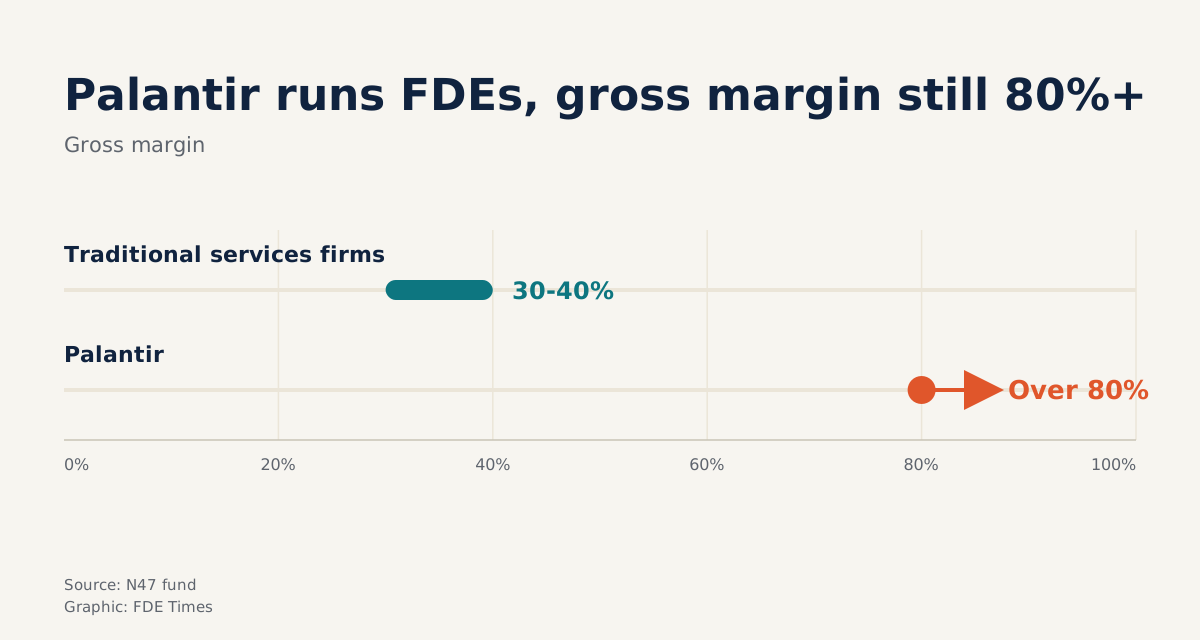
- The risk is drift: traditional services firms run at 30-40% gross margins, while Palantir holds above 80% despite heavy field deployment.
- The line between FDE work and consulting is the feedback loop into the product, and it is the thing to ask about in every interview.
In May 2026 OpenAI launched the OpenAI Deployment Company, a subsidiary dedicated to placing engineers directly inside enterprises, starting with more than $4bn in committed capital. Decrypt’s headline did not mince words: OpenAI had just set up a consulting arm.
Gergely Orosz, author of The Pragmatic Engineer, sees a broader trend: many new FDE roles sit in semi-independent companies, separated from the organisation where the AI product is built, and look more like consulting or systems integration.
That raises a question for anyone who works as an FDE or wants to: is your services work building up the product, or are you simply selling hours under a new name? The answer lies in whether what is learnt in the field makes its way back to the product, not in the job title on the offer.
Why do software companies take on services work?
a16z is candid about the cost: per-customer customisation initially drags gross margins down and pushes burn up. It cites two familiar names to illustrate. At IPO, ServiceNow had a gross margin of 63.2% and Workday just 54.1%, well below software’s ideal of roughly 80%.
The shortfall did not last. By 2024, according to a16z, ServiceNow had reached 79% and Workday 75%. In other words, ServiceNow recovered 15.8 percentage points and Workday 20.9.
TSIA, a research organisation focused on the technology services industry, names the trade precisely: short-term margin in exchange for long-term defensibility. It also attaches a condition, which is turning one-off deployments into reusable templates.
That condition explains how margins can recover: customisation only becomes an asset when it does not have to be rebuilt for the next customer.
The slippery slope towards consulting
The fund N47 looks at the flip side of that argument. Traditional services companies, it says, operate at gross margins of 30-40%. N47 predicts that many companies trying the FDE model will gradually drift into consulting businesses dressed up as software companies.
The telling detail is the counterexample N47 offers. Palantir, the company most closely associated with the FDE model, still holds gross margins above 80% despite deploying heavily in the field. So the gap between 30-40% and above 80% is not explained by how many engineers are sent out to customers.
In N47’s view, the healthy model is one in which innovations from the field are systematically fed back into the product’s core capabilities. That is what separates Palantir from an outsourcing shop with a lot of engineers.
The same job title can therefore lead to two very different jobs. Picture the first company: you write a connector, a prompt or a pipeline for customer A, and the product team packages it so customer B can use it straight away.
At the second, you rewrite everything from scratch for each customer, and the value you create comes down to the number of days you have put in.
The line is the feedback loop
Several independent sources arrive at the same test. KDnuggets writes that without a feedback loop from the field to the product, the role is simply consulting.
Valletta Software puts it differently: the obligation to feed customer-specific work back into the product is what separates an FDE from a consultant, and if nobody owns that obligation, “FDE” is just a label.
The table below groups those signs into two extremes for easy comparison. In practice, a company can show signs from both columns at once.
| Aspect | Services drifting into consulting | Services building a moat for the product |
|---|---|---|
| Reference gross margin | 30-40%, the level of traditional services firms | Above 80%, like Palantir; ServiceNow and Workday recovered to 79% and 75% |
| Output of each project | A one-off deployment | A reusable template for the next customer |
| Field work | Stays with the customer | Flows back into the product’s core capabilities |
| Who owns feeding it back to the product | Nobody in particular; “FDE” is just a label | A named person |
| Place in the organisation | Separate from where the product is built | The product team regularly reads what FDEs learn |
Which column is OpenAI in?
Seen through Orosz’s lens, OpenAI’s decision to put its deployment business in a separate subsidiary is a sign worth watching: organisational distance from the product team is what makes the feedback loop easy to break.
But a separate legal entity does not automatically mean a broken loop. What matters is whether there is a process that brings field work back to the product.
The large sum committed to a company focused purely on deployment shows that the services model is attracting investment at scale. For companies that have chosen this route, the question worth asking is where the field work ends up.
For job seekers, this is where to look closely. If, at the company you are about to join, what FDEs build and learn in the field never makes it back to the product, your career path will resemble a consultant’s, even if your title contains the word “engineer”.
Which skills put you in the right-hand column?
The core skill is spotting which part of a customer-specific request could be shared. Imagine you are asked to write a script that cleans order data for a retail chain.
An ordinary engineer stops once the script runs. A good engineer separates out the customer-specific configuration, writes tests, then opens a proposal to the product team, in the spirit of turning a one-off deployment into the template TSIA describes.
Write your CV the same way. Instead of “deployed a solution for customer X”, state clearly what you built for one customer that became a component other customers reused, or that shortened the next deployment.
For interviews, two questions are ready-made. KDnuggets suggests asking who on the product team reads what FDEs learn in the field, and how often. Valletta suggests asking who, by name, is responsible for turning customer-specific work into product features.
If the interviewer stumbles over both, you know which column you are looking at. KDnuggets still regards FDE as a good career choice when that feedback loop exists, so your job is to pick a place that has one, and after every project leave behind something that lets the next customer be deployed faster.
Was this article useful?
Thanks for the feedback!
7 sources
- Trading Margin for Moat: Why the Forward Deployed Engineer Is the Hottest Job in Startups · 2025-06-04
- The Forward Deployed Engineer dilemma · 2025-09-22
- What Is Forward Deployed Engineering? 4 Ways It Powers AI Economics · 2026-04-07
- Forward Deployed Engineer: AI's Hottest New Career, or Consulting With a Better Title? · 2026-10-02
- Forward Deployed Engineer vs Software Engineer · 2026-09-08
- The Pulse: Forward deployed engineering heats up again · 2026-05-24
- OpenAI Just Launched a Consulting Arm to Help Companies Deploy AI · 2026-05-11