The $550,000 FDE figure is annual total compensation at two leading AI labs, not a monthly salary
The median base salary in US forward deployed engineer job postings is about $190,000 a year. The $550,000 figure is the top of an estimate of total compensation at OpenAI and Anthropic. Most of the difference is equity, which pays out slowly and is hard to value.

In brief
- $550,000 is the top of an estimated range for annual total compensation at OpenAI and Anthropic. On Levels.fyi, median FDE total compensation in the US is $215,000.
- Across 135 US job postings, median base salary is about $190,000 a year, and base is capped by level. Bonuses are usually 15–25% of base.
- At the top of the market, equity makes up 55–70% of the package. It usually vests over four years with a one-year cliff, and what it is worth depends on how it is valued.
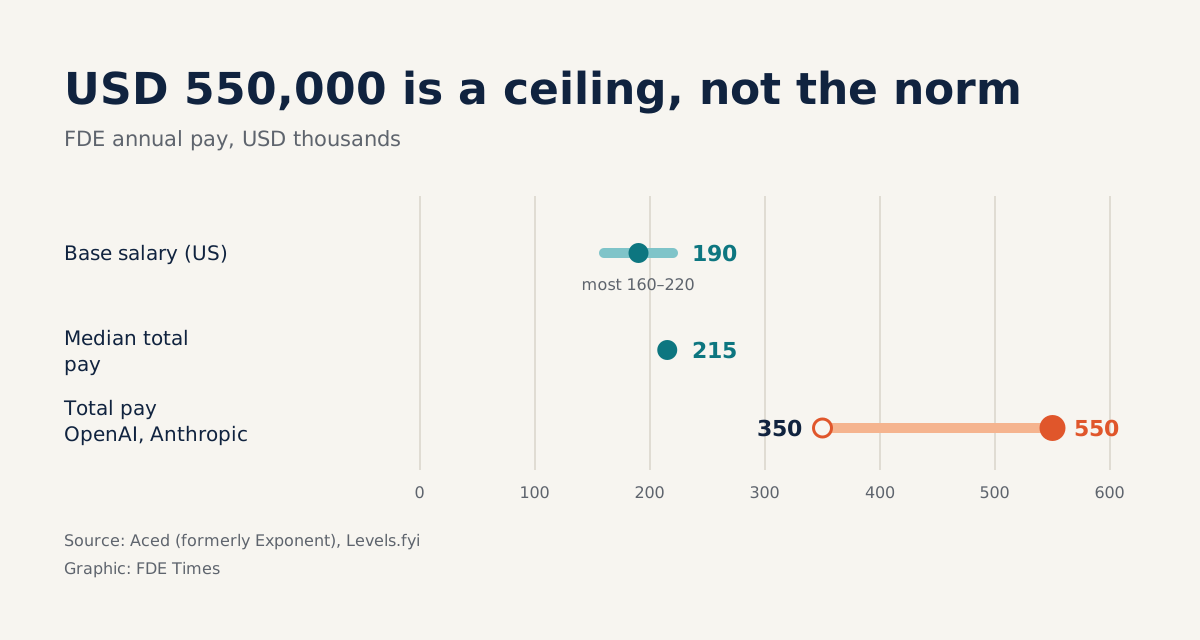
The $550,000 often quoted as “FDE salary” is the top of an estimate for annual total compensation at the leading AI labs. The same 2026 pay survey from Aced (formerly Exponent) puts the median base salary across 135 US forward deployed engineer (FDE) job postings at only about $190,000 a year.
The two numbers describe two different groups of people. The gap between them is not one pay package split into parts.
Even at those labs, the thing that lifts total compensation to $550,000 is mostly equity. Equity vests year by year rather than arriving monthly, and what it is worth depends on how you value it.
If you are thinking of moving into an FDE role, or already have an offer, misreading this structure can lead to two mistakes. The first is expecting a monthly payment that nobody promised. The second is choosing the offer with the bigger headline number when its first-year cash and vested equity are actually lower.
$550,000 is the ceiling for a small group, not the norm
Aced estimates total compensation for FDEs at OpenAI and Anthropic at $350,000–$550,000. Those are the two leading companies, not the whole market. Levels.fyi, which collects self-reported pay data, records median FDE total compensation of $215,000.
Perspective’s 2026 compensation report, built on 1,200 data points from Levels.fyi and public job postings, shows a very wide range. At one end is Palantir’s median of $215,000. At the other are senior FDEs at Anthropic and OpenAI on more than $785,000. The job title is the same, but the pay differs by more than three times.
So $550,000 is useful as a marker for the top of the market, not as what to expect from a first offer. To see where you stand, split the package into its layers.
The cash layer: base is capped by level, bonus is a percentage
According to Aced, half of US FDE postings list a base between $160,000 and $220,000 (25th to 75th percentile). Perspective’s salary negotiation guide notes that base is largely capped by level, so there is limited room to push it up without moving to a higher level.
Bonuses are surprisingly predictable. Perspective finds that FDE annual bonuses are typically 15–25% of base, tied to performance, and the target is usually met. On the median base of $190,000, that gives a bonus of about $28,500–$47,500, bringing annual cash to roughly $218,500–$237,500.
Divide a $190,000 base over 12 pay periods and you get about $15,800 a month before tax. For an FDE at the median, that is the figure closest to a “monthly salary”.
Read published pay ranges carefully, too. Anthropic’s $280,000–$320,000 range, which Aced identifies as the highest floor among public US ranges, already includes target bonus. Not all of it is guaranteed fixed cash.
The equity layer: the largest share, but slow to arrive
What inflates total compensation is equity. Perspective finds that equity now makes up 55–70% of the package at the top of the market, up from 35–45% in 2024. Aced says that at OpenAI (which pays in PPUs) and Anthropic (with RSU-heavy packages), equity can bring total compensation to roughly double the cash.
Equity does not arrive monthly. Perspective describes the structure at the big labs as RSUs in a private company, vesting over four years with a one-year cliff, and treats this schedule as the standard.
Suppose you are granted equity valued at $800,000. That is $200,000 vesting each year, but nothing at all in the first 12 months.
If you leave in month 11, you take no equity with you. Work out what the cliff means for you before you sign, not after.
One equity grant, several valuations
Aced counts about 70% of FDE postings as explicitly mentioning equity. But according to Aced, startups such as Sierra, Ramp and Perplexity grant significant equity on top of the posted range without giving a figure. To find out what it is worth, you have to ask directly at the offer stage.
At that stage, Perspective’s guide advises valuing private-company equity on a fully diluted basis and checking it against both the 409A valuation and the preferred share price from the latest funding round. The reason, according to the guide, is that preferred shares are typically priced at two to five times common stock.
A worked example: a recruiter says your equity is “worth $400,000” at the latest round price. If what you receive is common stock, a more realistic value may be only about $80,000–$200,000. It is the same grant, but the number on the slide and the money you can actually realise can differ by a factor of five.
| Package layer | Benchmark | When it becomes cash | Question to ask |
|---|---|---|---|
| Base | Median about $190,000/year, most $160,000–$220,000 (US) | Paid each pay period | What level is this role, and what is the base cap for that level? |
| Bonus | 15–25% of base, performance-based | Annually, when targets are met | Does the posted range already include target bonus? |
| Equity at big labs (PPUs, RSUs) | Can bring total compensation to roughly double the cash | Usually vests over 4 years, 1-year cliff | How much do I actually receive in the first 12 months? |
| Equity at startups | Postings often give no figure | Ask for the vesting schedule at offer stage | What is the fully diluted share count, the 409A price and the preferred round price? |
Read an offer the way you would read a client contract
Perspective advises comparing offers on total compensation defined as cash plus equity vesting in the first year, not on the headline number. This puts every package in the same terms.
In the hypothetical example in the figure, offer A at $300,000 is mostly cash, while most of offer B’s “$450,000” is equity valued at the preferred share price. Revalue B’s equity at the common stock price and its first year comes to only about $264,800–$334,250, which may be less than A.
This is also a core skill of the job. A good FDE does not accept a client’s number at face value but asks how it was calculated, from what data, and on what assumptions. Apply the same customer discovery habit to your own offer: ask about each layer, write down the answers, then do the maths yourself.
If you work in another country, do not compare these figures directly, but the method still applies. Split your local offer into base, bonus and equity, ask the same questions as in the table, and compare on cash plus first-year vesting.
Because base is capped by level, the real negotiating leverage lies in the level you are assigned and in the equity. When writing your CV or preparing for interviews, bring evidence for a higher level: deployments you owned end to end, and technical decisions you made in front of clients.
The FDE market is paying more and more in equity. Those who benefit will be the people who can read a cap table and a vesting structure, not the ones who remember the biggest number.
Was this article useful?
Thanks for the feedback!
4 sources
- Forward Deployed Engineer Salary: 2026 Data by Company - Aced (formerly Exponent) · 2026-09-02
- The 2026 Forward Deployed Engineering Compensation Report: What 1,200 FDEs Earn · 2026-05-21
- Forward Deployed Engineer Salary Negotiation in 2026: A Data-Backed Guide · 2026-06-17
- Forward Deployed Engineer Salary - Levels.fyi · 2026-10-09