One candidate's account: Cognition AI's final FDE round includes a pitch to executives
A pitch to a panel of executives does not grade how well you talk. It tests whether you really understand why the product is worth paying for.

In brief
- An FDE candidate at Cognition AI says the final stage of the loop was simulated customer work: one-on-ones, a case on a hypothetical company and a product pitch to a group of executives. The pitch was not about polished salesmanship.
- Paraform counts executive communication as a core FDE skill. Palantir's interview rounds and the customer-simulation round Scaler describes test the same habit in different forms: understand the problem before proposing anything.
- To persuade executives, build the habit of understanding the problem first: name the stakeholders, state your assumptions out loud, and only then present the solution.
A Forward Deployed Engineer (FDE) candidate at Cognition AI has described the final stage of their interview loop. It was simulated customer work: a set of one-on-ones, a case on a hypothetical company and a product pitch to a group of executives.
This is one person’s account, not an official description of Cognition’s process. Still, if you are aiming for an FDE role, the detail is worth noting, because it matches what many other FDE hiring guides stress.
So what does a final stage like this really measure, and how do you prepare for it if you are not a natural speaker?
Why it doesn’t grade salesmanship
The most striking part of the account is how the candidate read the pitch round. The brief was to explain the product’s value and where it sits in the customer’s workflow or systems. According to the candidate, the round was not about polished salesmanship.
The Cognition interview guide on Exponent/Aced likewise calls the pitch to a simulated panel the strongest test of whether you understand why the product matters to the customer.
Seen that way, preparation changes entirely. If you treat it as a sales meeting, you will rehearse your delivery, polish your slides and memorise closing lines.
If you treat it as a test of “why”, you have to answer harder questions. What problem does the product solve? How much effort is that problem costing whom? Why is this approach more sensible than the alternatives?
The candidate said the hardest part was not writing code. It was the barrage of “why” questions, and staying calm when asked something they had not prepared for.
The guide on Aced also describes Cognition’s later rounds as moving to pitching and answering customer questions on the spot. An engineer who has only memorised the features will struggle to survive the second question.
What language do executives listen in?
Read Paraform’s 2026 FDE hiring guide and a pitch round makes sense. Paraform lists executive communication among the core FDE skills. Its example is translating an architecture decision into the things a finance executive cares about.
Paraform pairs that skill with customer empathy: understanding why the customer’s workflow is the way it is before proposing changes. The two always go together, because you cannot speak your listener’s language until you understand how they work.
Max Dauber, writing about the FDE profession, describes the job as spanning solution design, writing code and working with the customer’s leadership.
He argues that as AI automates routine development, the most valuable thing will be understanding of the problem. A pitch to executives is where that understanding shows most clearly.
Palantir and Scaler look for the same thing in different ways
In other loops the test takes other forms. Exponent/Aced’s Palantir FDE interview guide advises candidates in the decomposition round to open with clarifying questions about the data and the end users before proposing anything.
Scaler describes its customer-simulation round in the same vein: the whole round checks whether the candidate finds the real problem before starting to build a solution. Its advice is specific: name the stakeholders and state your assumptions out loud.
Put these rounds in one table and you see the same skill tested in several forms. The last column is not drawn from any source. It follows directly: if a round measures something, the most common mistake is skipping it.
| Round | Format | What it really measures | Common mistake |
|---|---|---|---|
| Executive pitch (Cognition, per one candidate and Exponent/Aced) | Present the product to a group of executives | Whether you understand where the product matters to the customer | Listing features, trying to look polished |
| On-the-spot Q&A (Cognition: format per Exponent/Aced, staying calm per the candidate) | Answer customer questions immediately | Whether you stay calm in the face of an unprepared “why” | Filling gaps with jargon |
| Decomposition (Palantir, per Exponent/Aced) | Break down a problem | Whether you ask about the data and end users before proposing | Jumping straight into architecture |
| Customer simulation (per Scaler) | Work with a hypothetical customer | Whether you find the real problem before building | Taking the stated problem at face value |
In all four rows, the mistake comes when the candidate talks about the solution before understanding the problem. So to persuade executives, you don’t need to learn to speak well. You need the habit of understanding the problem first and presenting second.
An example: from architecture decision to the CFO’s question
Imagine a hypothetical case. You are an FDE deploying an agent system that processes claims files for an insurance company, and you decide to run the model on the customer’s own infrastructure rather than call an external API.
Speaking as an engineer, you would talk about latency, data access and GPU configuration. Afterwards the chief financial officer does not know whether to agree or object, because none of it answers what they care about.
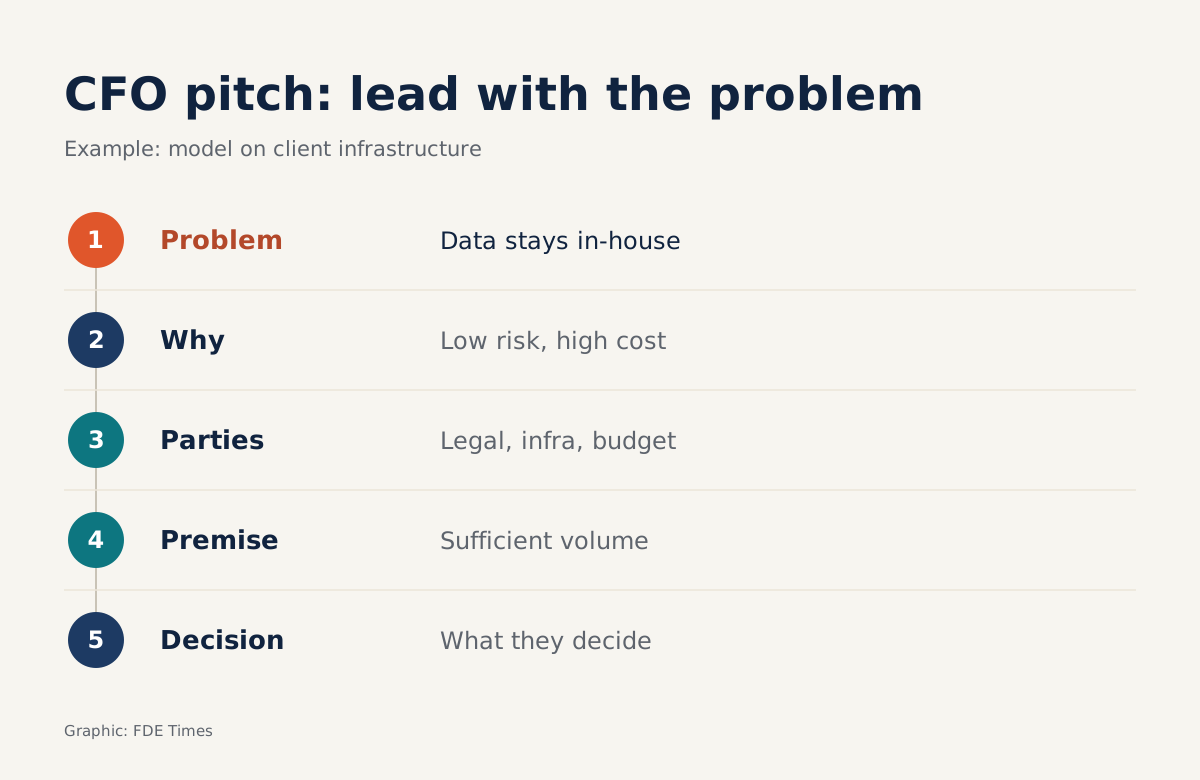
Translated into executive language, the same decision comes down to five points. First, the problem: customer claims data must not leave the company’s systems. Second, why this approach: lower compliance risk, at the cost of higher upfront spending.
Third, who is affected: the legal team, the infrastructure team and whoever approves the budget. Fourth, the assumption: the volume of claims must be large enough for the investment to pay off. Fifth, the specific decision you need them to make.
Points three and four are exactly Scaler’s advice: name the stakeholders and state your assumptions out loud. When you volunteer your assumption, the executive’s next “why” is likely to target that very assumption. You stay calm because you saw the question coming.
How to practise if you’re not a natural speaker
The good news is that this skill needs no special talent. It starts with understanding the problem, a habit engineers already have.
Each time you make a design decision in your current job, write a short paragraph for a non-technical reader. Do that for a few weeks and translating an architecture decision into executive language gradually becomes a reflex.
Nor do you need to be perfect in every round. The Cognition candidate concluded that the loop faithfully reflects the real job. In their view, you don’t need to be equally strong in every category, but you must genuinely stand out in at least one. Choose in advance where you want to score. For many engineers, that may well be the depth of their answers to “why”.
When reading a job description, look for phrases such as “executive communication”, “stakeholder management” or “customer-facing”. They suggest the loop may include a round testing this skill. Whether or not you see them, ask the recruiter what the final round involves and who will be in the room.
On your CV, don’t write “strong communication skills”. Scaler says FDEs spend a significant share of their time persuading people. Interviewers want to hear about a time you changed someone’s mind through communication rather than authority. A CV line that names the audience, the argument and the outcome gives them exactly that story to probe.
Before the pitch, prepare your answer to “why” before you build slides. If you cannot yet explain why the customer should pay to solve this problem, no slide deck, however polished, will save the presentation.
The final stage of the loop asks one more question: can you help the decision-maker understand why the code is worth building?
Was this article useful?
Thanks for the feedback!
6 sources
- Cognition AI Forward Deployed Engineer interview experience
- Cognition Forward Deployed Engineer interview guide (Exponent/Aced)
- The Silent Mistakes That Sink Forward Deployed Engineer Interviews
- How to hire a forward deployed engineer in 2026
- Palantir Forward Deployed Engineer interview guide (Exponent/Aced)
- Forward Deployed Engineer: Profession of the Future · 2024-12-31