Three logistics FDE job ads centre on the customer's TMS, but the real work starts in the inbox
Loadsmart, Vooma and Augment all want FDEs who can work with a customer's TMS, WMS or ERP. Vendor documentation and an industry guide show that the data those systems need still sits in emails and paperwork.

In brief
- Loadsmart and Vooma both require FDEs to run discovery directly with customers: Loadsmart allows for up to 50% travel, and Vooma wants up to 25% of time on site.
- A GetTransport guide treats triaging carrier emails as the entry-point use case, and settlement documents such as rate confirmations as the last stage still untouched by automation.
- According to GetTransport, the hard part is writing data back into the TMS, and Augment lists TMS, WMS and ERP experience directly in its requirements.
Loadsmart’s job ad for a Forward Deployed Engineer puts one requirement ahead of any code: run structured discovery to find the pain points worth solving, then rank them.
The hire works directly with the customer’s operations team and may travel up to 50% of the time. Only after that comes building and integrating with the customer’s real systems: TMS, WMS, ERP.
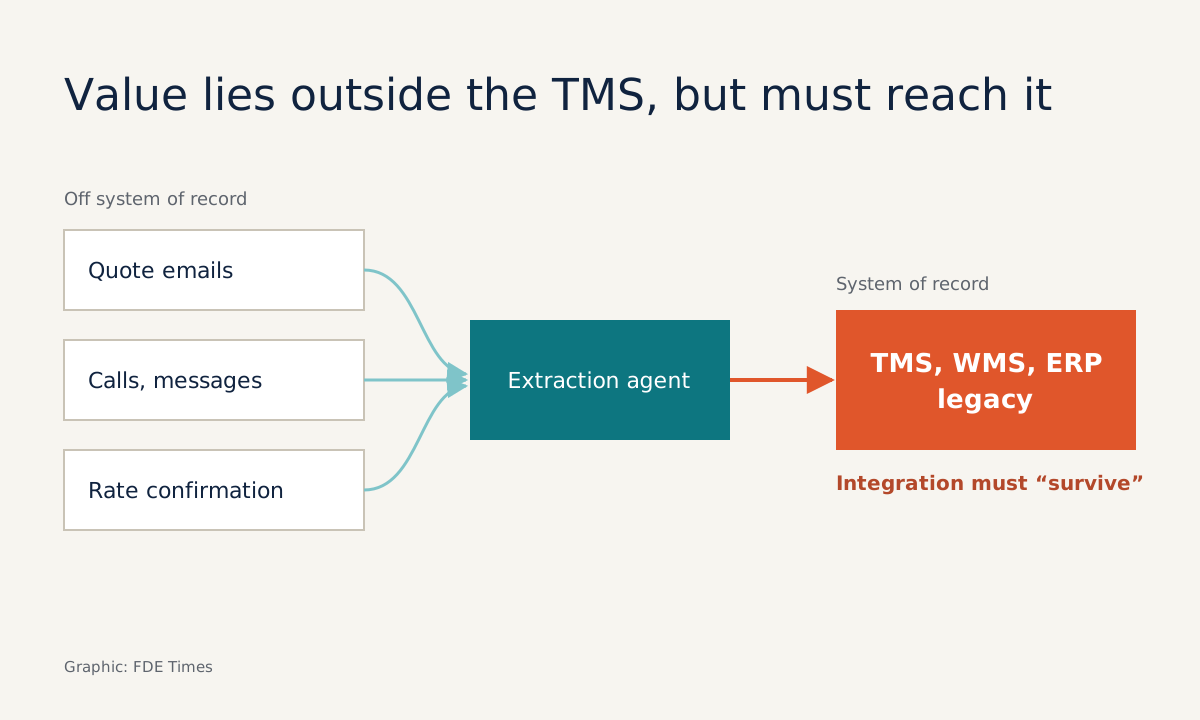
That order shows that value in logistics does not sit ready-made in a clean database. It sits in inboxes, phone calls and paperwork. Loadsmart’s own product page for ShipperGuide says that every day the average coordinator spends hours reading carrier emails and typing the figures into the TMS by hand.
For engineers looking for a way into FDE work, logistics is worth considering. Read the job ads from Loadsmart, Vooma and Augment alongside documentation from freight software vendors.
The picture is of an industry that needs exactly the skills of a deployment engineer: understanding messy processes, handling unstructured data and getting results into old systems.
Why go on site before writing code?
Vooma describes discovery in even more concrete terms. Its FDEs run working sessions with freight brokers, carriers and the IT teams of 3PLs to pin down pain points, data sources and success metrics. They must also be ready to spend up to 25% of their time at customer sites, to de-risk deployments and build relationships.
The figures of 50% and 25% differ, but the message is the same: customer discovery here happens inside the customer’s office. Picture a broker that uses some TMS as its system of record. Much of the work still happens outside it: dispatchers read emails, phone carriers, then retype the figures into a screen.
Read only the API documentation and it is easy to automate the wrong thing. Sit and watch someone do check calls (phoning drivers to ask where the freight is) for a morning. You will see what they ask, where they record it and where they have to guess.
Vooma’s insistence on agreeing success metrics during discovery is also worth copying: measure how long a task takes now before promising to shorten it.
The value is in the inbox, not the TMS
Vooma writes that its agents work over voice, email and messaging to automate critical workflows across the whole lifecycle of a shipment. All three channels sit outside the system of record. That is where people are doing the software’s job.
A 2026 guide on GetTransport’s industry blog reaches a similar conclusion. It calls triaging inbound carrier emails the entry-point use case for AI agents in freight brokerage, and ranks quote automation right behind it.
The approach is not new. In 2023 Tai TMS promoted its email assistant with the claim that win rates rise 30% when brokers answer quote requests instantly.
That figure is self-reported by the vendor. Read it only as a hint of why speed of reply to email is valued so highly.
What steps does a quote email go through?
Take an example. A shipper sends an email: needs a dry van, pick-up at warehouse A on Thursday morning, delivery to B, freight weighs about ten tonnes, “book it if the price is right”. A person reads it in ten seconds. The system has to extract five fields: origin, destination, pick-up date, equipment type, weight.
The hard part starts straight after. Which Thursday is “Thursday morning”? Which location code in the customer’s TMS does “warehouse A” map to? If the email omits the weight, should the agent ask again or route it to a human reviewer? Technical documentation does not answer these questions. Only sitting next to the person who does the work will.
Extraction is not the end. The GetTransport piece points out that the hard part of integration is writing data back into the TMS, in both directions. Once that works, every structured email becomes a countable row of data: how many requests came in, how long replies took, how many loads were won.
Rate confirmation, the last stage still not automated
If the quote email is the way in, settlement is the final stage the industry has not yet finished. GetTransport treats settlement documents as the last area automation has not yet reached. One example is the rate confirmation, the document confirming the price between broker and carrier.
Aljex, a TMS vendor, explains why: these time-consuming exchanges are costly because they need human intervention. The company also describes automatically uploading the signed rate confirmation to the TMS.
One wrong figure at this stage can put money out of line between two companies. So an FDE working on it should design a verification step too, not just the extraction.
The table below combines the three job ads with vendor documentation and the industry guide into a map of the work across a shipment’s lifecycle. No single source draws the whole picture.
| Stage | FDE’s job | Difficulty | Who is talking about it |
|---|---|---|---|
| Intake and quoting | Triage emails, extract fields, push to the pricing tool | Vague emails, missing fields, need for fast replies | GetTransport, Tai TMS, Loadsmart’s ShipperGuide |
| Shipment tracking | Automate check calls and shipment tracking | Information arrives by phone and message | Loadsmart |
| Settlement | Read rate confirmations, put the signed copy into the TMS | A wrong figure means money out of line | GetTransport, Aljex |
| Throughout | Design integrations that hold up against old systems | Writing data back into TMS/ERP | Loadsmart, Vooma, Augment, GetTransport |
The legacy TMS is the real test
The last row of the table is the work that decides whether a deployment succeeds or fails. Vooma describes the job as designing integration architecture that “survives” contact with legacy TMS/ERP systems. Loadsmart asks for building and integrating solutions with the customer’s real systems.
Vooma’s wording repays a close reading. It does not say “integrate with the TMS”. It says “survive”, which assumes something will go wrong. Familiar scenarios are easy to imagine: data fields named differently, no API so imports go through files, or an old customisation nobody remembers the reason for.
Here the FDE’s job differs sharply from a product engineer’s. A product engineer can assume a standard interface. An FDE should assume the opposite. When something changes on the customer’s side, the data flow must fail loudly rather than silently write the wrong thing.
What to prepare to get into this field
Augment states it directly in its requirements: experience in logistics, supply chain or transportation, specifically with TMS, WMS and ERP systems. For engineers who have never worked in the industry, that is not a wall. It is a list of things to learn.
The most sensible start is the industry’s vocabulary. Know what data TMS, WMS and ERP each hold, what a check call is and what a rate confirmation is for.
Then build a small project that follows the path in the table above. The input is an email or document, it goes through extraction, then it is written out to a TMS-like import format, with handling for missing and ambiguous fields.
On a CV, avoid the vague “built a document-processing pipeline”. State what the input was, which system the output went into, and how bad cases were handled.
When reading job ads, look for phrases such as “structured discovery”, “legacy TMS/ERP”, “check calls” or a specific share of time on site. They signal a company that understands real deployment, not one that just needs someone to demo.
All three job ads want people who can work with a customer’s TMS, WMS or ERP. Emails, calls and paperwork are where the data starts. The FDE who connects those two ends owns exactly the part GetTransport calls the hard part: writing data back into the old system.
Was this article useful?
Thanks for the feedback!
7 sources
- Forward Deployed Engineer @ Loadsmart | Purpose Job Board · 2026-08-22
- Forward Deployed Engineer at Vooma | Y Combinator
- Forward-Deployed Engineer @ Augment | Redpoint Ventures Job Board
- AI Agents for Freight Brokers in 2026: Automating Quoting, Carrier Email and Tracking · 2026-06-25
- Brokers can increase their win rates up to 30% with Tai Email Assistant · 2023-01-18
- ShipperGuide | Loadsmart AI
- Automatic Rate Confirmation: How to Streamline Carrier Communication · 2022-07-15