No right answer? Stop scoring outputs and ask which one is better
Pairwise comparison suits subjective criteria better than rating scales, but only if you swap positions, check for length bias and validate against the client's experts.
In brief
- When a criterion is subjective and several people are judging, asking 'which is better' produces more agreement than a 1-5 score.
- LLM judges are biased by position and length, so judge in both orders, count disagreements as ties and control for length.
- Elo means something only within the set of versions compared; shuffle match order many times or use Bradley-Terry, then check against experts.
Chatbot Arena, the leaderboard that ranks language models by user votes, never asks anyone for a score from 1 to 10. Its authors give a short explanation: feedback comes from a very large number of people, so keeping a consistent rating scale among them is close to impossible. They ask a single question instead: of these two answers, which is better?
On the client side, FDEs hit the same problem every time they have to evaluate a text-generation system. The legal team wants summaries that are “easier to read”; the customer service team wants emails that are “more on brand.” Nobody can write down the correct answer in advance, and five raters giving 1-5 scores will each read the scale their own way.
If you cannot measure it, you cannot prove the new prompt beats the old one, and the next demo turns into an argument about gut feel. Pairwise comparison, combined with an Elo-style rating system, gives you a number to bring into the meeting. It has its own traps, though, and most of this article is about them.
Why does “A or B” suit subjective criteria?
Chatbot Arena’s reasoning applies to a small client project too. Five raters struggle to share one scoring scale, but the question “which email would you rather send to a customer” needs no scale at all.
The same holds when the judge is a model. The MT-Bench paper found that when the judge model is swapped out, absolute scores are likely to swing more than pairwise results.
For an FDE this detail is very practical: the judge you use today may be replaced by a newer version in a few months, and the eval suite should not collapse with it.
The evidence does not all point one way. A 2025 study of feedback protocols for LLM judges found that when distractors were inserted into answers, pairwise choices flipped in about 35% of cases, while absolute scores changed in only 9%.
Pairwise comparison is therefore not immune to manipulation. It simply suits a particular kind of question.
If a criterion has a right answer, don’t compare pairs
Eugene Yan offers an easy rule: compare pairs for subjective criteria and score directly for objective ones, because the winner of a pair can still be broken. If two summaries both invent a contract clause, the “better” one is still wrong.
In practice, split the eval suite into two layers. The bottom layer holds the checks with right and wrong answers: the correct contract number is extracted, no personal data leaks, the JSON format is valid. Only the top layer uses pairwise comparison, for tone, clarity and persuasiveness.
A worked example from start to finish
The following example is hypothetical. The customer service department of an insurance company has three prompt versions for replying to complaint emails: A is the one in production, B is more concise, and C adds citations of contract clauses. You take 60 real emails that have passed the bottom-layer checks and form three pairs: A-B, A-C and B-C.
The first step is dealing with position bias. In MT-Bench’s experiments that swapped the order of two answers, only GPT-4 gave consistent results in more than 60% of cases.
The conservative fix the authors propose is to judge twice with positions swapped, count a win only when the same answer is chosen both times, and treat everything else as a tie.
def judge_both_orders(judge, query, a, b):
    first = judge(query, a, b)    # returns "left" or "right"
    second = judge(query, b, a)   # positions swapped
    if first == "left" and second == "right":
        return 1.0   # a wins in both orders
    if first == "right" and second == "left":
        return 0.0   # b wins in both orders
    return 0.5       # the two runs disagree: count as a tie
Three pairs times 60 emails times two orders makes 360 judge calls. Suppose the B-A pair comes out as B winning 33, A winning 15 and 12 ties. A tie counts as half a win and half a loss, which is how Chatbot Arena does it, so B scores (33 + 6) / 60 = 65%.
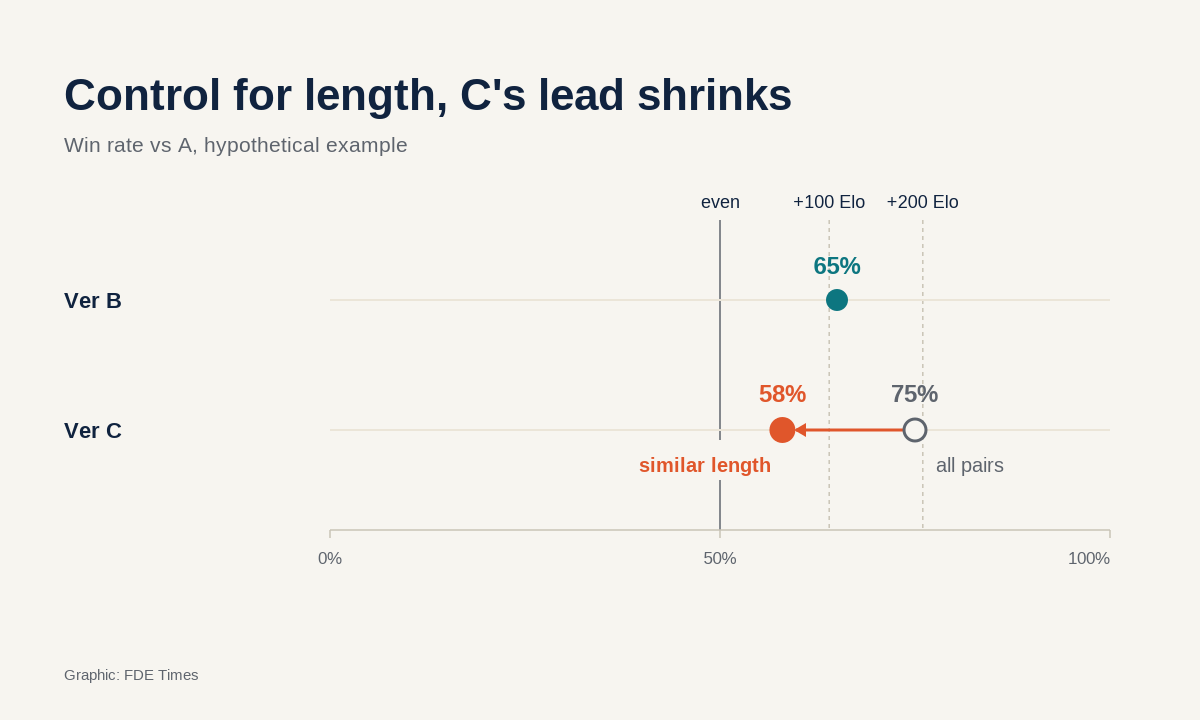
Elo converts a rating gap into an expected win rate: a 100-point lead corresponds to 64%, a 200-point lead to 76%. So B is about 100 points ahead of A. If C beats A 40 times, loses 10 and ties 10, C scores (40 + 5) / 60 = 75%, close to a 200-point gap.
The tie rate is data too. If a third of the pairs end in ties, your judge is changing its mind with position a great deal. That is a signal to fix the judge prompt before trusting any leaderboard.
Match order skews the rankings too
Classic Elo updates ratings after every match, so whichever matches are processed first affect the final result. Boubdir and colleagues showed that in language model evaluation, match order can significantly change Elo scores and even rankings; they recommend rerunning over many shuffled permutations.
import random

def elo(matches, k=16, base=1000):
    r = {}
    for a, b, s in matches:          # s = 1.0, 0.5 or 0.0
        ra, rb = r.get(a, base), r.get(b, base)
        ea = 1 / (1 + 10 ** ((rb - ra) / 400))
        r[a], r[b] = ra + k * (s - ea), rb - k * (s - ea)
    return r

def elo_shuffled(matches, n=1000):
    runs = []
    for _ in range(n):
        m = matches[:]
        random.shuffle(m)
        runs.append(elo(m))
    return runs   # look at the median and spread for each version
If B and C trade places across many shuffles, you do not yet have enough data to draw a conclusion. Chatbot Arena has moved entirely to the Bradley-Terry model, estimated by maximum likelihood, which assumes fixed ability and ignores match order.
For a client-side eval suite, where prompt versions do not “improve” between matches, that assumption fits better than online Elo.
Longer answers tend to win, and that is a trap
Version C won comfortably, but C is also the longest because it cites contract clauses. LMSYS found that style influences votes and that length is the dominant style factor, so it added style features to its Bradley-Terry regression to control for them.
At project scale you can do something simpler. Record the word-count difference for each pair, then see whether C still wins when you look only at pairs of similar length. If the advantage disappears, the client is paying for emails that are longer, not necessarily better.
Back to the example: keeping only the 24 A-C pairs with similar lengths, C wins 12, loses 8 and ties 4. C’s score drops to (12 + 2) / 24 = 58%, below the 64% mark, so its lead shrinks from nearly 200 points to under 100. C still edges out A, but most of its original win came from length.
The final step is checking against real people. Anthropic’s guidance on evals for agents stresses that LLM judges need to be closely calibrated against experts. Ask the customer service team lead to choose A or B for a few dozen pairs, then report the judge’s agreement rate with them right next to the leaderboard.
The mistakes that ruin a pairwise eval
The most common mistake is comparing this month’s Elo scores with last month’s. Elo is purely relative and valid only within the set that produced it; add or remove a version and you have changed the set. To compare over time, keep a fixed anchor version in every judging round.
The second mistake is letting the number of pairs balloon. The MT-Bench paper notes that pairwise comparison scales poorly as the number of candidates grows, because pairs grow quadratically: 10 versions already make 45 pairs.
Choosing pairs deliberately saves a lot; in Chatbot Arena’s experiment, random sampling needed 6,800 votes to reach the same accuracy that adaptive sampling reached with only 4,400.
The third mistake is using pairwise comparison for criteria that have answers, and the fourth is never asking an expert. Both produce a leaderboard that looks very scientific but that nobody on the client side trusts.
Where this skill belongs on your CV
A line like “built LLM evals” is too generic to impress. Be specific about what you did: designed a pairwise eval with swapped positions, controlled for length, checked results against labels from the client’s experts and reported the agreement rate.
When reading job postings, look for phrases such as “LLM-as-judge,” “human preference” or “eval design”; those are the roles that need exactly this skill.
A good leaderboard will not end the debate with the client, but it forces the debate to revolve around data instead of feelings.
Once you have a winning version, the next step is to sit down with the client’s team lead, pick a number they already track, such as how many emails staff have to edit before sending, and pilot that version with a small group to see whether the number moves.
Was this article useful?
Thanks for the feedback!
9 sources
- Chatbot Arena: An Open Platform for Evaluating LLMs by Human Preference · 2024-03-07
- Judging LLM-as-a-Judge with MT-Bench and Chatbot Arena · 2023-06-09
- Evaluating the Effectiveness of LLM-Evaluators (aka LLM-as-Judge) · 2024-08-18
- Pairwise or Pointwise? Evaluating Feedback Protocols for Bias in LLM-Based Evaluation · 2025-04-20
- Elo rating system (Wikipedia)
- Elo Uncovered: Robustness and Best Practices in Language Model Evaluation · 2023-11-29
- Chatbot Arena: New models & Elo system update · 2023-12-07
- Does style matter? Disentangling style and substance in Chatbot Arena · 2024-08-29
- Demystifying evals for AI agents · 2026-01-09