The client wanted automated PR review. The bottleneck was two people
Treat every stated requirement as a hypothesis to test, and a few well-placed discovery questions can save you three weeks of building the wrong thing.
In brief
- A client's stated request is only a hypothesis: a request to automate PR review can hide the fact that only two people are allowed to approve.
- Discovery has five phases; Scope is done when people and systems fit on a one-page map, Spec is done when a teammate can build without another meeting.
- The decomposition interview round grades exactly this skill: strong candidates spend the first ten minutes asking questions.
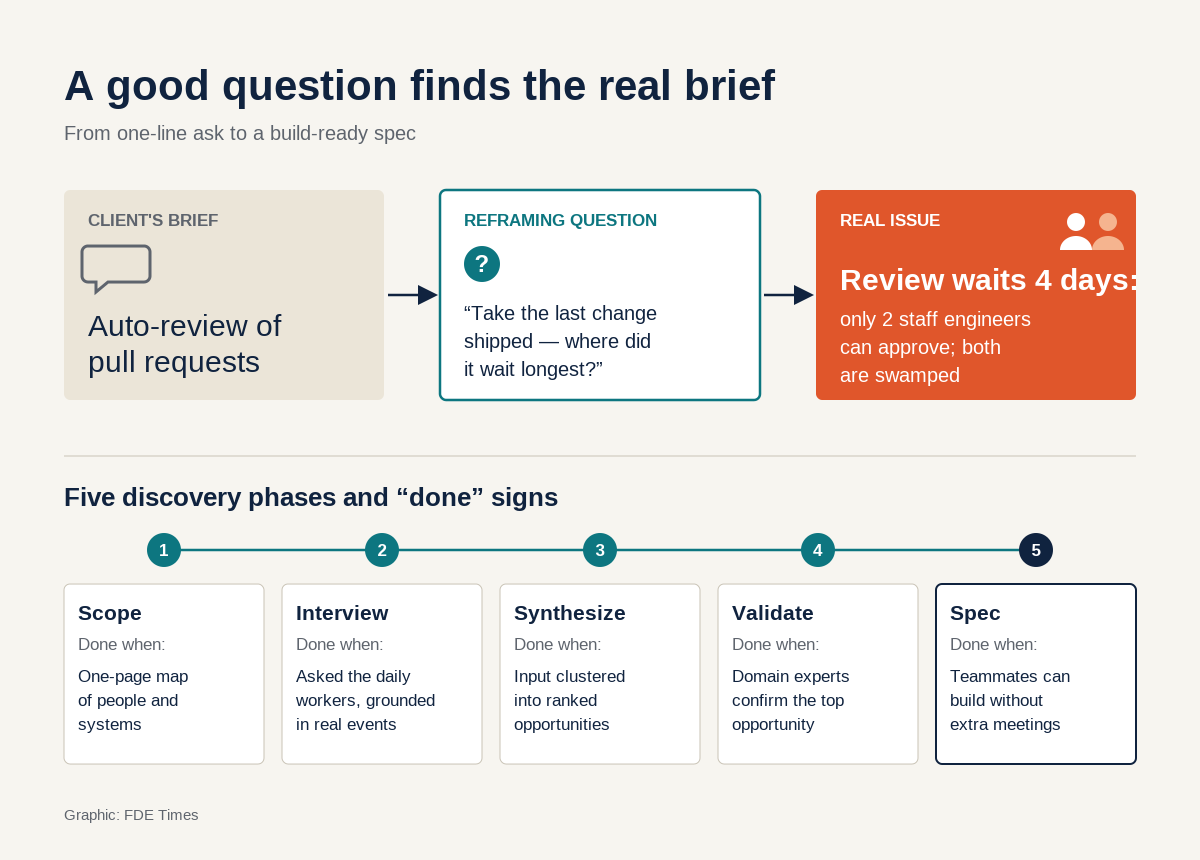
The request arrives as a single line: “The team needs a tool that reviews pull requests automatically.” The solution forms in your head at once: an agent that reads the diff, leaves comments and scores the risk. Three weeks later you demo it, the client likes it, and the time from opening a PR to merging it has not moved at all.
Learn Cursor’s FDE interview track opens with this scenario. An engineer on the client side hands you a problem statement, and according to Learn Cursor it is almost never the real problem.
In that example, the bottleneck has nothing to do with a lack of automation. Review takes four days because only two staff engineers are allowed to approve, and both are buried in work.
For a developer hoping to move into FDE work, this is the skill that separates an FDE from someone who just takes tickets. You already know how to write code. What you need to learn is how to turn a vague request into a plan that both the client and your teammates believe is heading the right way.
A request is a hypothesis
The FDE discovery playbook Perspective AI published in July 2026 starts from a blunt assumption: what the client says they need is not what they actually need. Clients are not lying. They describe the solution they can imagine, in terms of the tools they already know, rather than the place where work is getting stuck.
So “we need automated PR review” should be read as “the client believes automated review will make everything faster.” That is a hypothesis, and your first job is to test it. If it holds, you build with more confidence. If it fails, you have just saved three weeks.
Which question overturns the brief?
The common mistake is to ask the client, “What features do you want?” That only makes them repeat the original request. The question Learn Cursor proposes goes another way: ask the client to walk you through the most recent change they shipped, and point to where it waited longest.
It works because it pulls the conversation back to something that actually happened, with dates and real people. Here is a hypothetical exchange to show how it plays out:
FDE: Could you walk me through the last change your team shipped? Between opening the PR and reaching production, where did it sit waiting the longest?
Client: Probably review. Once a PR is open, it takes about four days before anyone approves it.
FDE: Who does the approving during those four days? What are they waiting on?
Client: Only two staff engineers can approve. They’re also handling on-call and system design, so they always have a dozen PRs piled up.
At this point the brief has changed. An agent that comments automatically still leaves the PR sitting in the queue of those same two people. A better plan might be to help those two review faster, or to make clear which kinds of change need them and which do not, but you should only choose once you have checked with the client.
Five phases, each with a sign that it is done
One good question is not yet a method. Perspective AI’s playbook splits discovery into five consecutive phases: Scope, Interview, Synthesize, Validate and Spec. Each has a condition that tells you when you can move on.
Scope is done when you can draw a map of the people and systems involved on a single sheet of paper. In the PR example, that sheet holds the people writing code, the two approvers, the CI system and the repo. The phase ends by naming the decision point: whom the system will help, and to take what action. If you cannot say that sentence, you are not ready to interview.
Interview is where you use event-based questions like the ones above, with the people who actually do the work every day, not only the person who sent the request. Synthesize means grouping what you heard into opportunities and ranking them. A bottleneck that many people mention usually deserves more attention than a complaint raised by one.
Validate is when you go back to the client’s domain experts to confirm that the opportunity at the top of the list really is the most valuable thing to build. With a ranking in hand, you will be tempted to skip this step, which is precisely why you should keep it. Finally, Spec is graded by the “handoff test”: a teammate holding the spec must be able to build it without another meeting.
The mistakes that sink discovery
The first and most common mistake is jumping straight to a solution. Techinterview.org’s analysis of FDE interviews describes exactly this: candidates hear the problem and rush straight into solving it. In the field, the same mistake becomes a polished demo nobody uses.
The second is talking only to the person who made the request. The engineer who filed the ticket sees the symptom; the two approvers know why the queue is long. If your one-page map has only one name on it, you are almost certainly missing people.
The third is writing a spec that needs an explanatory meeting attached. When a teammate needs a meeting to understand the spec, the decisions are still in your head. Go back and check whether you have written down the decision point and why you chose this opportunity.
Interviews grade this very skill
This is not only a skill for after you are hired. Palantir’s decomposition round, according to techinterview.org, assesses the ability to break an ambiguous real-world challenge into smaller parts and then propose a solution. Strong candidates spend the first ten minutes asking questions.
So when you practice for interviews, train yourself to resist the reflex of sketching an architecture straight away. Ask who uses the system, where work gets stuck and which decision is waiting, then talk through the map of people and systems out loud before proposing anything.
On your CV, instead of writing “built tool X,” write one line about a time you discovered the original request was wrong and how you changed course. A line like that shows the exact skill the decomposition round scores.
The next time you get a one-line request, open a blank page before you open your editor. If you cannot yet draw on that page who is waiting on whom, you do not yet know what you need to build.
Was this article useful?
Thanks for the feedback!