Vanderbilt's 16 prompt patterns were built for chat, not pipelines
The Template pattern earns its keep, and the real value lies in the 2023 arXiv paper behind the course, not its stock phrasings.
In brief
- Jules White's Coursera course is beginner level and takes about two weeks at 10 hours a week, across 6 modules and 7 assignments.
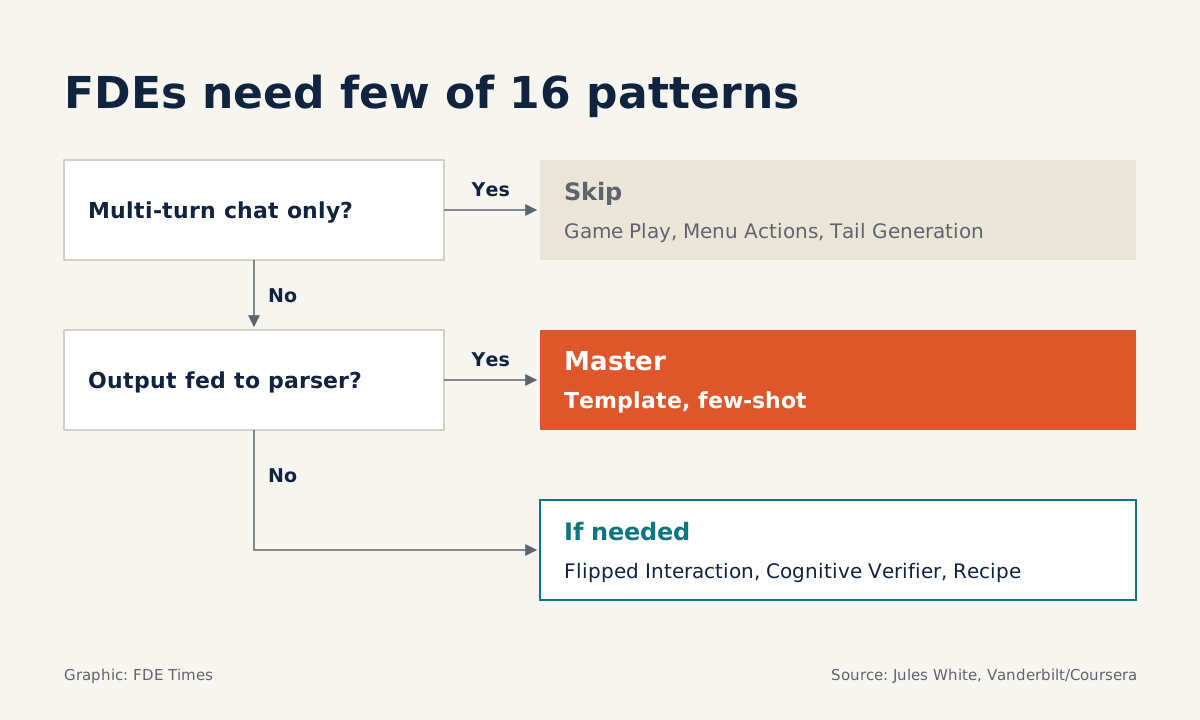
- Template, Flipped Interaction and Cognitive Verifier are the three patterns an FDE can use straight away; the conversational ones can safely be skipped.
- The original paper treats prompting as a form of programming; it follows that prompts should be named, versioned and tested like code.
The Coursera page for Prompt Engineering for ChatGPT lists 16 prompt patterns, from Persona to Semantic Filter. On top of those come few-shot, Chain of Thought and ReAct. For a beginner, the list is appealing. For a Forward Deployed Engineer who has to put a model into a client’s real system, it is both too much and missing exactly what is needed.
The course is still worth taking, provided you know which parts to keep. It is taught by Jules White, a professor at Vanderbilt University, and its patterns come from a paper he and colleagues posted to arXiv on 21 February 2023. The most valuable part of the course lies in that paper, not in the stock phrasings.
What does the course teach, and to whom?
According to Coursera, the course is beginner level and takes about two weeks at 10 hours a week. It is split into six modules: Course Introduction, Introduction to Prompts, Prompt Patterns I, Few-Shot Examples, Prompt Patterns II and Prompt Patterns III. In total that is roughly 18 hours of study, with 7 assignments.
The intended audience is spelled out: anyone can take it, with only basic computer skills required. Vanderbilt also publishes descriptions of the patterns on its own site, with White’s permission, and describes it as a free, self-paced course.
The course title alone shows its focus is ChatGPT, where a person types and reads each answer. An FDE’s work is usually an API call inside a pipeline, running thousands of times with nobody reading the output. So as you study each pattern, ask what it would look like once it moves from chat into code.
Template is the pattern that earns its keep
The Template pattern asks the model to preserve the format and overall structure the user supplies. In chat, it is merely a presentation trick. At a client, it decides whether your parser works or breaks.
Picture a logistics company that wants to extract the order number, complaint type and urgency from customer emails into JSON. Suppose that in 1 of every 20 outputs the model adds an introductory sentence before the JSON. A batch of 1,000 emails then yields 50 broken records, and the operations team will spot them before you do.
So the first thing to do at a client is to write the output schema explicitly, provide one few-shot example in that exact shape, and add a format check immediately after the model call. The course’s Few-Shot Examples module is the one to study closely alongside Template.
Where do Flipped Interaction and Cognitive Verifier fit?
Flipped Interaction reverses the roles: the model asks the user questions until a condition or goal is met. For an FDE, it is a tool for preparing discovery.
Before the meeting, have the model ask you, one question at a time, about the client’s process until there is enough to draft the requirements. The questions you cannot answer are the ones to bring to the meeting.
Cognitive Verifier makes the model generate additional sub-questions about the topic before it answers. The pattern suits internal assistants, where users ask vague questions such as “is this contract risky?”. Breaking that question into sub-questions lets you see at which step the model is misunderstanding.
Recipe is also worth keeping. You state the goal and a few known steps, and the model fills in the rest as a complete sequence. It is useful when writing a deployment runbook for an environment you do not yet know well.
What to drop, and why
Patterns such as Game Play, Menu Actions and Tail Generation come into their own when a person is chatting over many turns. In a single-turn API call, they have almost no use. Learn them well enough to recognise them, and do not spend effort practising them.
Persona, the “Act as Persona X” line, need not be dropped, but nor should it be treated as a cure-all. On its own, the line assigns a role and says nothing about the output format, so do not rely on it to keep a parser working. Use Persona as a context layer on top of Template, not as a replacement for it.
The idea most worth keeping is in the paper
The paper “A Prompt Pattern Catalog to Enhance Prompt Engineering with ChatGPT” treats prompting as a form of programming. It also presents prompt patterns as a way of transferring knowledge, much like software patterns. That is the idea an engineer should carry into a project.
A sensible order is to work through the six modules first, keep Vanderbilt’s pattern page as a reference, then read the arXiv paper for the software-pattern perspective. After that, make sure to take one more step: put your prompts in the repo, label each file with its pattern name, and write tests that check the output format.
That step is also what belongs on a CV. A certificate shows only that you finished the course; a library of named prompts with tests and figures on how often outputs match the schema shows you have put it to real use. Take the pattern names from the course, then gather the tests and figures from your own client projects.
Was this article useful?
Thanks for the feedback!