The Odin Project: an open-source JavaScript and Node.js path for Python FDEs
The Odin Project's seven-course path is an open-source curriculum maintained by volunteers. It can teach a Python engineer to read a client's Express backend, as long as the courses are taken in order.

In brief
- The Odin Project is an open-source full-stack web curriculum, founded by Erik Trautman in 2013 and maintained by volunteers.
- The Full Stack JavaScript path has seven courses and should be taken in order. The NodeJS course teaches Express, PostgreSQL, authentication, ORMs, APIs and testing.
- For a Python FDE, the JavaScript and NodeJS courses are the two to study closely in order to read and fix a client's Node backend.
Picture your first week with a client. The AI system you have brought is written in Python, while their entire backend runs on Express and Node.js. To connect the two, you have to read their routes, their middleware and the way they authenticate users. Nobody will wait for you to finish a long course before you start.
That is why Python FDEs should pay attention to The Odin Project, an open-source full-stack web development curriculum. Its Full Stack JavaScript path includes a dedicated NodeJS course covering Express, PostgreSQL, authentication, ORMs, APIs and testing: the very topics you are most likely to run into when you open a client’s Node codebase.
An engineer with a few years of experience does not need to work through it at a beginner’s pace. What matters is knowing which part serves which job, and where to begin.
Who is behind it, and why that matters
Erik Trautman founded The Odin Project in 2013. The project’s about page says the curriculum is maintained and continually improved by a team of volunteers, and that both the website and the full curriculum are open source. The GitHub repository states plainly that the project depends on community contributions.
Learners benefit directly from this model. Because the curriculum is open, you can read, edit and send a pull request for any lesson. When you get stuck, there is a Discord community, also run by volunteers, where you can ask people who have gone before you.
Seven courses, and advice worth following
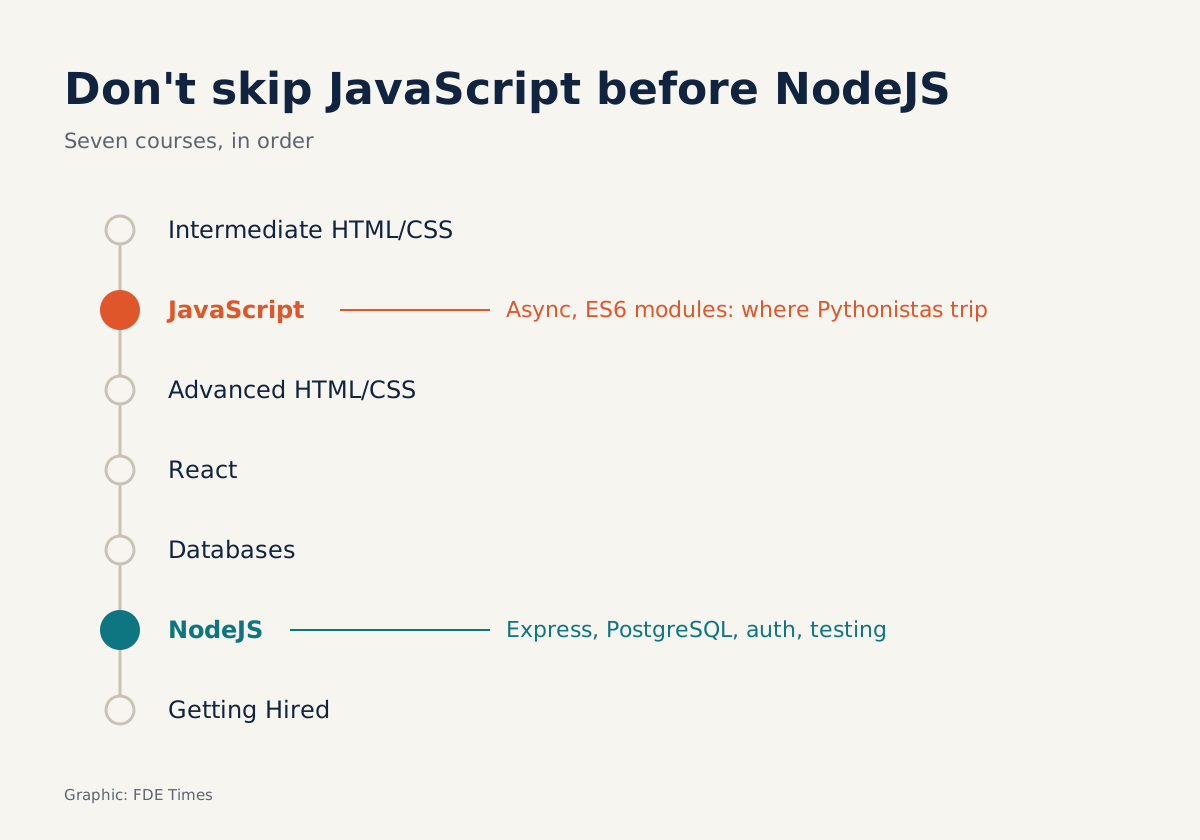
The Full Stack JavaScript path has seven courses: Intermediate HTML/CSS, JavaScript, Advanced HTML/CSS, React, Databases, NodeJS and Getting Hired. The path page advises taking them in the order shown.
Python engineers are tempted to jump straight into NodeJS. Do not skip the JavaScript course. It opens with building dynamic, interactive web pages, then covers async, testing, OOP, ES6 modules, npm, Webpack and data structures. Async and modules are usually where Python developers stumble when reading Node code for the first time.
You can move faster through HTML/CSS and React if your work is mostly on the backend. But do not drop them entirely: if you ever need to build a small interface to demo something for a client, this is the part you will need. Take the Databases course slowly, because it comes immediately before NodeJS, and the NodeJS course works with PostgreSQL.
What the NodeJS course maps to at a client
The NodeJS course takes JavaScript to the server, uses Express to build backends and adds the PostgreSQL relational database. Its sections are Introduction to NodeJS, Express, Authentication, ORMs, APIs and Testing Express. The table below matches each section with a task you might face at a client.
| Section of the NodeJS course | Corresponding task at a client |
|---|---|
| Express | Read existing routes and add an endpoint that calls your AI service |
| Authentication | Understand who is allowed to call that endpoint and avoid opening a new hole |
| ORMs and PostgreSQL | Query the client’s real data without writing SQL that drifts from the schema |
| APIs | Design responses the client’s frontend team can use straight away |
| Testing Express | Prove your change does not break what is already running |
One endpoint, five steps
Go back to the scenario at the start. Suppose your first assignment is to add an endpoint that returns recommendations from an AI model for a specific customer. You could work through the following sequence, with each step matching a section of the NodeJS course.
Step one: open the client’s route file, find a similar route that is already working and see which authentication middleware it uses. Step two: declare the new route and attach that same middleware. Step three: fetch the data from Postgres through the ORM they already use, selecting only the columns the model needs.
Step four: call the model service, catch errors when the model is slow or fails, and return JSON in the same shape as the client’s other endpoints. Step five: write two Express tests, one where a valid token returns data and one where a request without a token is rejected.
The common mistake for Python developers comes in steps three and four: forgetting await before the ORM or model call. The code still runs, but what you get back is a Promise rather than data, and errors can be silently swallowed. This is exactly the async material in the JavaScript course, and the reason not to skip it.
The second mistake is copying an old route but leaving out the middleware, which leaves the new endpoint open to anyone. The no-token test in step five exists to catch precisely this before it reaches production.
Three ideas worth keeping
First, the order has its own logic. Async and ES6 modules are taught in the JavaScript course, before you touch Express. For an FDE, this is also how to approach any unfamiliar system: understand the foundations before changing the layers above.
Second, testing sits inside the backend course rather than being split off as an extra. At a client, a working test suite is a quick way to earn their engineering team’s trust in your changes. Treat Testing Express as mandatory, even when you are in a hurry.
Third, the open-source model itself. The curriculum lives on GitHub and needs contributors. Sending a pull request that fixes a mistake in a lesson is a chance to practise code review in someone else’s repository, which is what FDEs do every day.
Turning the course into evidence on your CV
Do not just list the course name on your CV; let a working project speak for you. After the NodeJS course, build a small Express API with authentication, PostgreSQL and a test suite, then add an endpoint that calls an AI model following the five steps above. State clearly in the README what you tested.
When reading FDE job descriptions, look for where the company or its clients use JavaScript or Node. If they do, a line such as “built an Express API with auth, Postgres and automated tests” is far more concrete than “knows JavaScript”. The final course in the path, Getting Hired, is also there for guidance on how to present your work.
A client’s stack is something you are handed, not something you choose. Being able to read Express means one more kind of system you can walk into and work on immediately, instead of standing on the outside.
Was this article useful?
Thanks for the feedback!