Google and Kaggle's 5-Day AI Agents Intensive: which days FDEs should study closely and which to skim
Millions of people have taken this free agent course, so the certificate no longer sets anyone apart. What counts is what you can take from it to a customer site.

In brief
- The course is free and self-paced. Each day has a whitepaper and two codelabs built on Gemini and ADK.
- The parts most worth studying closely are tools and MCP, context engineering, and evaluation (days 2 to 4).
- ADK works with most models and runs on your own infrastructure, so do not let your skills work only with Gemini.
According to Google’s wrap-up post, the live November 2025 run of the agent course from Google and Kaggle drew more than 1.5 million learners, and the capstone received more than 11,000 submissions. With that many people taking it, the course certificate no longer makes anyone stand out.
So for people who work as FDEs, or want to, the question is no longer whether to take the course: it is free and open to everyone as a Kaggle Learn Guide. The better question is which parts to study closely so you can use them at a customer site next week, and which to skim.
Five days, each with a whitepaper and two codelabs
The course’s official name is “5-Day AI Agents Intensive Course with Google”. According to KDnuggets, each day has a technical whitepaper and two hands-on codelabs, built with Gemini and Google’s Agent Development Kit (ADK). If you have a day job, you can pace it: read the whitepaper first, do the codelabs later.
The Kaggle Learn Guide page renders its content with JavaScript, so the syllabus below is based on KDnuggets’ summary rather than Kaggle’s own page. The study plan in this article rests on that syllabus, so check it against the Kaggle page when you start.
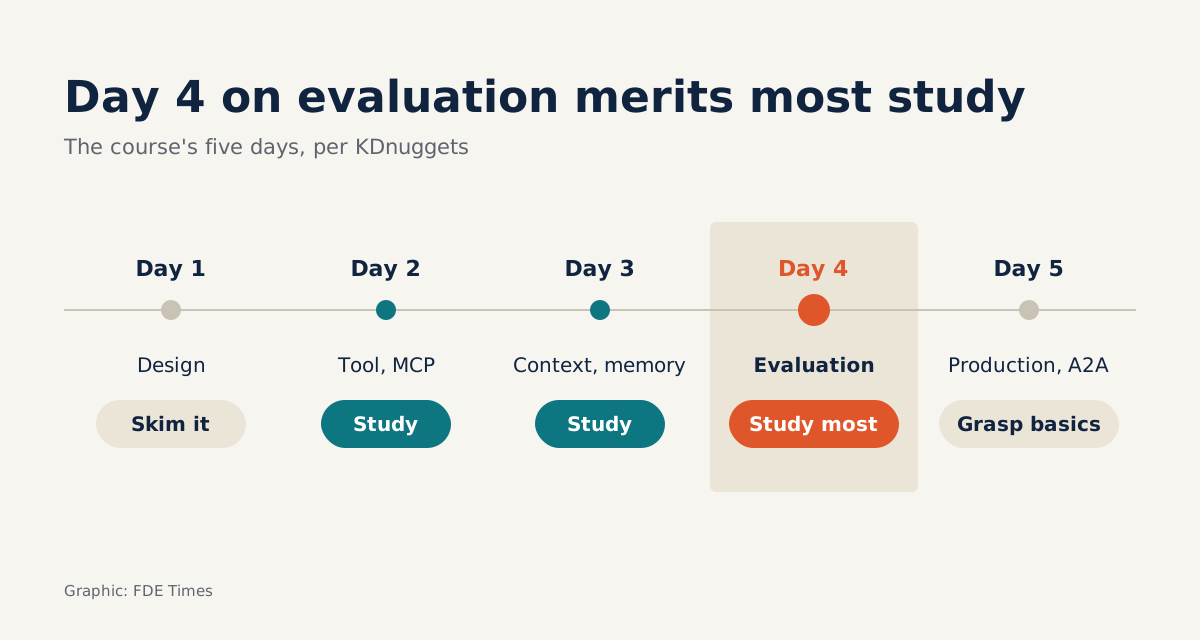
According to KDnuggets, day 1 introduces agents and their architecture. Day 2 covers tools and MCP. Day 3 covers context engineering, sessions and memory. Day 4 covers agent quality: logging, tracing, metrics and evaluation. Day 5 takes agents from prototype to production, with A2A and managed runtimes.
In June 2026 a refreshed run followed, themed around vibe coding. Pulse 2.0 reported more than 353,000 sign-ups for it, with content focused on designing, securing and deploying production-grade agents in the cloud.
Gemini is only the starting point; ADK is what you can reuse
The easy mistake is to think you are learning “agents on Gemini”. According to its official page, ADK is an open-source framework for building, debugging and deploying agents. The same page states that ADK works with almost any generative AI model.
That matters for FDEs, because you do not get to choose the customer’s stack. A bank may already have a contract with another model provider, or may not allow data to leave its own infrastructure. ADK can be packaged into a container and run on private infrastructure, so what you learn in the codelabs still applies there.
When doing the codelabs, treat Gemini as the default configuration, not a requirement. After each day, try switching to a different model. Whatever breaks after the switch is exactly what will break when you deploy at a customer.
Three ideas worth keeping
Tools are the main work (day 2). An agent at a customer is only useful when it connects to their existing systems, such as a CRM, an orders database or a ticketing system. So study tool definitions and MCP closely. The first thing to do at a customer is list the systems the agent needs to read from or write to, then write each one as a tool with clearly defined inputs.
Context has to be designed (day 3). Picture an agent that supports customer service staff. The history of the call in progress belongs in the session. The fact that this customer has complained twice this quarter belongs in long-term memory. Stuff both into the prompt and costs go up while answers get muddled. So decide with the customer what needs to be remembered, and for how long.
Evaluation is what you deliver to the customer (day 4). This is the day to study most closely. Suppose you take 50 real questions from a customer and the agent gets 40 right, or 80%. That number alone tells you little. Only by reading the traces of the 10 wrong answers do you learn whether the failure came from calling the wrong tool, missing context or the model itself, and each kind of failure needs a different fix.
Which parts can you skim?
If you have built agents before, a quick read of day 1 is enough. On day 5, get a grip on the concept of A2A, but do not invest too much in managed runtimes if your customers do not use Google Cloud. Spend that time practising packaging agents into containers.
The vibe coding run is good for quickly putting together a demo for a first customer meeting. But fast-generated code does not replace the eval set from day 4. The demo helps you win the contract; the evals keep the customer using the product.
Turning the capstone into a portfolio project
The order to study in: do days 2 and 3 first, spend the most time on day 4, then do day 5 according to the infrastructure you want to prove you can handle. Read day 1 as needed.
As for the capstone, do not submit it and forget it. Rebuild it with a model other than Gemini, run it in a container, and put both the eval set and a few traces of fixed failures in the repo.
On your CV, state the number of questions in the eval set, the accuracy before and after your fixes, and where the agent runs. Those lines show the work you actually did, which a course name cannot.
More than 11,000 capstones were submitted before yours. Yours gets noticed when it shows an agent running on infrastructure that is not Google’s, with a model that is not Gemini, and with measured results.
Was this article useful?
Thanks for the feedback!