The Challenger Sale: the sales book that teaches FDEs not just to follow requests
According to the research behind Matthew Dixon and Brent Adamson's book, the best salespeople do not indulge customers; they make them think again. The same line separates an FDE who creates value from one who only closes tickets.

In brief
- Research by CEB (now part of Gartner) sorted B2B sales reps into five types. The Challenger type performed best, while relationship builders made up only 7% of star performers
- Being agreeable is not enough: an insight has to change how the customer thinks about saving or making money
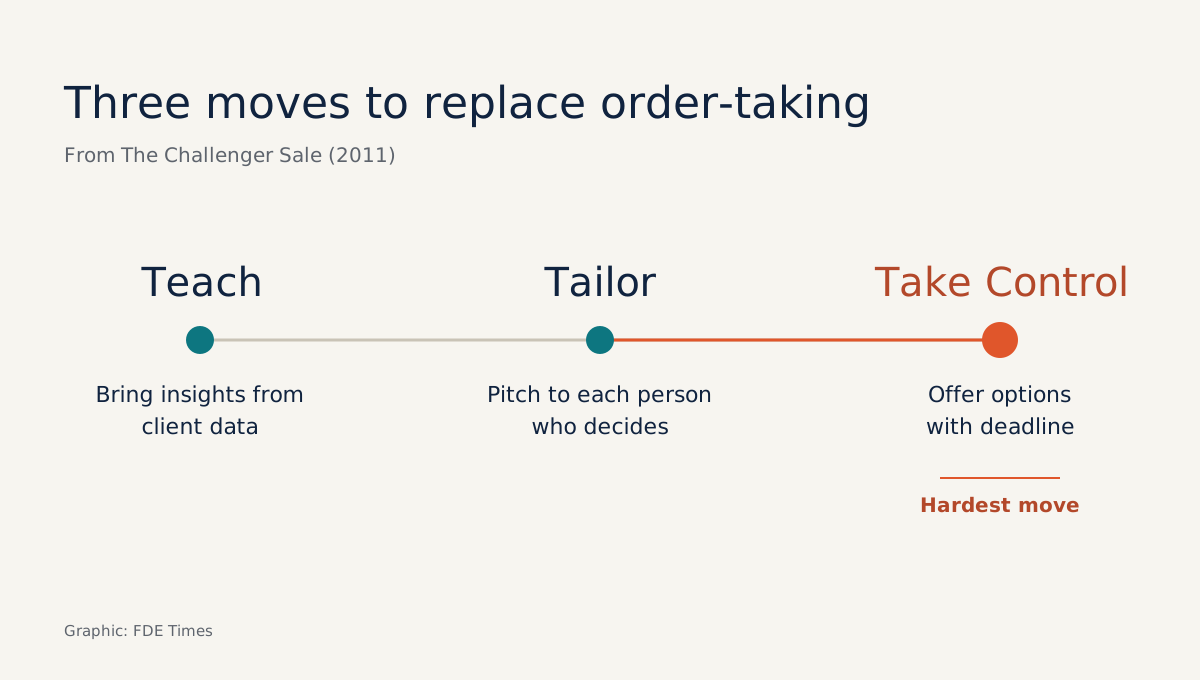
- For an FDE, the three moves are: bring insight from the data, tell the same finding differently to each person, and actively clear blockers
In the research behind The Challenger Sale, relationship-building sales reps came last: they made up only 7% of star performers. Challengers, the reps willing to challenge their customers, accounted for nearly 40%.
At first this sounds like a matter for the sales department. But picture a familiar week for an FDE. The customer sends a list of requirements, you build exactly that list, the demo goes smoothly, and yet months later the project still has not moved any number leadership cares about.
The book explains why being agreeable with customers is not enough, and offers three moves for doing things differently. Engineers who work on site with customers should read it alongside their technical books, because it fills precisely the customer-discovery gap that technical books leave open.
A sales book built on data
The full title is The Challenger Sale: Taking Control of the Customer Conversation, published by Portfolio on 10 November 2011. The original research was carried out by CEB, now part of Gartner, and began as a study of customer loyalty.
The authors found that every B2B sales rep fell into one of five types, and that the Challenger type performed best. The exact share varies by sample: the figure of nearly 40% comes from the original research, while Challenger Inc.’s website now puts it at about 54%. So remember the trend, not the precise number.
Good news for engineers who think they are “not cut out for sales”: according to the publisher, what makes a Challenger can be replicated and taught to an average sales rep.
Teach customers what they do not yet know
The first move, Teach, means bringing an insight that changes how the customer thinks. Richardson, a firm that trains people in the method, stresses that this value lies outside the product and its feature list. The publisher is more specific: it is insight into how the customer can save money or make more.
Imagine a logistics company asks you to build an agent that answers “where is my order?”, with a single requirement: answer faster. Suppose that after a week of reading ticket logs, you find most of the questions arise because delivery notification emails go out late.
At that point, what is worth bringing to the meeting is not “the agent is running” but a proposal to fix when the email is sent, so the number of questions falls at the source. There is a simple test: if an insight cannot be tied to the customer saving or making money, it does not carry enough weight.
One finding, many ways to tell it
The second move, Tailor, means adjusting the message to each customer’s particular needs and goals. Octave, applying Challenger to GTM engineers, advises tailoring the insight to each stakeholder’s context, and ties Take Control to building a stakeholder map.
The chart at the top of the article shows the delivery-email finding from the logistics example told in three versions. The insight stays the same; only the opening line changes, according to what each person is accountable for.
A habit worth building is to keep a stakeholder map and write each update from it, rather than sending one generic email to the whole group.
Lead, even when you have to say “not yet”
The third move, Take Control, means being assertive, pushing back when needed and owning the direction. If you are used to waiting for tickets to be assigned, this is probably the hardest move to practise. Challenger Inc. has since added a fourth skill, Constructive Tension, a name that captures the uncomfortable moment of saying plainly something the customer does not yet want to hear.
A 2026 practical guide to FDE work puts it in the language of the trade: you are not there to take on every field or button the customer asks for, but to push back on weak requests.
Suppose access to production data has been stuck for two weeks. Someone who only takes requests writes “blocked” and waits. A Challenger spells out what the wait is costing, offers two options (anonymised data or a staging environment) and asks who will choose by Friday.
The order-taking FDE
- Builds exactly the spec the customer sends
- Sends one generic update to the whole group
- Writes blocked and waits
The Challenger FDE
- Brings insight from the customer's own data
- Tells the same finding differently to each person
- Offers options with a deadline to decide
Challenging is not arguing
The most common mistake when starting out is pushing back on gut feeling. Saying “I don’t think this requirement is right” merely opens a debate about opinions. Saying “the past two weeks of logs show most tickets come from late emails” brings the conversation back to the customer’s own data, and that is the Teach the book describes.
The second mistake is challenging to the point of condescension, treating customers as if they do not understand their own business. Remember that Tailor sits between Teach and Take Control: the insight has to be framed around the listener’s goals. The word “constructive” in Constructive Tension is also a reminder that the tension should help the customer reach a decision, not help you win the argument.
The third mistake is objecting without offering a way out. Once you have said “not yet”, always pair it with an alternative and the person who needs to decide, as in the data-access example above.
Who should read it, and in what order?
Read the section on the five rep types first to see which way you lean, then move on to the three moves. After that, look at Challenger Inc.’s page describing the rep types to catch up on today’s set of four skills.
Read it with some caution. The data was measured on sales reps, not engineers, so translating it into deployment work is up to you. The book suits people who have just moved from SWE to FDE, or anyone who feels they are only working to spec.
For your career, rewrite one line of your CV, turning “implemented X per customer requirements” into a sentence showing how your insight changed the scope of the project. Before an interview, prepare a story about a time you pushed back on a customer requirement, the data you relied on and what happened next.
An exercise before you close the book: take the latest request a customer sent and write three lines. Line one states what the customer asked for, line two what the data shows the real problem to be, and line three an option that helps the customer save or make money. If line two merely repeats line one, you do not have an insight yet.
If a customer only needs someone to build to spec, they have little reason to send an engineer on site. The reason worth being there is to show where that spec is wrong.
Was this article useful?
Thanks for the feedback!
8 sources
- The Challenger Sale: Taking Control of the Customer Conversation (Penguin Random House) · 2011-11-10
- The Challenger Sale: How To Take Control of the Customer Conversation (Penguin UK) · 2022-10-02
- The Challenger Sale - Wikipedia
- The Challenger Sale: Taking Control of the Customer Conversation (The Art of Selling)
- Discover the Challenger Selling Profiles (Challenger Inc.)
- The Challenger Sale - Powered by Richardson Sales Performance
- The GTM Engineer's Guide to the Challenger Sale (Octave) · 2026-03-16
- A Day in the Life of a Forward Deployed Engineer: Real-World Tasks and Challenges (Blockchain Council) · 2026-06-22