Anthropic's AI Fluency course: the two Ds an FDE should learn first, then teach to clients
This free course takes about three hours. It gives FDEs ready-made concepts for teaching client users what to hand to an agent, and a simple way to set the scope of a deployment.

In brief
- Anthropic built the course with professors Joseph Feller and Rick Dakan. It is free, takes about three hours over 10 modules, and is not specific to Claude.
- Delegation means deciding whether to give a task to AI, when, and how. Those three questions are also the three columns of a deployment scope table.
- To teach the material to clients, take the follow-up course, Teaching AI Fluency. Before reusing the material in a paid service package, check the non-commercial (NC) clause in its licence.
Anthropic teaches its “4D” framework to its own new hires during onboarding. The framework is now available as a free course. According to its Coursera page, the course takes about three hours across 10 modules.
For an FDE, this is not a soft-skills course to tick off a list. Getting an agent into production is only half the job. If your role includes training users on the client side, you will have to teach them which tasks to hand to the agent and who is accountable when it gets them wrong.
The course gives you a ready-made set of concepts to teach with. According to SD Times, the content is not specific to Claude, so you can use it with clients running any model.
Who made the course, and where does the 4D framework come from?
The course’s full title is “AI Fluency: Framework & Foundations”. It sits on Anthropic Academy, which runs on the Skilljar platform, and enrolment is free. It is taught by professors Joseph Feller and Rick Dakan, who also developed the 4D framework.
The framework’s copyright line reads 2025, Dakan, Feller and Anthropic, under a CC BY-NC-SA 4.0 licence. UT Austin uses the framework to define AI fluency for the university, so it is already used beyond one company’s own training material.
Anthropic says the course teaches people to work with AI effectively, efficiently, ethically and safely. Of the four competencies, two are ones an FDE needs almost from the first week at a client: Delegation and Diligence.
Lesson one: decide what to delegate before you write a prompt
In Disco’s short version, Delegation is deciding which work should be handed to AI. Envisioning puts it more precisely: deciding whether to bring AI into a task, when, and how. Those three questions, whether, when and how, are also the three columns of a deployment scope table.
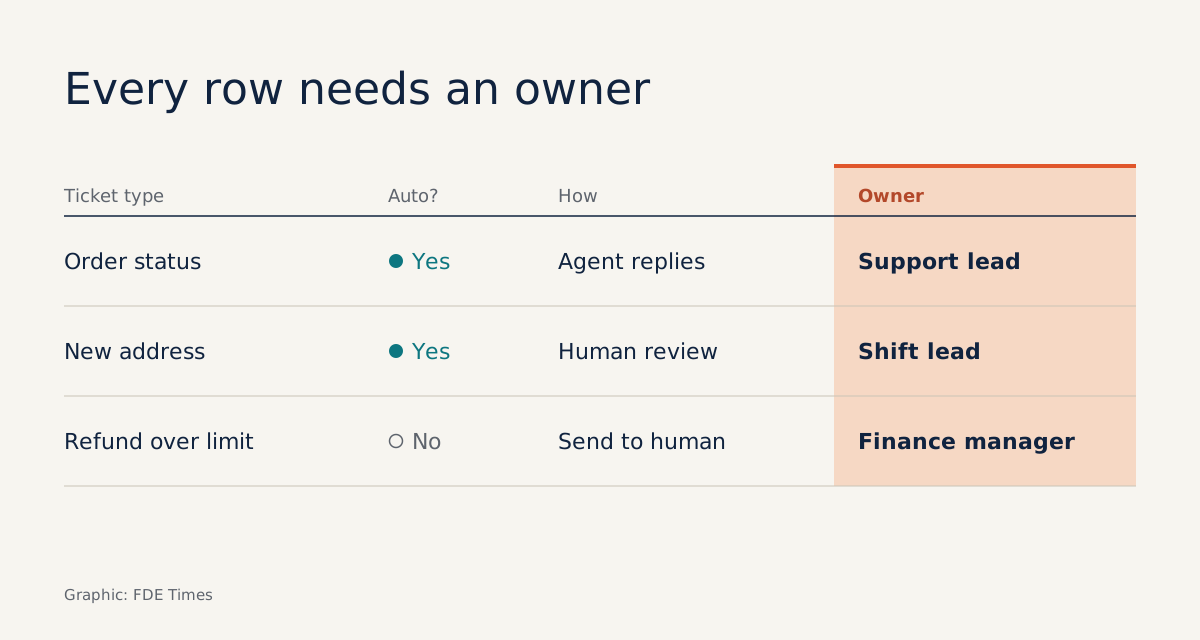
Picture a retail client that wants an agent to handle customer service tickets. Don’t open the training session with prompting tips. Sit down with the team lead and rate the risk of each ticket type.
| Ticket type | Risk | Delegate? | When | How | Accountable |
|---|---|---|---|---|---|
| Order status enquiry | Low | Yes | Always | Agent replies directly | Customer service lead |
| Delivery address change | Medium | Yes | Only before the order leaves the warehouse | Agent drafts, staff member approves | Shift supervisor |
| Refund above threshold | High | No | — | Route straight to a person | Finance manager |
The table does two jobs at once. It teaches Delegation using the client’s own data, and it is the “in scope / out of scope” section you copy straight into the deployment scope document. If the client later wants to extend the agent to refunds, the two sides only need to revisit one row, rather than argue on instinct.
Lesson two: teach by role, and give Diligence a name
Disco suggests building a role-based matrix in which each group of staff focuses on different Ds. In the example above, the team lead needs Delegation most, because they decide the scope table. The staff member approving drafts most needs the daily habit of checking the agent’s output.
Disco defines Diligence as making sure AI is used ethically, responsibly and safely. At a client company, that definition should become a concrete question for every row of the table: if the agent gets it wrong, who is accountable, and who has to be told?
So the last column of the table must not be left blank, and the question should not be pushed to the final slide of the session. Each row needs the name of a specific person on the client side, written into the scope document before the agent sends out its first wrong answer.
Lesson three: you may adapt the material, but read the licence
According to Disco, the Creative Commons licence lets you turn the course content into onboarding material, internal training programmes or workshops. You don’t have to start from scratch: keep the framework and replace the generic examples with the client’s ticket table.
One point needs care. NC in the licence name means non-commercial. If the training is part of a paid service package, check with your legal team before reusing the material verbatim.
The fact that Anthropic uses this framework to onboard its own new hires is also a useful argument with clients. You are bringing a vocabulary that many organisations share, not a framework you made up.
In what order should you take the courses?
Take the foundations course first, on Skilljar or Coursera. If your role includes training client users, go on to Teaching AI Fluency. Anthropic built that course for educators, instructional designers and anyone who needs to teach and assess AI fluency in a classroom.
The second course assumes you already know the 4D framework, and it covers how to design exercises and assess AI fluency. The assessment part helps you show that a training session worked, instead of just counting attendees.
When you read FDE job postings, look for descriptions that mention user training or helping clients run things themselves. If they do, don’t write a generic line such as “trained users” on your CV. Say that you built an AI delegation table with the client, turned it into the deployment scope, and then ran training tailored to each role.
In interviews, talk about a row of the table that you deliberately left out of scope, and explain why. That shows you understand Delegation rather than just knowing the definition.
When is the training finished?
The best scope table is one the client’s users can fill in themselves next time, including the accountability column. Only then has the training done its job.
Was this article useful?
Thanks for the feedback!
7 sources
- AI Fluency: Framework & Foundations (Anthropic Academy)
- AI Fluency Framework (UT Austin Office of the Provost)
- Anthropic's AI Fluency course: how to upskill your org with the 4D framework (Disco) · 2025-08-12
- Teaching AI Fluency (Anthropic Academy)
- AI Fluency: Framework & Foundations (Coursera) · 2026-05
- Claude Academy Teaches How to Use AI Safely and Effectively
- 4d ai fluency (Envisioning)