Only 9–19% of FDE job ads allow remote work, and remote still means visiting customers
Two hiring datasets give two different remote shares. Five specific job ads all show the same thing: for a forward deployed engineer, "remote" rarely means you can skip the customer.

In brief
- According to Rung, about 19% of 402 FDE job ads are listed as remote-friendly. FDE Pulse counted only 98 of 1,086, or 9%.
- Even a remote-friendly company such as Cohere asks for up to 20–40% of time travelling to customers, because the job is built around working inside the customer's team.
- According to Valletta Software, job ads that understate travel are the most common reason FDEs quit within their first year. Ask for the actual figure before accepting an offer.
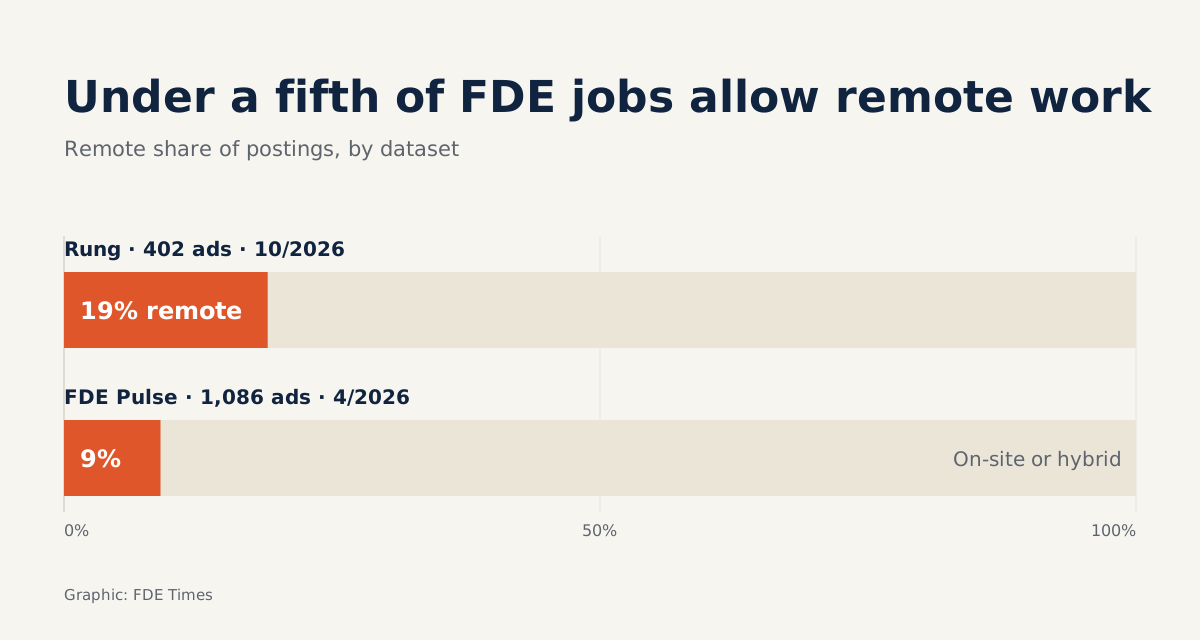
In October 2026 Rung collected 402 Forward Deployed Engineer job ads from public ATS boards. Only about 19% of them were listed as remote-friendly. In the same dataset, 80% of ads mentioned travel or on-site work.
Both figures can easily appear in the same job ad. If you are looking for a remote FDE job, understanding why is the first thing to get right.
For anyone outside the US, or living in a city without offices of the big AI companies, the question “can I work remotely?” decides whether you can apply at all. Such roles exist, but there are not many of them. And even when the role is remote, you still have to go to the customer.
Each tracker counts its own number
There is no agreed remote share for FDE work. Rung counted about 19%, or roughly 76 of 402 ads. FDE Pulse, another tracker, counted 1,086 open FDE ads in April 2026 and found only 98 that allowed remote work, or 9%. The rest were on-site or hybrid.
A twofold gap shows that the share depends on which dataset you look at. Rung’s is a single snapshot, drawn from Greenhouse, Lever, Ashby and Workday. The two trackers counted six months apart, on different sets of ads, and quite possibly define “remote” differently.
Whichever figure you trust, the conclusion holds: fewer than one in five ads allow remote work. The ads are also concentrated in a handful of countries. About 42% of the ads in Rung’s dataset are in the US, followed by the UK, Singapore, Japan, France and Germany.
The data does not say whether remote ads are restricted by country, so if you live elsewhere, read the location conditions of each ad carefully before applying.
“Remote” means away from the office, not away from the customer
Reading individual ads tells you more than the headline share. Cohere states plainly that it is remote-friendly but has offices in Toronto, London and New York. Its FDE Agentic Platform ad asks for up to 20–40% of time spent working on site with customers and partners.
Convert that into a working calendar. In a five-day week, 20–40% is one to two days with a customer. A month has about 20 working days, so that is 4 to 8 days away from home. A role like this still carries the remote-friendly label.
Put five job ads side by side and you see a whole range of arrangements, none of which lets you stay put:
| Job ad | Location | Arrangement | On-site customer requirement |
|---|---|---|---|
| Cohere, FDE Agentic Platform | Offices in Toronto, London, New York | Remote-friendly | Travel up to 20–40% of the time |
| Databricks, AI Engineer – FDE | London | Tied to one city | Roughly once every 4–8 weeks, as needed |
| HackerRank, FDE | Santa Clara | Hybrid | Lead technical person on site with customers |
| Palantir, FDSE for the Norwegian government | Norway | Usually on site with the customer | 25–50% (preferred, varies by team and location) |
| Factory, FDE | San Francisco, New York or London | In the office 5 days a week | Frequent customer visits |
Databricks asks for the least travel: a customer visit roughly once every 4–8 weeks, or about 6 to 13 trips a year if spread evenly. In exchange, the role is firmly tied to London.
Factory sits at the other end: five days a week in the office, plus frequent customer visits. Palantir notes that its 25–50% figure varies by team, which means that on some teams half your time is spent with the customer.
So when comparing two offers, do not look only at the remote or on-site label. Count how many days a month you must be in the office or at a customer’s site.
Why customers still need FDEs in the room
The answer lies in the definition of the job. According to Paraform, Palantir’s “Delta” model places engineers directly inside customer teams, in government, financial services and enterprise operations.
FDE Pulse explains the low remote share along the same lines: being physically present with the customer is often part of the value an FDE delivers.
Beyond the business case there are technical limits. In its 2026 FDE job description template, Valletta Software points out that if a customer’s network is air-gapped, the engineer has to be in the building.
Picture deploying an agent for a bank whose internal network is completely isolated. You cannot SSH in, you cannot pull logs to your laptop, and every debugging session happens in front of their screens.
It follows that the more security-sensitive the customer, the less of the work can be done remotely, however relaxed your own company’s policy may be.
Misreading the ad has a cost
Valletta warns that job ads that understate travel are the most common reason FDEs quit within their first year. Imagine someone who takes a job believing it is remote, only to realise a few months later that they spend more nights in a hotel near the customer’s factory than at home.
Valletta’s guidance also advises readers of job ads to check whether “remote” really comes with little travel. In interviews, ask directly: last month, how many days did an FDE on the team spend with customers, what industry are the main customers in, and are there any air-gapped environments?
A figure like “20–40%” without context says almost nothing, because 20% and 40% are two different lives.
If you live far from the hiring hubs
For engineers outside the US, there are two practical routes. The first is to target cities with many ads, such as London or Singapore, and accept an office-based role with little travel, like the Databricks one. The second is to hunt for the few remote-friendly ads such as Cohere’s, provided you are genuinely willing to travel one to two days a week.
Whichever route you take, your CV has to prove what the “remote” label leaves unsaid: that you do good work sitting across from a customer. Describe a time you went on site to fix an incident, or installed a system inside a restricted internal network. Then state clearly in your cover letter how much travel you accept.
For the days you are not with a customer, build your asynchronous working skills: write deployment documents that others can follow without help, and report progress without needing a meeting.
Remote FDE work is real, but it is a way of arranging travel, not a substitute for being with the customer. Those who understand that before signing a contract will choose a job they can stay in for the long run.
Was this article useful?
Thanks for the feedback!
9 sources
- Forward Deployed Engineer jobs in 2026: 402 open roles analyzed (Rung) · 2026-10-11
- Forward Deployed Engineer Hiring Trends 2026 (FDE Pulse) · 2026-04-30
- Forward Deployed Engineer, Agentic Platform (Cohere, via U of T startup job board)
- AI Engineer - FDE (Forward Deployed Engineer), Databricks
- Forward Deployed Software Engineer - Norwegian Government (Palantir)
- Forward Deployed Engineer (Factory careers)
- Forward Deployed Engineer (HackerRank, via Khosla Ventures job board)
- Forward Deployed Engineer Job Description (2026 Template), Valletta Software · 2026-09-07
- What a Forward Deployed Engineer Actually Does at Palantir, Runway, and Greptile (April 2026) · 2026-04-22