Rob Fitzpatrick's The Mom Test: a handbook for FDEs on questioning customers when everyone lies
A discovery session full of compliments is a failed discovery session. This slim book shows how to spot that before you write your first line of code.
In brief
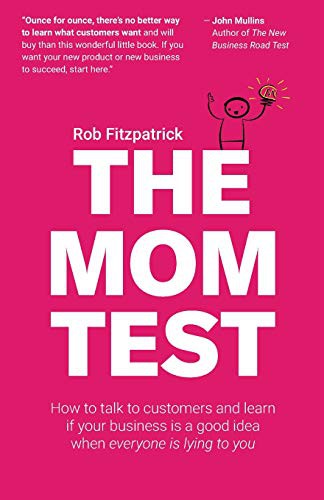
- Rob Fitzpatrick wrote The Mom Test as a short handbook, with no new theory, on how to talk to customers when everyone is lying to you.
- Three rules: talk about their life, not your idea; ask about specific things in the past; talk less and listen more.
- Compliments are bad data. Only concrete commitments, and a concrete chance to say no, prove that a customer really needs what you are building.
Asking about things that actually happened and requesting a concrete commitment yields real data; asking for opinions yields only compliments.
Graphic: FDE Times
You walk out of a customer meeting with a notebook full of “that’s a great idea” and “we’d definitely use it”. According to Rob Fitzpatrick, that is not success. It is bad data. Michael Lynch, reviewing the book, quotes the line in which Fitzpatrick compares compliments to fool’s gold: shiny, distracting and worthless if you want to learn anything from customers.
For a Forward Deployed Engineer, that line goes straight to the hardest part of the job. You sit with the customer to understand what they really need before you deploy, and everything you build afterwards rests on those answers. If the answers are polite compliments, your deployment is built on sand.
A book that refuses to be theory
The subtitle of The Mom Test states its ambition plainly: how to talk to customers and learn whether your business idea is any good when everyone is lying to you. The official site, momtestbook.com, presents it as a short, practical guide to learning more and selling more from customer conversations, and says outright that the world does not need another framework or theory.
That is why it suits engineers. It does not ask you to learn a new model; it fixes how you ask questions. Yevgeniy Brikman boils Fitzpatrick’s rules down to three: talk about their life instead of your idea; ask about specific things that happened in the past rather than generalities or opinions about the future; and talk less, listen more.
The second rule is the most valuable for FDEs. Ask “do you think this feature would be useful?” and everyone nods, because nodding costs nothing. Ask “the last time that happened, how did you handle it, and how long did it take?” and the customer has to tell a true story. Only in true stories do you find the workarounds, the dirty data and the person who is responsible.
Questions that only produce compliments
- Do you think a dashboard with automatic alerts would help your team?
- If you had this tool, would you use it every day?
- What did you think of the demo?
Questions that surface what really happened
- The last time the pipeline failed, how did you find out and who fixed it?
- What did you do last week to stop that happening again?
- Which tools have you already tried, and why did you drop them?
Why customers stop talking when you start pitching
Fitzpatrick identifies a simple psychological mechanism: once you start talking about your idea, the customer stops talking about their problem. For FDEs the temptation arrives early. You know the product, you see the solution immediately, and you want to demo. But every minute of demo is a minute in which the customer shifts from storyteller to reviewer, and polite reviewers praise.
The book calls these empty answers “fluff” and sorts them into three kinds: generic claims, promises about the future, and “might” hypotheticals. For FDEs, recognising these three kinds is the core of customer discovery, so practise it as a listening skill. When a customer says “we run into this all the time”, you do not yet have data; you have data only once you follow up with “when was the last time?”
The only measure: will they risk saying no?
The toughest part of the book is about how to end the conversation. Sachin Rekhi, summarising Fitzpatrick, stresses that the next step must be a request for a very specific commitment, and that a prospect only becomes a real lead once you have given them a concrete opportunity to turn you down. Lynch adds a line worth taping to your monitor: the only way to fail is to not ask the customer for any commitment.
Read that closely and it inverts the usual instinct. If the only failure is not asking, then a clear rejection falls outside the definition of failure; it is something you can take away with you. The scarier outcome is leaving with a smile and nothing to verify.
In an FDE context, a commitment might be access to real data, one of the customer’s engineers assigned to work alongside you, or a scheduled pilot day.
If the customer praises you warmly but sidesteps every request of that kind, you have just learned the most important thing from the meeting.
Who should read it, and in what order
The book suits engineers with two to eight years of experience who are moving from simply taking tickets to sitting directly with customers. If you are preparing for FDE interviews, read it before you practise case exercises: when a prompt describes a customer who wants X, your first reflex should be to ask what happened that made them want X, not to start designing X.
The book is short, so the best way to use it is in three passes, each with a different purpose. On the first pass, read it straight through, simply to absorb the three rules as Brikman summarised them. On the second, reopen the section on fluff with the notes from your latest discovery session beside it, and underline every customer answer that falls into one of the three kinds; you will be surprised how much you underline.
The third pass is not reading at all. Return to the section on commitments just before every real call, so you decide in advance what commitment you will ask the customer for.
On your CV, do not write “read The Mom Test”. Describe a project where you changed what you were building after discovering that the customer’s original request was fluff.
The next time a customer compliments you, treat it as a sign that you have talked too much, and ask them what happened last Tuesday.